

Imagine a simple moment. A street vendor in Delhi receives a UPI payment. Within seconds, an AI system scans the transaction, detects fraud risk in Hindi, and even evaluates whether the user is eligible for small credit. No human intervention, yet everything works seamlessly.
This is not a futuristic idea anymore. It is already happening across India’s financial system.
The real story here is not just about AI adoption. It is about how India is using AI with discipline and structure. With AI spending expected to reach $4.4 billion by 2031, the focus has clearly shifted from speed to trust.
This is where AI governance comes in. It may sound like regulation, but in reality, it is becoming the foundation that allows fintech to scale safely. It ensures that innovation does not come at the cost of security or transparency.
The Governance Wake-Up Call
In the early days, financial institutions were excited about AI because of its ability to automate processes and improve efficiency. The goal was to move faster, reduce costs, and enhance customer experience.
However, as AI systems started making important financial decisions, new concerns emerged. What if the system makes a mistake? Can that decision be explained? Who takes responsibility?
This is where regulators like RBI and SEBI stepped in. They made it clear that AI systems cannot operate like black boxes. Every decision must be explainable, every piece of data must be used with consent, and systems must be accountable.
This created a major shift in mindset. Earlier, the focus was on what AI could do. Now, the focus is on what AI should be allowed to do.
Banks have started building systems where every AI-driven action is recorded. Whether it is a loan approval or a fraud alert, there is a clear audit trail. This makes decisions transparent and easier to review.
The impact of this shift is significant. Compliance costs have reduced by 30-40%, as automation has improved monitoring and reporting. At the same time, the chances of regulatory penalties have dropped because systems are designed to follow rules from the beginning.
A strong example is NPCI’s FiMI model, launched in February 2026. It powers UPI’s support system in multiple languages like Hindi, Telugu, Bengali, and English. More importantly, it is trained on Indian data and operates within the country.
This ensures that sensitive financial data does not leave India. Governance, in this case, is not slowing down innovation it is actually strengthening it.
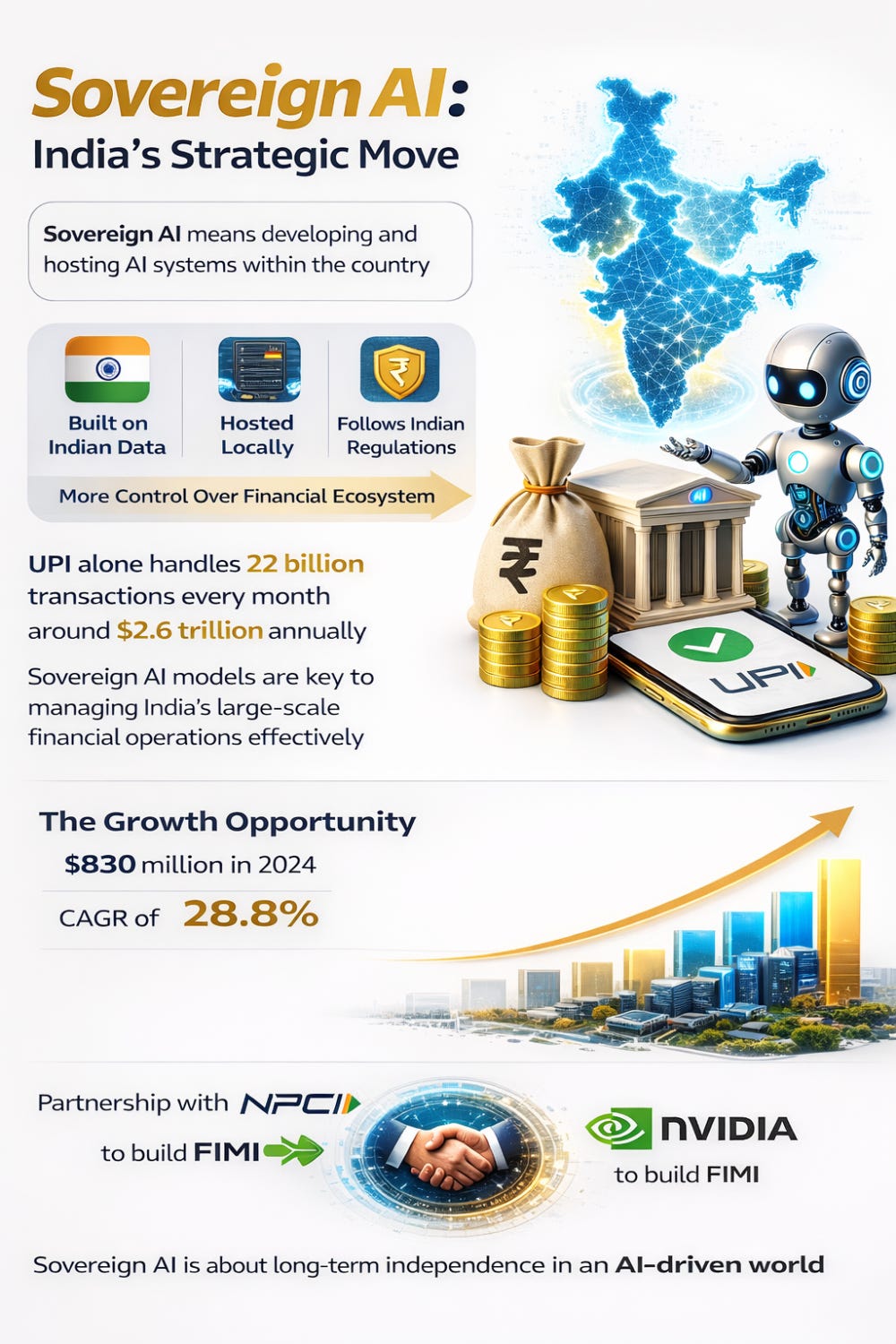
Sovereign AI: India’s Strategic Move
India is taking a different approach compared to many other countries. Instead of depending fully on global AI systems, it is focusing on building its own models.
This is known as sovereign AI.
It means AI systems are trained on Indian data, hosted within the country, and designed to follow Indian regulations. This approach gives India more control over its financial ecosystem.
This becomes important because of the scale at which India operates. UPI alone handles 22 billion transactions every month and around $2.6 trillion annually. Managing this kind of volume requires systems that understand local behavior, languages, and patterns.
Sovereign AI models are built for this purpose. They are designed to work in India’s environment, not just adapted from global solutions.
The collaboration between NPCI and NVIDIA to build FiMI is a clear step in this direction. It shows that India is moving from using external technology to building its own.
The growth opportunity here is huge. India’s AI-in-BFSI market, which was $830 million in 2024, is expected to grow to $8 billion by 2033, with a CAGR of 28.8%.
This growth is not limited to fintech companies. It also benefits infrastructure players like data centers and AI platforms. Companies such as AdaniConneX are likely to play an important role in supporting this ecosystem.
Sovereign AI is not just about technology. It is about building long-term independence in a world where data is becoming a critical asset.
Agentic AI: From Chatbots to Decision-Makers
The next phase of AI in finance is the rise of agentic AI. Unlike traditional systems that only respond to commands, these systems can take actions on their own.
They follow a simple process. They observe data, analyze it, and then act based on that analysis.
For example, when a transaction happens, an AI system can instantly check if it looks suspicious, verify compliance requirements, and either allow or block it. All of this happens in real time.
A practical example can be seen in platforms like Razorpay. Here, AI is being used for voice-based commerce. A farmer can speak in Tamil, and the system understands the request, verifies identity, and disburses a loan through UPI.
This is what experts call distributed intelligence systems that can operate efficiently at the scale of 1.4 billion people.
The benefits are clear. Fraud losses have reduced by more than 50%, and compliance automation is saving banks around $1 billion every year. Decision-making has also become much faster, with processes happening nearly 10 times quicker than before.
At the same time, these systems are not completely independent. Human oversight still exists. AI handles most routine cases, while complex situations are reviewed by humans. This ensures a balance between efficiency and control.
UPI + AI: The Killer Fintech Combo
UPI has already transformed payments in India, but when combined with AI, it becomes even more powerful.
With 22 billion transactions every month, UPI generates a massive amount of data. AI uses this data to improve financial services in multiple ways.
One of the biggest improvements is in fraud detection. Instead of reacting after fraud happens, AI systems can now predict and prevent it in real time. This makes the system more secure.
Another major development is accessibility. AI-powered voice systems allow users to interact in their own languages. This is important in a country where a large portion of the population prefers regional languages.
AI is also helping expand credit access. By analyzing transaction patterns, financial institutions can offer loans to nearly 500 million unbanked individuals. This is bringing more people into the formal financial system.
At the same time, embedded finance is becoming more common. Financial services are being integrated directly into everyday transactions, making them seamless for users.
The market is already responding to these changes. Fintech valuations have increased by 25%, reflecting growing confidence in AI-driven growth.
There is also a strong link between UPI volumes and the Nifty Fintech index, with a correlation of 0.85. This shows how closely digital payments and market performance are connected.

Risks, ROI, and Roadblocks
While the opportunities are significant, there are also challenges that need attention.
AI systems depend heavily on data. This data must be clean, accurate, and collected with proper consent. Without this, the effectiveness of AI can be reduced.
There is also a shortage of specialized talent. Although India produces around 1 million AI professionals every year, the demand in the BFSI sector is still higher.
Ethical concerns are another important factor. AI systems must avoid bias, especially in areas like lending. Continuous monitoring and governance are required to ensure fairness.
Despite these challenges, the returns are strong. Fraud detection systems are reducing costs by 40% while increasing transaction volumes by 15%. Compliance automation is saving 35% in costs, and personalization is helping increase loan growth by 22%.
India is also moving faster than many global markets. While others are still discussing regulations, India is actively building and deploying solutions. NASSCOM estimates a $12 billion surge in the AI ecosystem.
For investors, it is important to stay cautious. Data shows that 90% of F&O traders lose money, which highlights the importance of focusing on long-term investments rather than short-term trading.
The Decade Ahead: Fintech’s AI Chessboard
Looking ahead, the growth of AI in India’s BFSI sector is expected to continue strongly. Spending is projected to reach $4.4 billion by 2031, driven by increasing adoption and better infrastructure.
The next phase will likely see the rise of more advanced AI systems that can manage entire customer journeys. From onboarding to lending to investment management, AI will play a role at every stage.
We may also see the development of super AI agents that can handle complex tasks across different financial services. At the same time, new technologies could further improve risk modeling and decision-making.
India also has the potential to take these solutions global. Systems built for India’s scale and diversity can be adapted for other countries.
Final Thought
The biggest shift in India’s fintech space is not just about adopting AI, but about how it is being implemented. AI is no longer just about speed or automation. It is about building systems that are reliable, transparent, and scalable. Governance ensures accountability. Sovereign AI provides control. Agentic AI improves efficiency.
Together, these elements are shaping the future of finance in India.
India is not just following global trends anymore. It is building its own path and setting a new standard for how AI can be used responsibly at scale.
Lingo of the Week: Agentic AI
Agentic AI refers to systems that independently observe data, analyze situations, and take actions without constant human input, enabling real-time decisions, automation, and smarter operations across industries like finance, healthcare, and technology.
Pocketful isn’t just another trading platform - we’re your partners on the journey to financial freedom.
Thank you for reading!
👀 Stay tuned. Stay diversified.
Until next time,
Team Pocketful.
Follow Us: Website
Download Our App: Available on Google Play & Apple App Store