

Imagine crude oil rising by $10 a barrel.
It may sound like a small move in an international commodity market. But for India, that movement can travel much further from the oil market to the rupee, from the rupee to inflation, and eventually to businesses, consumers and economic growth.
India imports around 90% of its crude oil requirements, making global oil prices an important economic variable.
With crude prices recently gaining attention amid geopolitical tensions and concerns around the Strait of Hormuz, here’s how the oil-to-economy chain works.
The First Hit: India’s Import Bill
Think of crude oil as one of India’s biggest recurring purchases from the world.
When crude becomes more expensive, India has to spend more dollars to buy roughly the same amount of oil.
For example, if the price rises from $70 to $90 per barrel, the cost of importing the same volume increases significantly.
That additional spending can put pressure on India’s trade deficit and current account, particularly when exports do not rise enough to compensate.
Recent data shows the scale of this relationship. India’s merchandise trade deficit reached $31.98 billion in July 2026, while the country’s oil import bill was around $18.31 billion.
So, the first link in the chain is simple:
Crude ↑ → Import Bill ↑ → External Balance Pressure ↑
And that’s only the beginning.
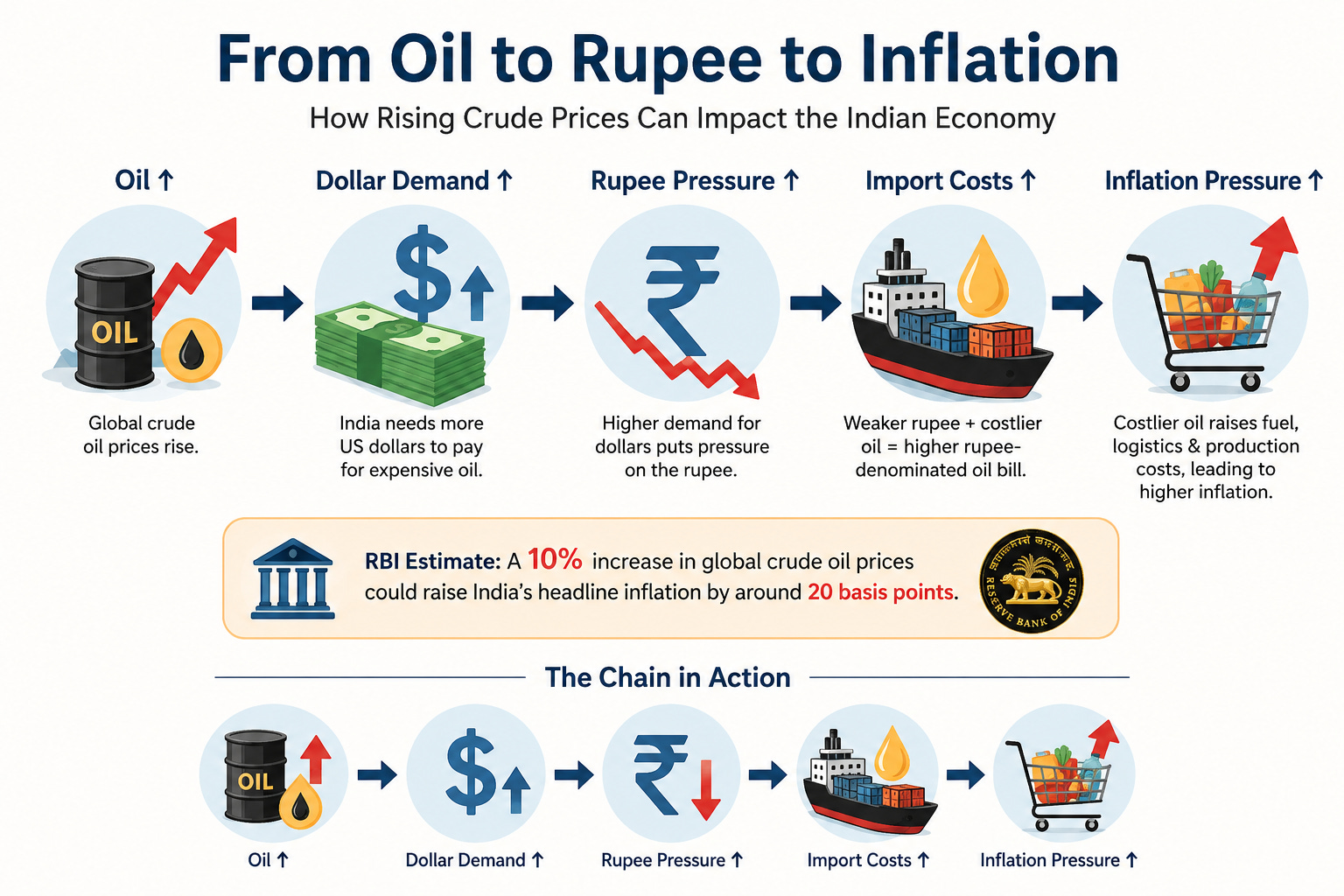
From Oil to Rupee to Inflation
Here’s where the story gets more interesting.
Crude oil is largely purchased in US dollars. When oil becomes expensive, Indian importers need more dollars to pay for it.
More demand for dollars can put pressure on the rupee.
And if the rupee weakens at the same time that crude prices are rising, India’s cost of imported oil can increase even further.
Higher crude + weaker rupee = bigger rupee-denominated oil bill
Then comes inflation.
Oil affects the economy directly through fuel prices and indirectly through transportation, logistics and production costs.
A truck doesn’t run without fuel. Neither does the supply chain.
When transportation becomes more expensive, companies may eventually increase prices to protect their margins.
The RBI estimates that a 10% increase in global crude oil prices could raise India’s headline inflation by around 20 basis points, although the actual impact depends on several policy and market factors.
The chain now looks like:
The Hidden Impact: Businesses & Consumers
Crude oil doesn’t just affect petrol pumps, Its impact can spread across the economy.
For businesses: Higher fuel and transportation costs can increase operating expenses. Airlines, logistics companies, manufacturers and other fuel-sensitive businesses may see margins come under pressure.
Companies then face a choice:
Absorb the cost → Lower margins
or
Pass it on → Higher prices
For consumers: Higher fuel and transportation expenses can reduce disposable income.
If a household spends more on commuting and transportation, it may have less money available for restaurants, shopping, travel and other discretionary spending.
That creates a broader economic chain:
Higher Oil Costs → Higher Business Expenses → Higher Prices → Lower Purchasing Power
The longer the oil shock lasts, the more important this transmission becomes.
From Household Budgets to Economic Growth
Now connect the dots.
Suppose crude prices remain elevated for months, Businesses face higher costs, Consumers face higher expenses, Inflation remains under pressure.
Companies may become more cautious about investment, while households may reduce discretionary spending.
This can eventually affect economic growth.
Crude oil can also create a policy challenge for the government. Higher oil prices can increase inflationary pressure, while reducing fuel taxes to protect consumers can affect government revenues.
So policymakers have to balance three competing priorities:
Inflation Control + Consumer Relief + Fiscal Stability
The Reserve Bank of India’s research shows that oil-price shocks can influence both inflation and economic activity, although the magnitude depends on the size and persistence of the shock.
This is why economists don’t look at crude prices in isolation.
They look at where prices are going, why they are moving and how long the move could last.
Why the Strait of Hormuz Matters to India
Here’s where geopolitics enters the picture.
The Strait of Hormuz is one of the world’s most important energy routes. Around one-fifth of global oil and LNG shipments pass through the waterway.
Any prolonged disruption can raise concerns about global supply and push oil prices higher.
India has diversified its crude suppliers. In July 2026, Russia accounted for a record 50.83% of India’s crude imports, according to Reuters data.
But changing suppliers doesn’t completely eliminate the risk.
Why?
Because crude oil is a globally priced commodity.
If international prices rise, India can still feel the impact even when its suppliers change.
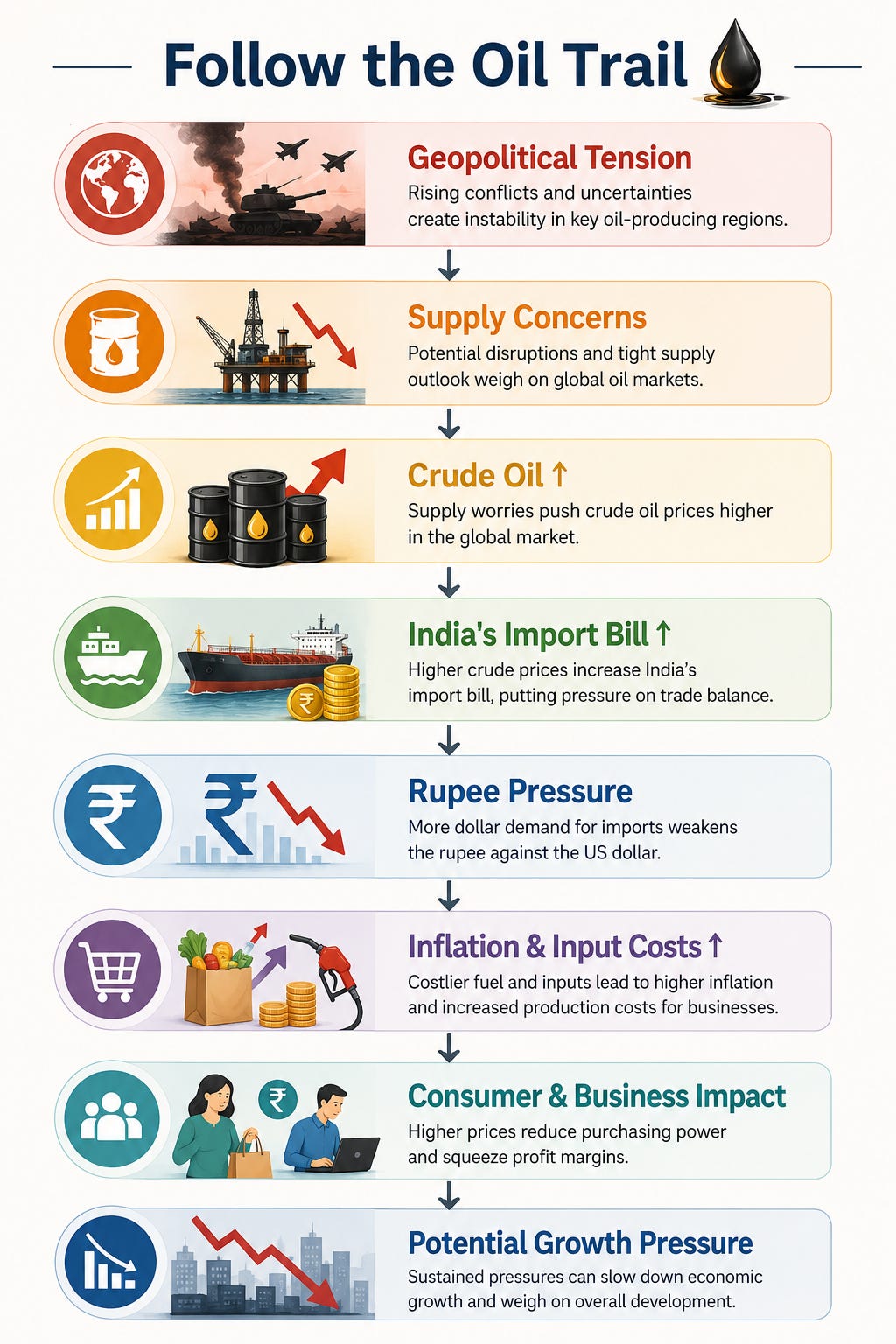
Investor Takeaway: Don’t Just Watch the Oil Price
For investors, crude oil can act like an economic thermometer.
When oil moves sharply, ask five questions:
1. Why is crude moving? Supply disruption, geopolitical tensions or stronger demand?
2. Is the move temporary or persistent? A short spike is different from months of elevated prices.
3. What is happening to the rupee? A weaker rupee can amplify the impact of expensive oil.
4. Is inflation responding? Persistent oil inflation can influence monetary-policy expectations.
5. Which parts of the economy are most exposed? Transportation, aviation, logistics, manufacturing and other fuel-sensitive sectors may feel the impact differently.
The Big Picture
Crude oil may be traded thousands of kilometres away, but its impact can eventually reach Indian households, businesses and markets.
That’s the real lesson:
Oil doesn’t just power the economy. Its price can influence the cost of running it.
As of August 14, 2026, Brent crude remained in focus amid geopolitical tensions and uncertainty surrounding the Strait of Hormuz.
For India, the next move in crude isn’t just a commodity-market story - it’s an economic story.
Pocketful isn’t just another trading platform - we’re your partners on the journey to financial freedom.
Thank you for reading!
👀 Stay tuned. Stay diversified.
Until next time,
Team Pocketful.
Follow Us: Website
Download Our App: Available on Google Play & Apple App Store