


Indian equity markets are increasingly influenced by developments in the US. From Federal Reserve policy and Treasury yields to Wall Street performance, the US financial system has a strong impact on global liquidity, investor sentiment and capital flows.
For Indian investors, this connection has become particularly important as foreign institutional investors (FIIs) allocate capital across global markets based on interest rates, valuations, economic growth and risk appetite.
The relationship is not as simple as “US markets fall, Indian markets fall.” Instead, investors need to understand the chain reaction:
Fed policy → bond yields → dollar → global flows → Indian equities.
Why Does Wall Street Matter to Dalal Street?
The US remains one of the most influential financial markets globally. Movements in major US indices can affect sentiment across Asian and emerging markets even before Indian markets open.
The recent market action provides a good example. On August 20, the Dow Jones Industrial Average declined 1.32%, while the S&P 500 and Nasdaq Composite fell 0.87% and 1.00%, respectively. The S&P 500 closed at 7,641.16, while the Nasdaq ended at 26,067.17.
The decline came as rising Treasury yields and higher oil prices weighed on investor sentiment.
For Indian investors, such movements matter because global funds constantly compare the potential returns available in markets such as the US and India. When US assets become relatively more attractive, emerging-market equities can face pressure. When global risk appetite improves, India can benefit from renewed foreign investment.
However, India’s domestic fundamentals remain important. Strong earnings, economic growth and domestic institutional buying can help Indian markets absorb global volatility.
Fed Policy: The Key Global Trigger
The Federal Reserve remains one of the most important institutions for global investors because its interest-rate decisions influence borrowing costs, bond yields and liquidity across financial markets.
At its July 28–29 meeting, the Fed kept the federal funds target range unchanged at 3.50%–3.75%. The decision was passed by a 9–3 vote, with three members preferring a 25-basis-point rate increase. The Fed also noted that inflation remained elevated relative to its 2% goal.
This makes upcoming US economic data particularly important.
If inflation remains sticky, the Fed may have less room to ease monetary policy. Conversely, softer inflation and weaker economic data could strengthen expectations of rate cuts.
For Indian markets, the important point is that expectations often matter more than the actual decision.
If investors expect a rate cut and the Fed delivers it, the market reaction could be limited. But if the Fed signals a more hawkish outlook than expected, global equities could react sharply.
This is why Indian investors should watch US inflation, employment data, Fed speeches and FOMC decisions alongside domestic economic indicators.
US Bond Yields and the Dollar
US Treasury yields provide another important link between Wall Street and Dalal Street.
The 10-year US Treasury yield stood at around 4.69% on August 20, according to the US Treasury’s daily data. It had been around 4.65% on August 19, highlighting the recent upward movement in longer-term borrowing costs.
Why does this matter for India?
Higher US yields can make US fixed-income assets more attractive to global investors. If investors can earn comparatively higher returns from relatively lower-risk US government securities, they may become more selective about investing in emerging markets.
Higher yields can also strengthen the US dollar, although the relationship is influenced by several other factors.
A stronger dollar can create pressure on emerging-market currencies, including the Indian rupee. It can also increase the rupee cost of imported commodities such as crude oil.
At the same time, currency movements can have mixed effects on Indian companies. Export-oriented businesses, including several IT companies, can benefit from a weaker rupee because overseas revenue translates into more rupee earnings.
Therefore, investors should look at US yields and the dollar together, rather than treating either indicator in isolation.
Wall Street and the Indian IT Sector
The relationship between US markets and Indian equities becomes particularly visible in the technology sector.
A large portion of Indian IT companies’ revenue comes from overseas clients, especially from the US. As a result, technology spending by American companies can influence the growth outlook for Indian IT services.
Artificial intelligence has added a new layer to this relationship.
US technology companies continue to invest heavily in AI infrastructure, cloud computing and data centres. This can create opportunities for Indian technology service providers involved in cloud migration, digital transformation, cybersecurity and AI-related services.
However, AI also presents a potential disruption to traditional technology services. Investors are therefore watching not only how much US companies spend on technology, but also where that spending is going.
Strong enterprise technology budgets could support Indian IT demand, while weaker spending or delays in discretionary projects could affect growth expectations.
This makes US technology earnings and management commentary important indicators for Indian IT investors.
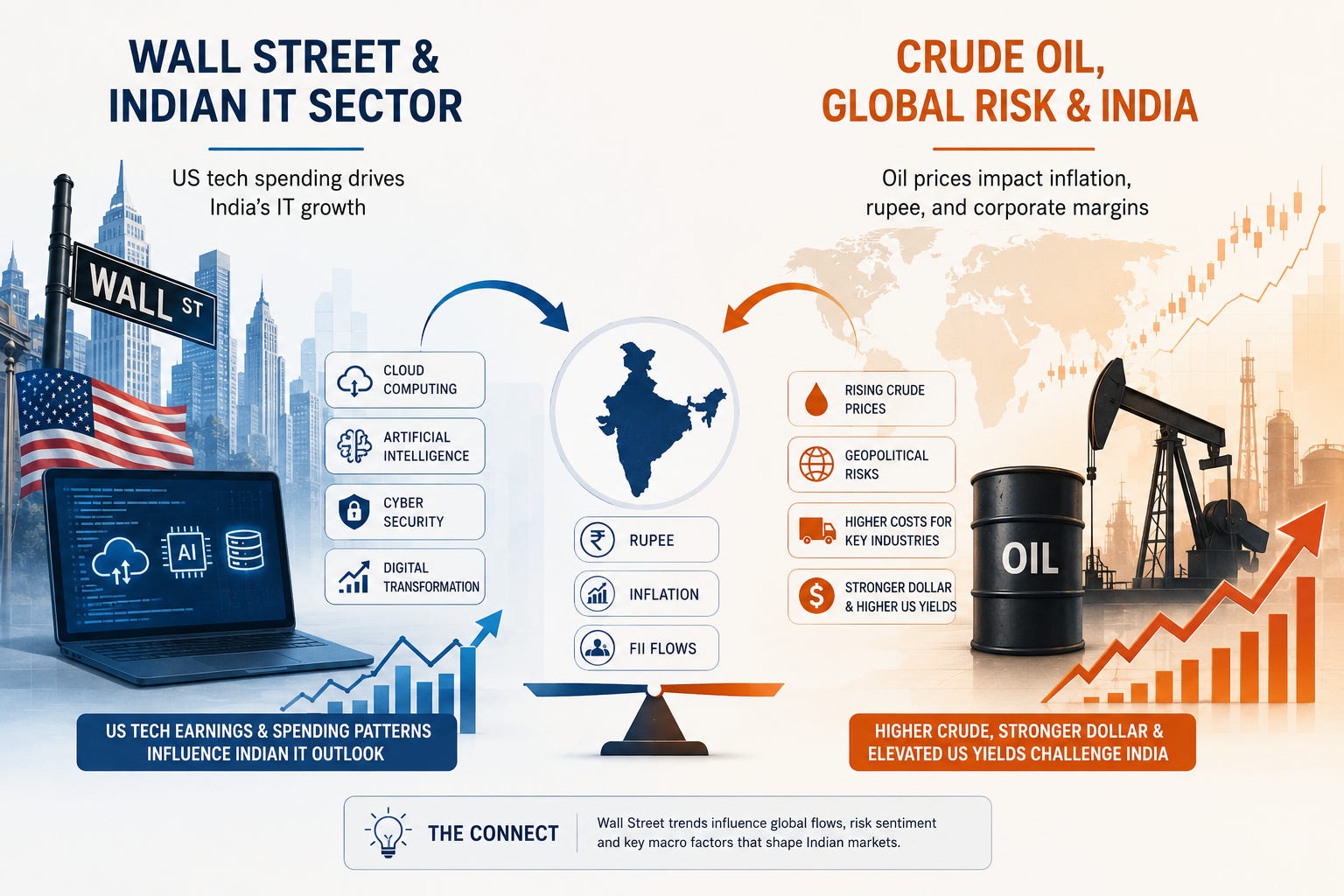
Crude Oil, Global Risk and India
Crude oil is another major channel through which global developments influence India.
When oil prices rise, India’s import bill can increase, potentially affecting inflation, the current account balance and the rupee. Higher energy costs can also increase expenses for several industries.
The impact can extend beyond the energy sector. Aviation, logistics, paints, chemicals, tyres and other businesses with significant fuel or petroleum-linked costs can experience margin pressure when crude prices rise sharply.
Oil prices are also sensitive to geopolitical developments and expectations for global economic growth.
This creates an important connection between the US, global risk sentiment and Indian markets. A geopolitical shock can push crude higher, while simultaneously increasing uncertainty across equities.
For India, the combination of higher crude prices, a stronger dollar and elevated US yields can become particularly challenging because all three can influence inflation, currency stability and foreign investment flows.
FII Flows: The Link Between Global and Indian Markets
Foreign institutional flows are one of the clearest channels through which global developments reach Indian equities.
Recent data shows that foreign investors have been active again. According to reports based on market data, FPIs invested ₹16,621 crore in Indian equities during the first half of August, reflecting renewed interest after previous selling pressure.
The shift has also been visible in specific sectors. FIIs invested a net ₹6,535 crore in Indian financial stocks during the first half of August, compared with net selling of ₹2,669 crore in the second half of July.
This highlights an important point: global investors do not simply decide between “India” and “US.” They also rotate between sectors based on valuations, earnings expectations and changing macroeconomic conditions.
Domestic institutions can provide an important counterbalance. For example, NSE data showed domestic institutional investors recorded net buying of about ₹3,980 crore on August 19, based on the exchange’s reported trading activity.
Therefore, FII flows should be viewed alongside DII activity rather than independently.
What Should Investors Watch Ahead?
The US–India market relationship is likely to remain important as investors assess the direction of global interest rates, economic growth and risk appetite.
For Indian investors, the focus should not be on reacting to every movement in Wall Street. Instead, it is more useful to monitor a handful of indicators and understand how they interact.
The key indicators to track are:
Federal Reserve policy: The current target range is 3.50%–3.75%, with inflation still above the Fed’s 2% goal.
10-year US Treasury yield: Around 4.69% on August 20, making bond-market movements important for global valuations.
US technology performance: Important for global technology sentiment and Indian IT demand.
Crude oil: Higher prices can affect India’s inflation, trade balance and corporate margins.
FII flows: Provide clues about global investor positioning toward Indian equities.
Dollar movement: Influences the rupee, commodities and foreign investment returns.
The broader takeaway is that Wall Street does not dictate the direction of Dalal Street, but it can significantly influence the environment in which Indian markets operate.
For long-term investors, the focus should remain on company fundamentals, earnings and valuations. For shorter-term market participants, however, global cues can provide important signals about volatility and sentiment.
Investor Takeaway
The connection between Wall Street and Dalal Street runs through interest rates, bond yields, the dollar, crude oil and foreign capital flows. With the Fed maintaining rates at 3.50%–3.75% and the 10-year US Treasury yield near 4.69%, global liquidity and rate expectations remain important variables for Indian equities. Understanding these links can help investors distinguish between short-term global volatility and changes in India’s long-term investment story.
Pocketful isn’t just another trading platform - we’re your partners on the journey to financial freedom.
Thank you for reading!
👀 Stay tuned. Stay diversified.
Until next time,
Team Pocketful.
Follow Us: Website
Download Our App: Available on Google Play & Apple App Store