

Every AI query, cloud application and digital service depends on computing infrastructure that consumes electricity. As companies expand their data centres, the demand for reliable power is creating opportunities for businesses across the energy industry.
Waaree Energies, one of India’s leading solar manufacturers, is making two significant moves: expanding its US solar manufacturing capacity and entering the data-centre business.
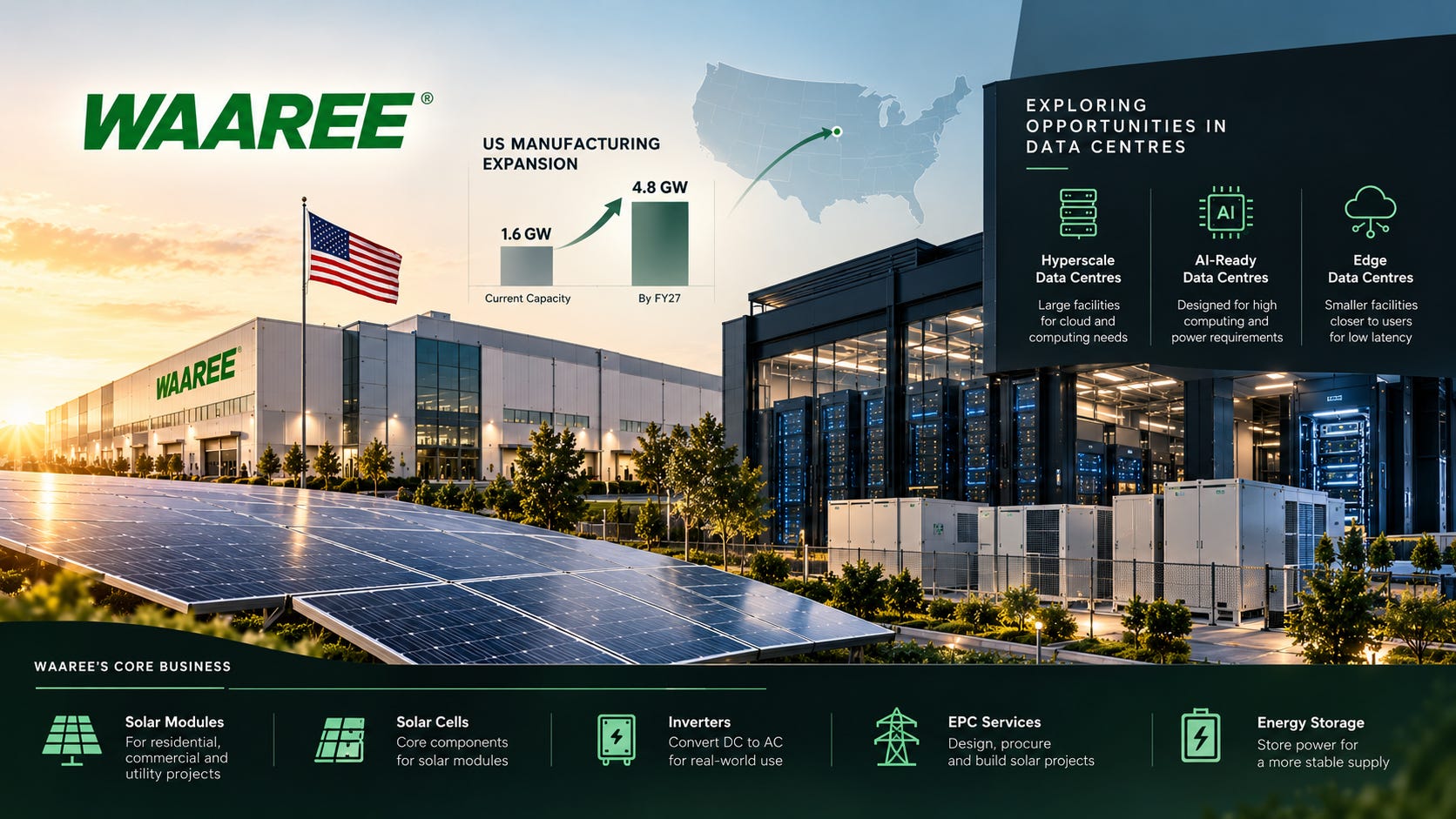
The company plans to increase its US solar module capacity from 1.6 GW to 4.8 GW by March 2027. Separately, it has approved acquiring data-centre entities to explore opportunities in AI-ready and hyperscale infrastructure. These developments come at a time when its revenue is growing but quarterly profitability is under pressure.
So, what is Waaree building beyond solar panels, and how do these moves fit into its larger business strategy?
Let’s decode.
First, What Does Waaree Energies Actually Do?
Before understanding its expansion plans, it helps to understand how Waaree makes money.
Waaree Energies operates primarily in solar manufacturing. Its core products are photovoltaic (PV) modules, commonly known as solar panels, which convert sunlight into electricity.
However, its business extends beyond finished solar panels.
Solar modules: Finished panels supplied to residential, commercial and utility-scale solar projects.
Solar cells: Components that convert sunlight into electricity and are assembled into solar modules.
Inverters: Equipment that converts the direct current generated by solar panels into alternating current used by electrical systems.
EPC services: Designing, procuring equipment for and constructing solar power projects.
Energy storage: Battery solutions that store electricity for later use, helping manage fluctuations in renewable energy generation.
Waaree is also expanding its capabilities across the wider clean-energy value chain, including battery storage and related infrastructure.
This matters because the company is not simply trying to sell more solar panels. It is building manufacturing capacity and exploring adjacent businesses that could serve changing energy requirements.
Why Is Waaree Expanding Its US Manufacturing?
Waaree’s US expansion is a response to two important developments: growing demand for electricity and changing trade conditions.
According to Reuters, the company plans to increase its US solar module manufacturing capacity from 1.6 GW to 4.8 GW by March 2027. That would triple its current stated capacity.
The company is also working to source more components locally rather than relying entirely on imports from India.
The business logic behind local manufacturing
Imagine a manufacturer producing goods in India and exporting them to the United States. If import duties and other trade-related costs increase, supplying American customers from India can become less competitive.
Manufacturing within the US can help the company adapt to these conditions and build a more locally integrated supply chain.
Waaree’s strategy therefore has three parts:
1. Expand production: Increase US module manufacturing capacity to serve more customers.
2. Localise sourcing: Develop domestic supply sources for components, including solar cells.
3. Strengthen order execution: Serve US customers through local operations as the manufacturing footprint expands.
Reuters reported that Waaree had a US order book exceeding 10 GW, providing visibility into potential future deliveries.
However, an order book is not the same as guaranteed revenue. Deliveries, customer commitments, production capacity and costs will determine how much of that business ultimately translates into financial performance.
The expansion also involves execution risks. Building capacity requires capital, and the economics depend on how efficiently new facilities operate.
The key takeaway: Waaree’s US strategy is both a growth initiative and a way to adapt to a changing trade environment.
The AI Connection: Why Data Centres Need More Power
Artificial intelligence has created a new challenge for the energy industry.
AI systems rely on servers, specialised computing chips, networking equipment and cooling systems. These operate inside data centres, which can consume substantial amounts of electricity.
As AI adoption grows, technology companies are investing in additional computing infrastructure. That creates a potential opportunity for electricity producers, energy storage companies and solar equipment manufacturers.
This is where Waaree’s existing business connects with the AI boom.
Solar power can contribute to the electricity supply for data centres, while battery storage can help manage differences between solar generation and demand. However, solar power alone cannot guarantee uninterrupted electricity around the clock. Data centres generally require a combination of grid power, storage and other reliable energy sources.
For Waaree, rising data-centre electricity demand could support demand for solar equipment in the US market.
But there is an important distinction: benefiting from data-centre demand for solar equipment is different from owning and operating data centres.
Waaree is exploring both opportunities, but they are at different stages of development.
Waaree’s New Bet: Entering the Data-Centre Business
On October 27, 2026, Waaree Energies approved acquiring a 100% stake in Waaree Green Data Centers Pvt Ltd and its two wholly owned subsidiaries, Aurovault Data Centers Pvt Ltd and Sunstar Data Centers Pvt Ltd.
The entities are being acquired from Waaree Renewable Technologies Ltd, a subsidiary within the wider Waaree group. The announced cash consideration is ₹1 lakh.
The proposed acquisition brings these entities directly under Waaree Energies as it explores opportunities in digital infrastructure.
What does the company want to explore?
Waaree has identified three potential areas:
Hyperscale data centres: Large facilities designed to support extensive computing and cloud infrastructure.
AI-ready data centres: Facilities designed to accommodate the computing, power and cooling requirements of artificial intelligence workloads.
Edge data centres: Smaller facilities located closer to users and devices to process data with lower latency.
Why does this matter?
Data centres require more than buildings and servers. They need reliable electricity, cooling systems, connectivity and significant infrastructure investment. Waaree’s experience in energy equipment could be relevant to this ecosystem, although building and operating data centres requires capabilities beyond solar manufacturing.
There is an important caveat. According to NDTV Profit, the acquired entities had not yet commenced operations, and Waaree had not disclosed specific investment commitments, project locations or capacity targets for the proposed business. Completion of the acquisition was expected during FY27.
Therefore, this is an early-stage strategic move, not an established source of data-centre revenue.
The Numbers: Revenue Grows, but Profitability Weakens
Waaree’s Q2 FY27 results provide another perspective on its business.
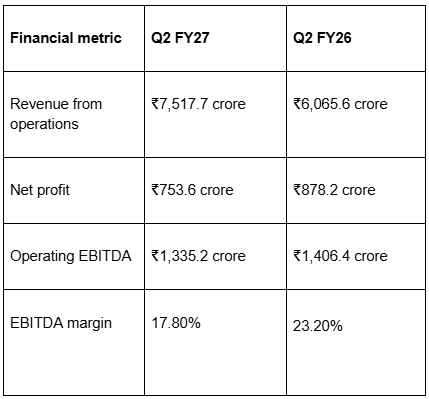
For the quarter ended September 30, 2026, the company reported higher consolidated revenue but lower profit and operating EBITDA compared with the corresponding period last year.
What do these numbers tell us?
Revenue increased 23.9% year-on-year. The company generated more revenue than it did in the same quarter last year.
Net profit declined approximately 14.2%. Higher revenue did not translate into higher earnings for shareholders.
EBITDA margin narrowed. The margin fell from 23.2% to 17.8%, meaning the company generated less operating earnings per rupee of revenue.
For a manufacturing business, margins can be affected by selling prices, product mix, input costs and operating expenses. The results establish that profitability weakened, although the reported figures alone do not explain the contribution of each factor.
This is an important distinction when analysing expansion. Higher sales and greater manufacturing capacity can support growth, but sustainable performance also depends on cost management and the ability to earn healthy margins.
What Should We Watch Next?
Waaree’s next phase will depend on execution rather than announcements alone.
Here are the developments that will help clarify its progress:
US capacity: Whether the company reaches its 4.8 GW manufacturing target by March 2027.
Order execution: How its US order book translates into deliveries and recognised revenue.
Local sourcing: Whether a more local supply chain improves competitiveness.
Data-centre development: Completion of the acquisition, disclosure of investment plans and commencement of operations.
Profitability: Whether operating margins stabilise as the company expands.
Each milestone will help distinguish stated ambitions from measurable business outcomes.
The Final Decode
Waaree Energies is pursuing two different opportunities linked to the changing energy landscape.
Its US manufacturing expansion builds on an established solar business, with higher capacity and local sourcing aimed at serving the American market. Its data-centre initiative represents an early attempt to enter digital infrastructure as AI increases the importance of computing capacity and electricity supply.
The financial picture is more mixed: revenue is growing, but quarterly profit and operating margins have weakened.
The central business question is whether Waaree can convert its expanding manufacturing footprint and new strategic ambitions into sustainable financial performance. Its progress over the coming quarters will provide a clearer picture of how these plans translate into operating businesses.
This newsletter is for informational and educational purposes only. It does not constitute investment advice or a recommendation to buy or sell any security.
Lingo of the Week: Gigawatt (GW)
A gigawatt (GW) is a unit of power equal to 1 billion watts. It is used to measure the capacity of large power plants, renewable energy projects and industrial facilities.
Why it matters: In the energy sector, gigawatts help measure the scale of electricity generation and manufacturing capacity.
Example: Waaree Energies plans to expand its US solar module manufacturing capacity from 1.6 GW to 4.8 GW by March 2027, tripling its stated capacity.
Pocketful isn’t just another trading platform - we’re your partners on the journey to financial freedom.
Thank you for reading!
👀 Stay tuned. Stay diversified.
Until next time,
Team Pocketful.
Follow Us: Website
Download Our App: Available on Google Play & Apple App Store