

There’s a crazy story unfolding in the global energy market. You wake up, check the news, and see that a conflict in the deserts of the Middle East has accidentally broken one of the world’s most important energy pipelines.
Suddenly, the consequences are everywhere. Ceramic factories in Gujarat are shutting down, the agricultural subsidy budget for Indian farmers is under threat, and there’s a bizarre crash in the prices of precious and industrial metals. How does a single strike cause all this chaos?
Let’s connect the dots!
Fire in Gulf
To understand the chaos, we have to rewind to March 18 and 19, 2026. Tensions in the Middle East, which had been simmering for months, finally boiled over. The escalation began when Israel launched a targeted attack on Iran’s massive South Pars gas field. Think of South Pars as the main engine of Iran’s domestic energy.
In retaliation, Iran launched missiles and drones directly at Qatar’s Ras Laffan Industrial City. Ras Laffan isn’t just any city; it’s the largest liquefied natural gas (LNG) export hub on the planet.
Qatar Energy, the state owned energy behemoth, confirmed the nightmare scenario. Several of its LNG facilities were struck, causing massive fires and damage. The CEO of Qatar Energy addressed the media in disbelief, stating, “I never in my wildest dreams would have thought that Qatar would be......in such an attack”.
The damage report was brutal. The strikes knocked out Trains 4 and 6 of the LNG production line, effectively wiping out roughly 17% of Qatar’s entire LNG export capacity, carrying an estimated loss of $20 billion in annual revenue.
Magic of LNG and 5 Year Repair Window
To grasp why a 17% loss is causing absolute panic, we need to understand the science of Liquefied Natural Gas (LNG).
When natural gas comes out of the ground, it takes up a massive amount of space. You can’t efficiently ship it across the ocean from the Middle East to India in its gaseous state. But, if you cool it down to a freezing -162°C (-260°F), it physically changes from a gas into a liquid.
This process shrinks the volume of the gas by about 600 times. This cooled liquid is then pumped into specially designed ships, sailed across the ocean, and warmed back up into a gas when it arrives. Qatar is the king of this process, extracting gas from the North Field. The exact same underwater gas field as Iran’s South Pars, just shared across the maritime border.
Now What Are Cryogenic Heat Exchangers
So, if the plant is broken, why did the Qatar Energy CEO state it will take three to five years to repair?
Well, there is a thing called Main Cryogenic Heat Exchanger (MCHE). Think of it as the heart of an LNG facility. These aren’t standard parts you can pick up at a hardware store. They are 55meter tall aluminium towers (300 to 500 tonnes). Inside these, thousands of kilometres of aluminium tubing carry the gas while chilled refrigerants wash over them, instantly freezing the gas into a liquid.
And only two companies on the planet have the technology, patents, and capability to build these mega exchangers. It’s a global duopoly controlled by an American company, Air Products and Chemicals, and a European engineering giant, Linde.
Each MCHE is custom designed. From the moment an order is placed, engineering, building, and shipping take years. Plus, the order books for both companies are completely full for years into the future.
As replacing them takes years, Qatar Energy was forced to officially declare a “Force Majeure” on their long-term supply contracts, warning global buyers that the gas simply will not arrive for up to half a decade.
The India Problem
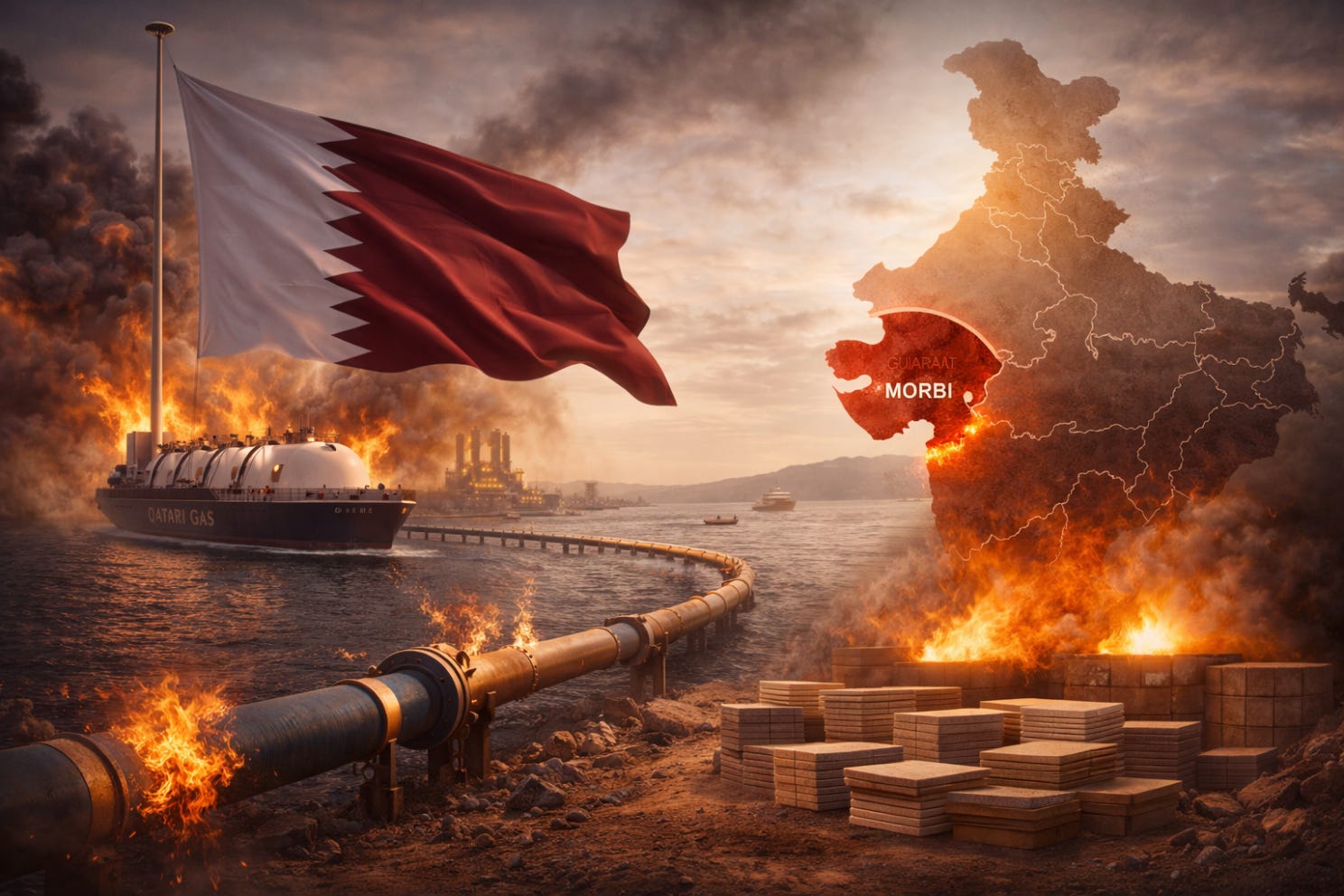
We are an energy hungry economy, and our domestic natural gas production falls far short of demand. We rely heavily on imports, and our largest supplier, by a massive margin, is Qatar.
According to official figures, India imported about 27.8 million metric tonnes (MMT) of LNG in 2024. Out of that, a staggering 11.30 MMT came directly from Qatar.
Relying on Qatar for nearly 50% of imported gas means that when their supply drops, our industrial sector feels the pain immediately. State-run Petronet LNG distributes this fuel to downstream customers like GAIL, Indian Oil, and BPCL. With the Strait of Hormuz facing disruptions and Qatar’s facilities damaged, the flow of gas has hit.
Let’s look at Morbi, a town in Gujarat that holds the title of the world’s second largest ceramic tile production hub. Producing about 80% of all ceramics in India, it’s a massive INR 750 billion industry.
However, making ceramic tiles requires continuous, intense heat. Raw clay is baked in massive industrial kilns and the fuel of choice for these kilns? Yes, it’s the Natural gas and propane.
Following the Qatar attack, distributors like Gujarat Gas made drastic cuts, reducing industrial gas supply by nearly 50% to 70% to save fuel for residential cooking and city transport.
And the result is out of 670 ceramic factories in Morbi, an astonishing 430 to 550 factories were forced to halt production immediately.
Fertilizer Crisis
The economic pain also hits the farm. Indian farmers rely heavily on fertilizers like Urea and Di-Ammonium Phosphate (DAP) for the crucial Kharif sowing season.
Urea is made using natural gas, which makes up roughly 70% of the raw material requirement. The Indian government strictly controls the retail price of Urea to protect farmers, paying the difference as a subsidy. For the 2026-27 fiscal year, the government budgeted ₹1.71 lakh crore for this. However, with spot LNG prices shooting up to $19 per MMBtu (up from an average of $11-12), production costs are exploding. Analysts warn this subsidy bill will balloon massively, draining national funds.
The government mandates that residential Piped Natural Gas (PNG) and Compressed Natural Gas (CNG) get priority during shortages. While there are adequate stocks for now, a prolonged outage in Qatar will wipe out the current stockpile.
The Metals Paradox
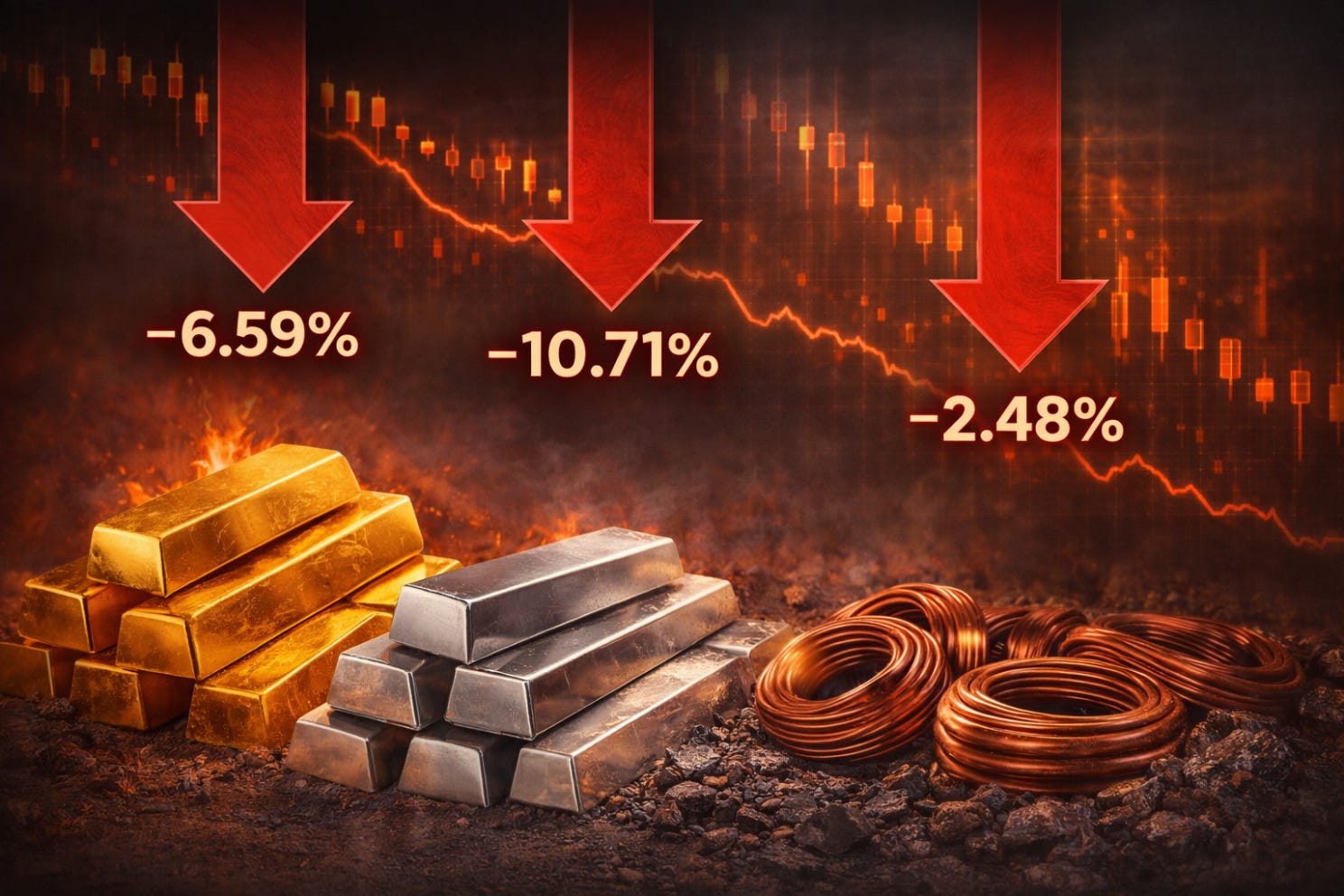
Here is where the markets got truly weird this week. Normally, during a major war, investors panic and buy safe haven assets like gold and silver soaring. Industrial metals usually rise too, due to fears of supply chain disruptions. Instead, we saw a broad crash:
Metal Price Drop
Gold -6.59%
Silver -10.71%
Copper -2.48%
You must be scratching your head, right? Well, there are two different reasons.
1. Demand Destruction: Copper is like a health gauge for the global economy, used in everything from electric motors to power grids. The sudden drop in copper and aluminium is driven by something called “Demand Destruction”.
When energy prices spike violently, running a factory becomes too expensive. Just like in Morbi, manufacturing plants are forced to shut down. A closed factory doesn’t buy raw materials. Investors, predicting a global manufacturing slowdown, aggressively sold off their copper and aluminium.
2. Liquidity Squeeze: Gold’s sharpest weekly drop since March 2020 is all about the Paper Market. The prices you see on the ticker are driven by institutional traders managing contracts, not physical gold bars.
When the conflict escalated, inflation fears spiked, the US Dollar strengthened, and bond yields rose. Massive institutional funds started losing money on riskier bets. To cover these losses, brokers issued margin calls.
To raise cash quickly, funds sold their liquid and profitable assets. Because gold had been hitting record highs, it was the easiest thing to sell for a quick profit. This classic liquidity squeeze crashed the paper price, even though physical demand at local jewellers remained steady.
The Water Crisis Is Also Coming
Authorities in Bahrain reported that an Iranian drone strike damaged a water desalination plant. This followed claims by Iran that the US had previously struck a desalination plant on Iran’s Qeshm Island.
Countries like Kuwait, Oman, Bahrain, and the UAE rely on these plants for up to 90% of their drinking water. Direct attacks on drinking water facilities represent a direct threat against civilian survival. We will cover this story in upcoming weeks.
Lingo Of The Week
Force Majeure
Imagine a bakery signs a contract to deliver a massive wedding cake, agreeing to pay a huge fine if they fail. But a severe earthquake completely destroys the bakery. The cake can’t be delivered, but the bakery is protected from the fine because the failure was caused by an unforeseeable, unavoidable catastrophe outside of their control.
That is Force Majeure.
Originating from French, it literally translates to “Superior Force” (often called an Act of God). It is a standard protective clause built into major business contracts worldwide.
Pocketful isn’t just another trading platform - we’re your partners on the journey to financial freedom.
Thank you for reading!
👀 Stay tuned. Stay diversified.
Until next time,
Team Pocketful.
Follow Us: Website
Download Our App: Available on Google Play & Apple App Store