

For years, India was the global market darling.
Foreign investors loved India’s growth story. Retail participation exploded. SIP inflows kept breaking records. And Indian equities consistently traded at premium valuations compared to most emerging markets.
Then suddenly, something changed.
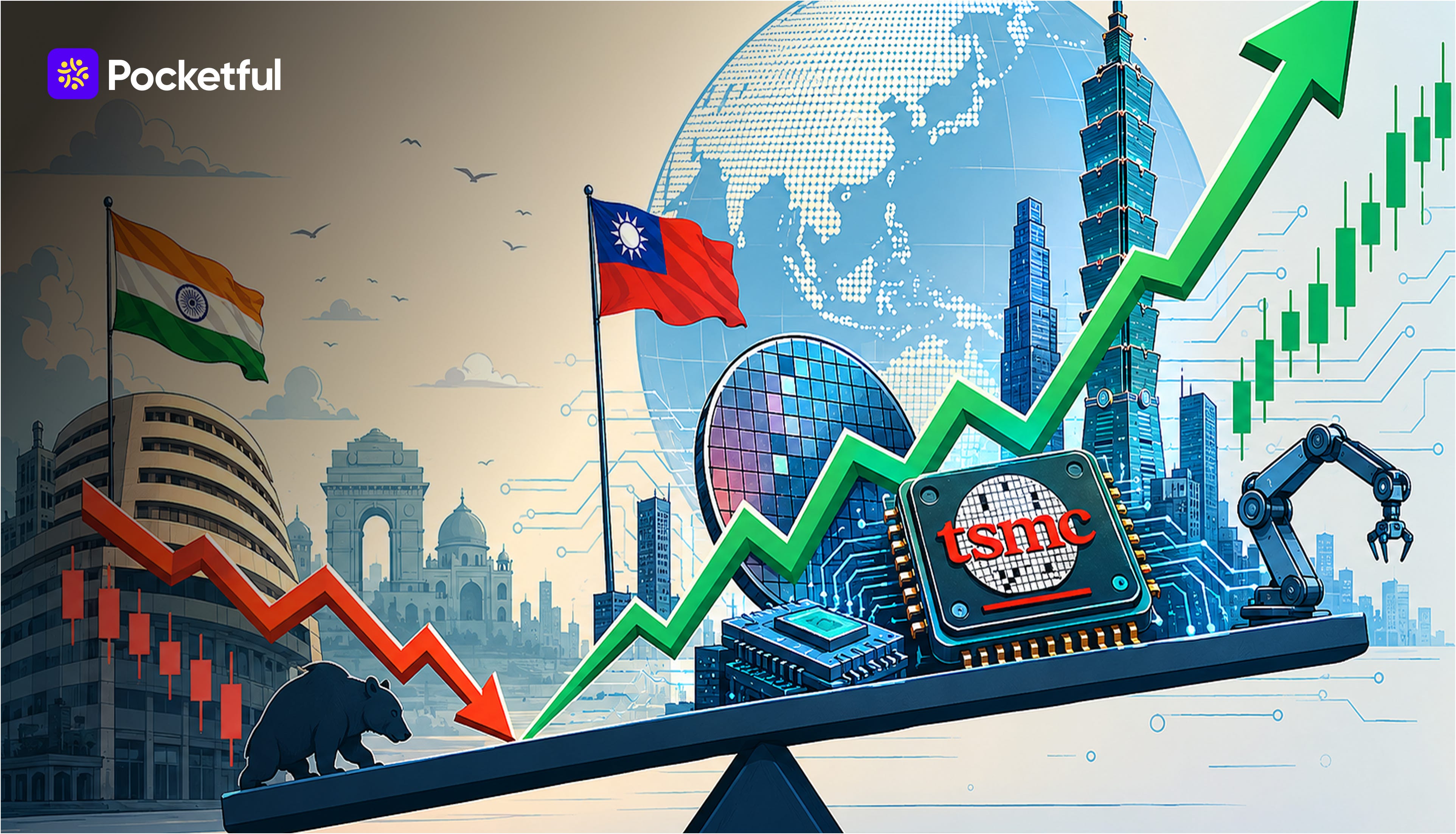
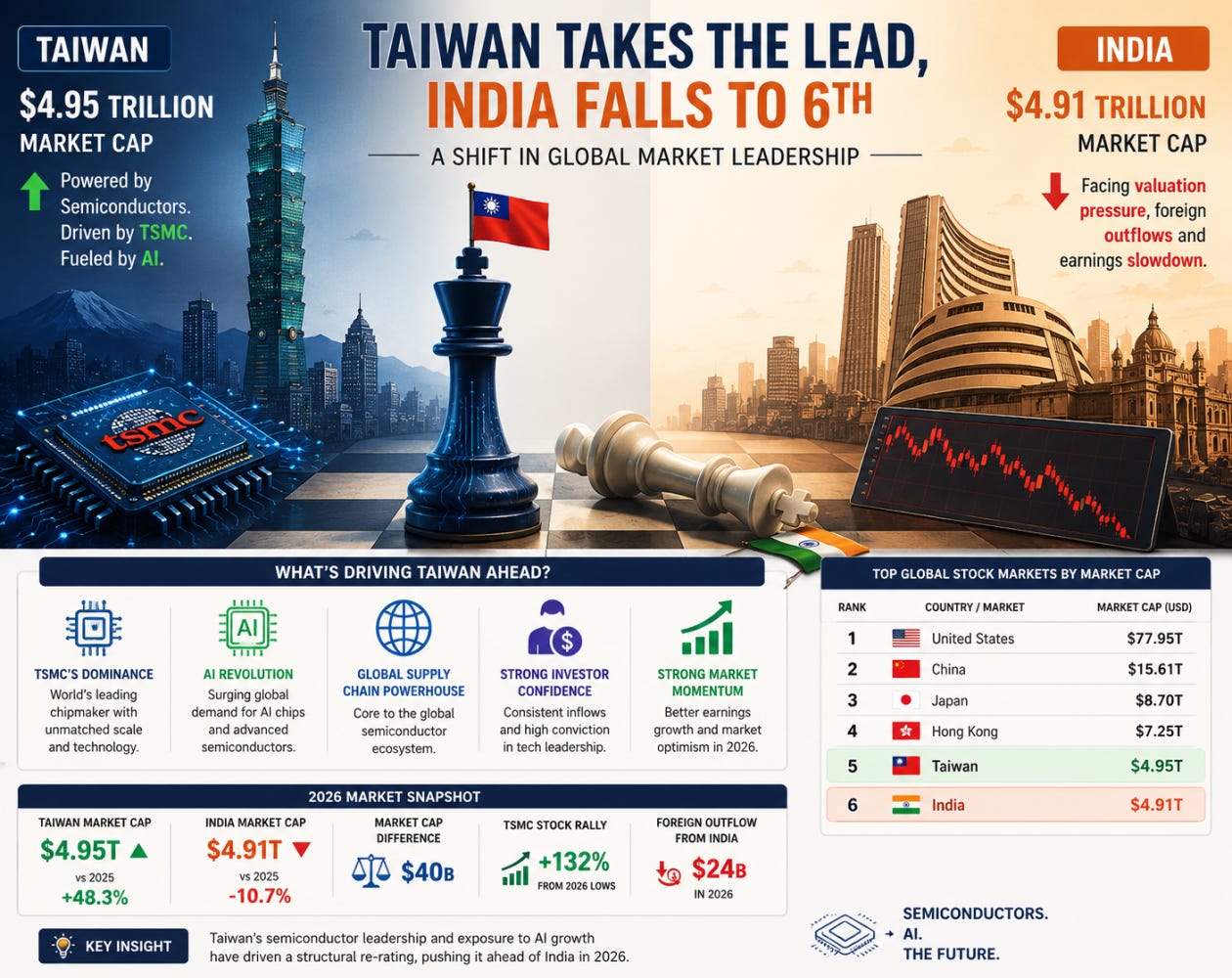
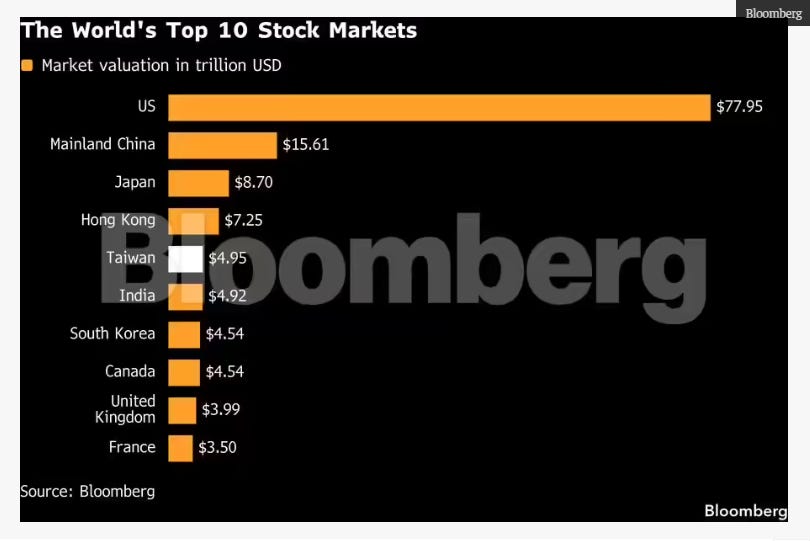
Taiwan, a tiny island economy with a population smaller than Delhi NCR - quietly overtook India to become the world’s fifth-largest stock market.
Taiwan’s market capitalization surged to nearly $4.95 trillion, pushing India to sixth place globally.
And the reason behind this takeover can be summed up in just four letters:
TSMC
The rise of artificial intelligence has completely changed the global investing landscape. While India benefited from domestic consumption and financialization, Taiwan became the center of the AI revolution.
This isn’t just a story about stock markets. It’s a story about how the next global wealth cycle is being created.
The Company Bigger Than Entire Economies
At the center of Taiwan’s rise stands Taiwan Semiconductor Manufacturing Company (TSMC). Most people have never directly used a TSMC product. But almost every modern technology product depends on it.
From Apple iPhones to Nvidia AI chips, from AMD processors to advanced data centers - TSMC manufactures the world’s most sophisticated semiconductors.
Today, the company has become the backbone of the global AI infrastructure boom.
As demand for artificial intelligence exploded, companies rushed to build AI servers, GPUs, cloud infrastructure, and advanced chips. But all roads eventually led to one company capable of manufacturing those ultra-advanced semiconductors at scale: TSMC.
The result?
TSMC’s stock witnessed a historic rally, adding hundreds of billions of dollars in market value within months. And because TSMC alone forms a massive portion of Taiwan’s stock market, the entire Taiwanese market surged along with it.
In simple words:
Taiwan didn’t overtake India because its economy suddenly became larger. It overtook India because the world started valuing AI infrastructure more aggressively than domestic growth stories.
AI Changed the Rules of Global Investing
The market leadership of the last decade was dominated by internet platforms, consumer technology, and digital businesses.
But the AI era has shifted the focus toward infrastructure. The world now needs massive computing power.
That means:
More GPUs
More advanced chips
More semiconductor manufacturing
More data centers
More cloud infrastructure
This created a powerful supply chain where semiconductor companies became the new oil producers of the digital economy. And Taiwan sits right at the center of that ecosystem.
Global investors now believe AI demand could continue for years, possibly even decades. As a result, semiconductor companies started receiving valuations similar to what internet giants received during the smartphone boom.
That’s exactly why Taiwan’s stock market accelerated so rapidly.
The AI trade became larger than the India trade.
Meanwhile, India Faced Valuation Pressure
India’s fall to sixth position doesn’t mean Indian markets collapsed.
In fact, Indian equities remain among the strongest-performing markets globally over the long term.
But there’s an important difference.
India’s rally over the past few years was largely driven by:
Domestic inflows
Retail participation
Strong banking performance
Manufacturing optimism
Infrastructure spending
Consumption growth
However, Indian markets also became expensive.
The Nifty traded at significantly higher valuations compared to many global peers. Foreign investors increasingly questioned whether earnings growth could justify such premiums.
At the same time:
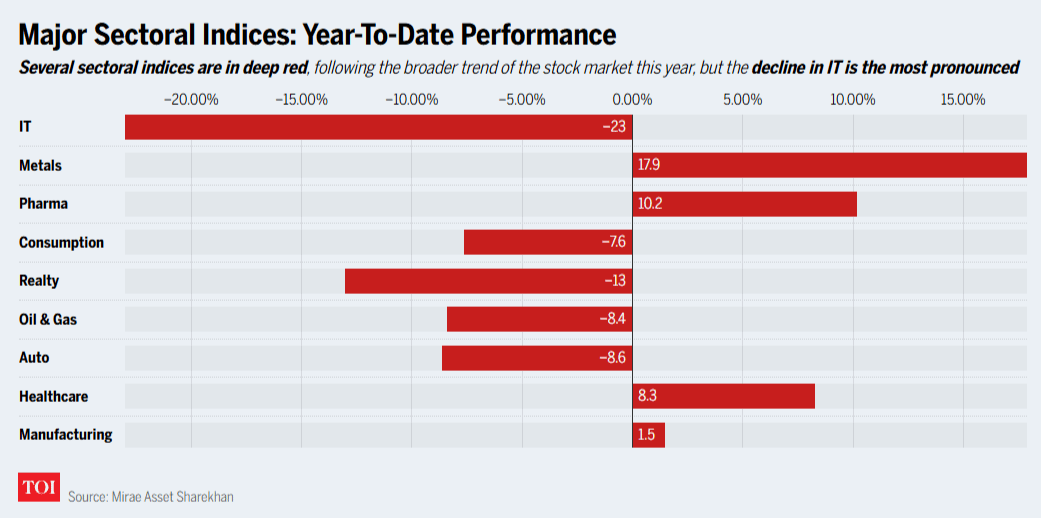
IT stocks struggled due to global slowdown fears
Private capex remained uneven
Export sectors lacked momentum
Earnings growth normalized after the post-COVID boom
This created a situation where India remained fundamentally strong, but Taiwan became globally “more exciting” because it represented direct exposure to the AI boom.
In markets, excitement often attracts capital faster than stability.
And right now, AI is the biggest excitement in global finance.
Why TSMC Is So Important to the World
TSMC is not just another technology company.
It’s strategically critical to the global economy.
Building advanced semiconductor fabrication plants requires:
Tens of billions of dollars
Years of research
Highly specialized engineering
Extreme manufacturing precision
Very few companies globally possess this capability.
That’s why major technology giants depend heavily on TSMC.
Even companies designing their own chips still need TSMC to manufacture them.
This has created an extraordinary competitive advantage.
As AI demand rises, chip shortages become possible. Governments globally now view semiconductor independence as a national security issue.
The United States, Europe, Japan, and China are all aggressively investing in semiconductor ecosystems.
But despite those investments, TSMC continues to dominate the advanced chip manufacturing space.
And global investors know it.
That confidence is exactly what pushed Taiwan’s market capitalization higher than India’s.
Does This Mean India’s Story Is Over?
Absolutely not.
In fact, India and Taiwan represent two completely different investment themes. Taiwan’s rise is heavily concentrated around semiconductors and AI infrastructure.
India’s long-term story is broader and more diversified:
Rising middle class
Manufacturing expansion
Financial inclusion
Infrastructure development
Digital economy growth
Energy transition
Formalization of the economy
India remains one of the fastest-growing major economies globally. But this episode highlights something very important: Global capital flows toward the strongest narrative.
Right now, AI is dominating that narrative. And India still lacks a globally dominant technology manufacturing giant comparable to TSMC.
That’s the real lesson here.
Not that India is weak - but that semiconductor leadership creates extraordinary market power.
Can India Build Its Own Semiconductor Giant?
This is where the conversation becomes truly interesting.
India has already started aggressively pushing semiconductor manufacturing initiatives through incentives and policy support.
Major global companies are exploring chip-related investments in India. The government understands that semiconductors are not just an economic opportunity — they are a strategic necessity.
But building a TSMC-like ecosystem is incredibly difficult.
Taiwan spent decades developing:
Engineering talent
Supply chain expertise
Manufacturing ecosystems
Research capabilities
Specialized infrastructure
Semiconductor leadership cannot be created overnight.
However, India still has significant advantages:
Massive talent pool
Growing electronics manufacturing
Strong domestic demand
Government incentives
Geopolitical support from global partners seeking supply chain diversification
The next decade could determine whether India becomes a serious semiconductor player or remains dependent on imports.
And that may shape future market leadership rankings as well.
The Bigger Picture Investors Must Understand
This entire development reveals how rapidly global markets are evolving.
Ten years ago, oil prices heavily influenced global equities.
Today, AI chip demand influences trillions of dollars in market capitalization.
The world is entering a new economic cycle where computing power may become as important as energy resources. Countries controlling critical technologies could dominate capital markets for years.
Taiwan currently enjoys that advantage because of TSMC. But market leadership constantly changes.
Japan dominated once. Then America. Then China’s manufacturing boom. Then India’s consumption story.
Now the AI infrastructure cycle has placed Taiwan at the center of investor attention.
The key takeaway for investors is simple:
Follow where future economic power is being created.
And right now, the AI revolution is creating enormous wealth for semiconductor ecosystems.
The Bottom Line
Taiwan overtaking India as the world’s fifth-largest stock market is more than just a ranking change. It reflects a deeper shift in global investing priorities.
The market is rewarding companies and countries powering the AI revolution.
TSMC became the face of that transformation.
Meanwhile, India continues to remain a structural long-term growth story driven by demographics, consumption, and domestic expansion.
One market represents the future of AI infrastructure. The other represents the future of economic scale and consumption. And over the next decade, investors will closely watch which theme creates greater wealth.
Because in modern markets, narratives move trillions.
And currently, AI is the most powerful narrative in the world.
Lingo of the Week
Market Capitalization (Market Cap)
Market capitalization, commonly called market cap, represents the total market value of a company’s outstanding shares. It is calculated by multiplying the company’s current share price by the total number of shares available in the market.
For example, if a company has 100 crore shares and each share trades at ₹500, its market cap becomes ₹50,000 crore. Investors use market cap to understand a company’s size, stability, and overall market valuation compared to other companies.
Pocketful isn’t just another trading platform - we’re your partners on the journey to financial freedom.
Thank you for reading!
👀 Stay tuned. Stay diversified.
Until next time,
Team Pocketful.
Follow Us: Website
Download Our App: Available on Google Play & Apple App Store