


What if your stock could return your original investment to you and you never had to sell it?
That sounds almost too good to be true.
But this is one of the most overlooked stories in the Indian stock market. While investors chase the next multibagger, IPO or hot sector, some companies are quietly following a much simpler formula: make money, generate cash, and share a portion of it with shareholders.
These payments are called dividends.
For a short-term trader, a ₹5 or ₹10 dividend may barely matter. But for someone who owns a strong business for 10, 15 or 20 years, those payments can become a meaningful part of total returns. In some extraordinary cases, cumulative dividends can even exceed the investor’s original purchase price while the shares remain in the portfolio.
That raises a fascinating question:
Which Indian companies have turned dividends into a long-term wealth-creation machine?
And perhaps more importantly, how should an investor actually choose and invest in them?
TCS: The “Money Back” Example
Let’s start with a simple historical experiment.
Tata Consultancy Services came to the stock market in 2004 with an IPO price of ₹850 per share. Since then, TCS has issued three 1:1 bonus shares in 2006, 2009 and 2018. The company’s official investor-relations records provide the bonus history as well as its annual dividend history.
Imagine buying one TCS share at ₹850 during the IPO and then doing absolutely nothing.
No trading.
No market timing.
No selling.
Just holding.
Initially, you own one share. The 2006 bonus takes your holding to two shares. The 2009 bonus takes it to four, and the 2018 bonus eventually takes it to eight.
But the real story is the cash that arrives along the way.
TCS’s official dividend history records ₹11.50 per share in FY2005, ₹13.50 in FY2006, ₹13 in FY2007, ₹14 in FY2008, ₹14 in FY2009, ₹20 in FY2010, ₹14 in FY2011, ₹25 in FY2012, ₹22 in FY2013, ₹32 in FY2014 and ₹79 in FY2015.
When the dividend is adjusted for the number of shares held after each bonus issue, the cumulative dividends attributable to the original ₹850 investment cross ₹850 during FY2015.
Think about what that means.
Historically, the investor had received more cash than the original purchase price without selling the shares.
The investment had effectively paid itself back through dividends.
And the investor still owned the stock.
That is the fascinating part of dividend investing. You’re not necessarily waiting for someone else to pay a higher price for your shares. If the underlying business keeps generating excess cash, the company itself can keep returning money to you.
TCS continued that shareholder-return story in later years. Its FY2025 total dividend was ₹126 per share, including a ₹66 special dividend. For FY2026, TCS’s payment record shows total dividends of ₹110 per share, including a ₹46 special dividend.
But TCS is not the point of this story.
It is simply the example that makes the bigger idea easier to understand.
Because India’s dividend universe stretches far beyond technology.
The Dividend Story Is Bigger Than IT
Different businesses produce cash in different ways, and that creates different types of dividend opportunities.
Take ITC.
ITC is one of India’s most established shareholder-return stories. The company has maintained a long record of dividend distributions, and for FY2026 it declared a total dividend of ₹14.50 per share, compared with ₹14.35 per share in FY2025. The company’s FY2026 dividend cash outflow was approximately ₹18,168 crore.
Its business is also much more diversified than simply one product. ITC operates across cigarettes, FMCG, hotels, paperboards, packaging and agribusiness.
That matters because a dividend is ultimately supported by the company’s ability to generate cash.
Now move to Infosys.
Here the dividend story comes from a completely different engine. Infosys generated ₹33,097 crore of free cash flow in FY2026, while revenue reached ₹1,78,650 crore. The company reported free-cash-flow conversion of 112.3% of net profit and declared a total FY2026 dividend of ₹48 per share.
This is an important distinction.
Investors shouldn’t look only at how much dividend a company pays.
They should ask:
“Where is that dividend coming from?”
If a company consistently generates strong free cash flow, it has a much stronger foundation for shareholder distributions.
Then there is Hindustan Unilever.
HUL represents the everyday-consumption side of the dividend story. Its FY2026 total dividend was ₹41 per share, comprising a ₹19 interim dividend and ₹22 final dividend. The company reported consolidated turnover of ₹63,763 crore and profit after tax from continuing operations of ₹10,652 crore.
The attraction here is different again.
People may postpone buying a car or a new television when the economy slows.
But they still need detergent, personal-care products and household essentials.
That recurring demand can help create a relatively resilient business and potentially a resilient dividend stream.
From Consumer Goods to India’s Power Grid
The dividend story doesn’t end with consumer and technology companies.
Consider Power Grid.
Instead of selling software or consumer products, Power Grid operates India’s electricity-transmission network. Its official website reports 1,86,889 circuit kilometres of transmission lines, 292 substations and 6,37,016 MVA of transformation capacity, with system availability of 99.81% as of July 31, 2026.
Its investor-relations website also maintains a detailed dividend archive covering multiple financial years.
This is a completely different type of dividend business.
Its story is linked to essential infrastructure.
As India’s electricity demand grows and the power system expands, transmission infrastructure remains critical.
Then there is Coal India, which gives investors exposure to another cash-generating but more cyclical business.
For FY2026, Coal India’s board recommended a ₹5.25 per share final dividend. The company reported consolidated revenue from operations of approximately ₹1.68 lakh crore and profit attributable to owners of approximately ₹31,094 crore.
Coal India can therefore offer substantial shareholder distributions, but investors need to understand the trade-off.
Commodity businesses can experience much larger swings in earnings.
Coal prices, production levels, government policy, energy demand and India’s transition toward cleaner energy can all influence future cash generation.
A high dividend today does not automatically mean a high dividend five or ten years from now.
Five Dividend Businesses Worth Studying
Instead of asking for the “five best dividend stocks,” investors should think in terms of different dividend models.
TCS represents technology and global services, with a remarkable historical example of cumulative dividends eventually exceeding the original IPO price.
Infosys combines technology growth with significant free cash flow and shareholder distributions.
ITC represents a mature, diversified consumer business with a long record of returning cash.
HUL provides exposure to everyday consumption and an established dividend record.
Power Grid brings essential infrastructure into the picture.
And for investors willing to accept higher commodity and policy risk, Coal India is another company worth researching.
The point isn’t that one is automatically better than the others.
Their businesses are fundamentally different.
A technology company can be affected by global IT spending. An FMCG company faces raw-material inflation and changing consumer behaviour. A power utility requires significant capital expenditure. A mining company is exposed to commodity cycles.
That is precisely why diversification matters.
So, How Do You Actually Invest in Dividend Stocks?
This is where many investors go wrong. They search for the highest dividend yield, find a stock offering 8% or 10%, and assume they’ve found a bargain. Not necessarily. A high dividend yield can sometimes be a warning sign. Imagine a company paying ₹10 in annual dividends while its stock trades at ₹100. The yield is 10%. Sounds attractive but what if the stock previously traded at ₹200 and fell to ₹100 because investors expect profits to decline? The yield has doubled, but the investment hasn’t necessarily become safer.
That’s why the first question should always be about the business. Does the company have a durable competitive advantage? Is demand stable? Can it consistently generate cash across economic cycles? Next, examine the dividend history. Has the company consistently paid dividends? Has the dividend grown over time? Were previous large payments regular dividends or one-time special dividends?
Then look at free cash flow. A dividend ultimately requires cash, so strong free cash flow gives a company greater flexibility to reward shareholders while continuing to invest in the business. Another important metric is the payout ratio:
Dividend Payout Ratio = Dividend ÷ Net Profit × 100.
If a company earns ₹100 crore and distributes ₹40 crore, its payout ratio is 40%. However, a lower payout isn’t automatically better a company that retains too much cash without productive investment may not be using shareholder capital efficiently.
Finally, consider valuation. A great company can still be a poor investment if you pay too much for it. If a company pays ₹10 in annual dividends, buying it at ₹200 gives you a 5% yield, while buying it at ₹400 gives you only 2.5%. The company is the same. Your entry price isn’t.
Dividend Reinvestment: Where Compounding Gets Interesting
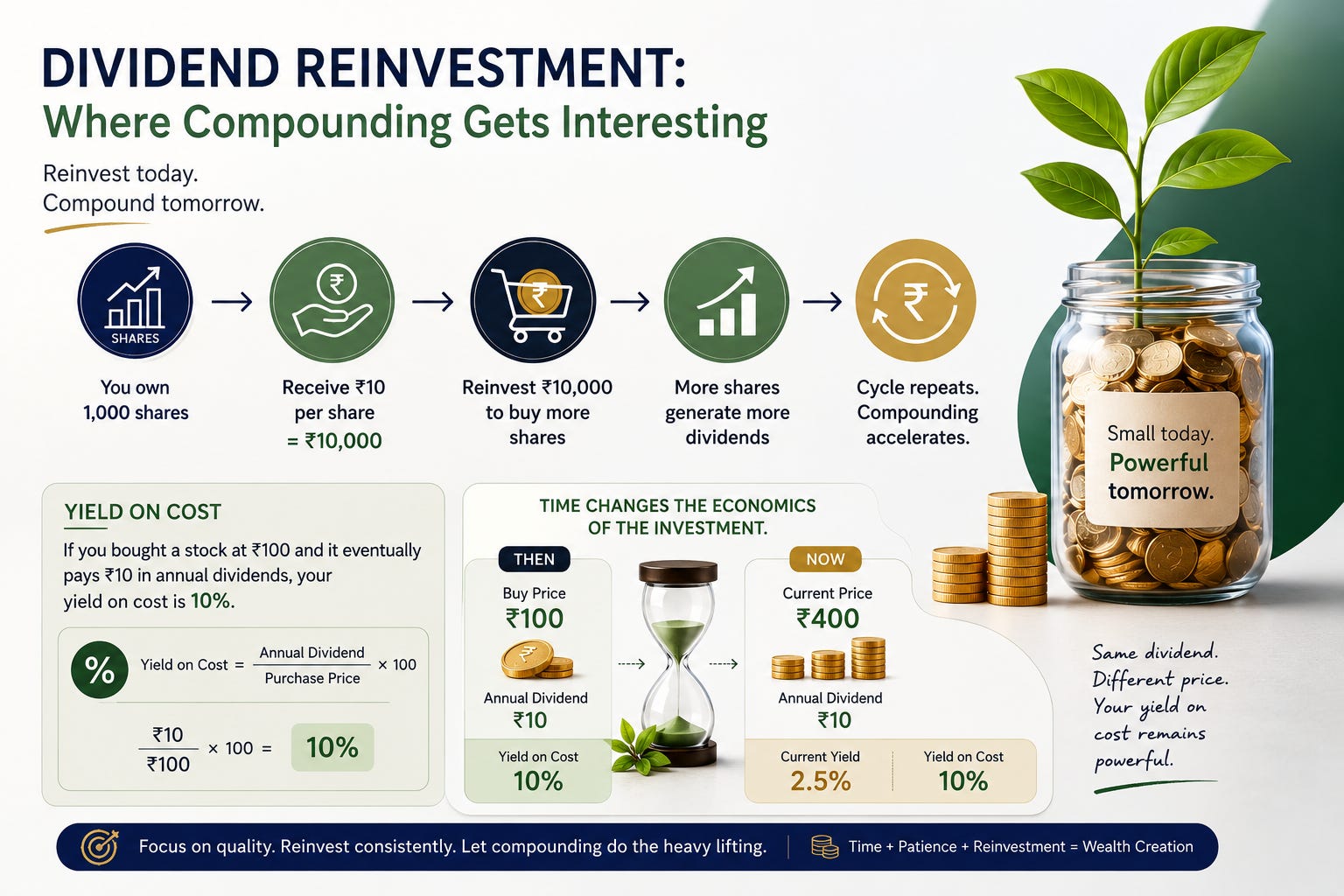
Once the dividend reaches your account, you have a choice: spend it or reinvest it. For investors seeking regular income, taking the dividend as cash can make sense. But for those with a long investment horizon, reinvesting dividends can potentially accelerate compounding. Suppose you own 1,000 shares and receive ₹10 per share that’s ₹10,000. Instead of withdrawing it, you could use the money to purchase additional shares. Those additional shares can generate dividends in the future, which can then be reinvested again. The cycle continues, allowing your investment and potential income to grow together.
This is why dividend growth can be more important than simply chasing a high yield. A company paying a 3% dividend today but steadily increasing its dividend could eventually generate a much larger income stream on your original investment. This brings us to an important concept: yield on cost. If you bought a stock at ₹100 and it eventually pays ₹10 in annual dividends, your yield on cost is 10%. Even if the stock is now trading at ₹400 and its current dividend yield is only 2.5%, you are still receiving ₹10 annually on your original ₹100 purchase price. Time can change the economics of an investment.
The Real Dividend Strategy: Buy Businesses, Not Just Dividends
The biggest lesson from India’s dividend companies is simple: Don’t chase the dividend. Study the business that produces it.
TCS shows how a long-term shareholder could historically receive cumulative dividends exceeding the original IPO investment while continuing to hold the shares. ITC represents a mature, cash-generating consumer business, while Infosys shows how strong free cash flow can support shareholder returns. HUL highlights the resilience of everyday consumption, Power Grid represents essential infrastructure, and Coal India demonstrates the cash-generating potential of commodity businesses along with their additional risks.
These companies have different dividend yields, growth rates and risk profiles, but they share one important principle: wealth doesn’t have to come only from selling a stock at a higher price. A company can create value by growing its business, increasing shareholder wealth and returning excess cash through dividends.
For a long-term investor, the better question isn’t “Which stock pays the biggest dividend today?” It is “Which business can continue generating enough cash to pay me and potentially pay me more ten years from now?”
Because the real goal isn’t simply to collect dividends. It is to own businesses that keep earning, growing and sharing. Over decades, those regular cash payments can become a meaningful part of total wealth creation.
Lingo of the Week: Dividend Yield
Dividend Yield = Annual Dividend per Share ÷ Current Share Price × 100
If a stock trades at ₹500 and pays ₹20 annually, its dividend yield is 4%.
But remember: a high yield is not automatically a good investment. Always look at dividend sustainability, free cash flow, earnings growth, debt and valuation before making an investment decision.
Pocketful isn’t just another trading platform - we’re your partners on the journey to financial freedom.
Thank you for reading!
👀 Stay tuned. Stay diversified.
Until next time,
Team Pocketful.
Follow Us: Website
Download Our App: Available on Google Play & Apple App Store
Wouldn’t dividend yield funds be smarter and easier to choose?