

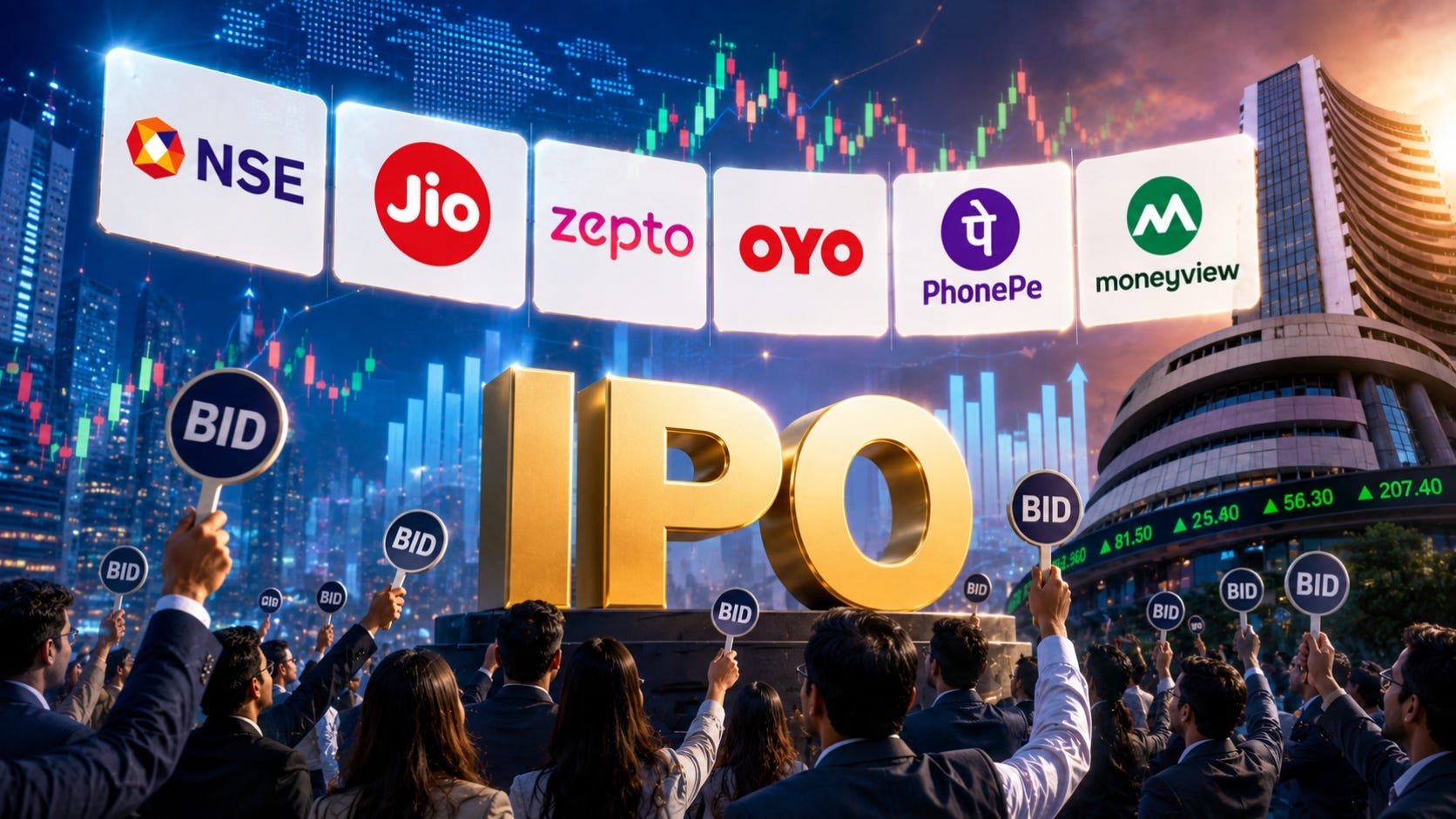
Back in 2021, almost every new IPO felt like an event. Investors rushed to open Demat accounts, social media was flooded with Grey Market Premium (GMP) discussions, and listing-day gains became dinner-table conversations. It seemed every company going public was destined for success.
Then reality arrived.
Global interest rates surged, inflation squeezed liquidity, and investor enthusiasm faded. Several companies delayed their IPO plans, while others struggled to justify lofty valuations. The primary market, once overflowing with excitement, suddenly turned cautious.
Fast forward to 2026, and the mood has changed once again.
India’s IPO market is buzzing with activity. Companies from asset management, manufacturing, infrastructure, healthcare, and technology are lining up to raise capital. Investors are subscribing to quality issues, institutional participation is rising, and investment banks are once again talking about a multi-year IPO cycle.
But unlike the frenzy of 2021, today’s market feels more measured. Investors aren’t asking “How much will this IPO list at?” They’re asking something far more important:
“Is this business worth owning for the next five or ten years?”
That shift may define India’s next phase of wealth creation.
IPOs Don’t Thrive Alone. Markets Create the Right Conditions.
An IPO isn’t just about one company deciding to go public. It’s often a reflection of the broader market.
When markets are volatile, investors become defensive, valuations compress, and companies postpone listings. But when confidence returns, businesses see public markets as the perfect place to raise capital.
That’s exactly where India stands today.
Despite global uncertainties, India’s economy continues to show resilience. Corporate earnings remain healthy across several sectors, domestic investors continue to invest through mutual funds, and public markets have become deeper than they were just a few years ago.
Goldman Sachs recently noted that India’s equity capital markets are entering a “new phase,” supported by strong domestic participation and a healthy pipeline of companies waiting to list. The investment bank believes India’s primary market is evolving beyond short-term enthusiasm into a more mature fundraising ecosystem.
Source: Economic Times - “India’s equity capital markets are entering a new phase”.
Why Companies Are Choosing to Go Public Again
Behind every IPO lies a business decision.
While raising capital remains the primary objective, companies today have several reasons to enter the public markets.
For some, it’s about funding the next phase of expansion. For others, it’s an opportunity to reduce debt, improve brand visibility, or provide an exit to early investors who backed the company years ago.
Unlike the startup-heavy wave seen earlier this decade, today’s IPO pipeline is far more diversified.
Asset managers, industrial manufacturers, logistics firms, healthcare companies, consumer brands, and financial institutions are all preparing to tap public markets.
That diversity is often a sign of a healthier primary market.
The Numbers Tell an Interesting Story
The scale of India’s IPO pipeline is difficult to ignore.
According to data cited by The Economic Times, 173 companies have already received regulatory approval from SEBI to collectively raise nearly ₹2.7 lakh crore through public offerings.
Another 64 companies are still awaiting approval, with plans to raise an additional ₹1.95 lakh crore.
Together, that’s a pipeline worth over ₹4.6 lakh crore one of the largest India has seen in recent years.
While not every company will launch immediately, the sheer volume reflects growing confidence among promoters, private equity investors, and investment bankers.
Source: Economic Times - IPO Pipeline Report, June 2026.
July Has Been One of the Busiest Months for IPOs
If the pipeline shows the future, July’s calendar reflects the present.
The month has witnessed a steady stream of public issues across both the Mainboard and SME segments.
According to IPO market trackers, nearly 20 IPOs have hit the market during July, including 11 Mainboard IPOs and 9 SME offerings.
Some of the biggest names include

The mix of sectors is particularly noteworthy.
Unlike previous cycles dominated by internet companies, today’s pipeline reflects India’s broader economic transformation from manufacturing and infrastructure to financial services and healthcare.

Investors Have Become More Disciplined
Perhaps the biggest difference between today’s IPO market and the one we saw a few years ago is the mindset of investors.
During the 2021 boom, many IPOs were subscribed primarily because everyone expected listing gains. Fundamentals often took a back seat.
That approach has changed.
Today, institutional and retail investors alike are paying closer attention to:
Revenue growth
Profitability
Cash flows
Debt levels
Corporate governance
Valuation relative to listed peers
This is a healthy development.
A successful IPO is no longer judged solely by its listing-day performance. Increasingly, investors want businesses that can continue creating value long after the opening bell.
Bigger Deals, Bigger Confidence
The size of public offerings is also increasing.
According to investment banking firm Rothschild & Co., Indian IPOs are becoming larger as domestic markets deepen and institutional participation expands.
Mutual funds, insurance companies, pension funds, sovereign wealth funds, and foreign institutional investors are all playing a larger role in absorbing sizable public issues.
That’s an encouraging sign.
It suggests India’s capital markets are gradually becoming capable of funding larger businesses without relying entirely on overseas capital.
And that’s perhaps the most important story behind this IPO revival.
It’s not just about companies raising money.
It’s about India’s financial markets becoming strong enough to support the country’s next generation of businesses.
Not Every IPO Is a Winner And That’s a Good Thing
Every IPO season creates a familiar narrative.
One company lists at a premium, social media celebrates the listing gains, and suddenly every upcoming issue is labelled a “must apply.” But history tells us a different story.
Some IPOs create long-term wealth because they are backed by strong businesses with sustainable earnings and reasonable valuations. Others generate excitement on listing day but struggle to justify their market capitalisation over time.
That’s why experienced investors rarely ask, “How much is the Grey Market Premium?”
Instead, they ask:
Is the business profitable?
Can it continue growing for the next decade?
Is the valuation justified?
What is management planning to do with the money it raises?
Those questions matter far more than listing-day gains.
Why Foreign Investors Are Using India’s IPO Boom
One of the more interesting developments in this IPO cycle isn’t just the number of companies going public it’s who is selling.
Many recent IPOs include a significant Offer for Sale (OFS) component, where existing shareholders such as private equity firms, venture capital funds, or global investors sell part of their stake instead of the company issuing entirely new shares.
At first glance, that might sound negative.
But it often reflects the natural investment cycle.
Private equity firms typically invest in businesses for five to eight years. Once a company matures, listing on the stock exchange provides an opportunity to unlock value and return capital to their investors.
According to The Economic Times, several global investment firms are increasingly using India’s buoyant IPO market to monetize long-held investments, underscoring international confidence in India’s capital markets.
This doesn’t necessarily mean they’re losing confidence in India. In many cases, they’re simply completing the investment journey they started years earlier.
For retail investors, however, it raises an important question:
Is the IPO raising fresh capital to grow the business, or is it primarily providing an exit for existing investors?
The answer can significantly influence the company’s long-term growth prospects.
The IPOs Everyone Is Watching
The pipeline for the coming quarters remains one of the strongest India has witnessed in recent years.
Several high-profile companies are expected to approach the markets, subject to regulatory approvals and market conditions.
Some of the names attracting investor attention include:
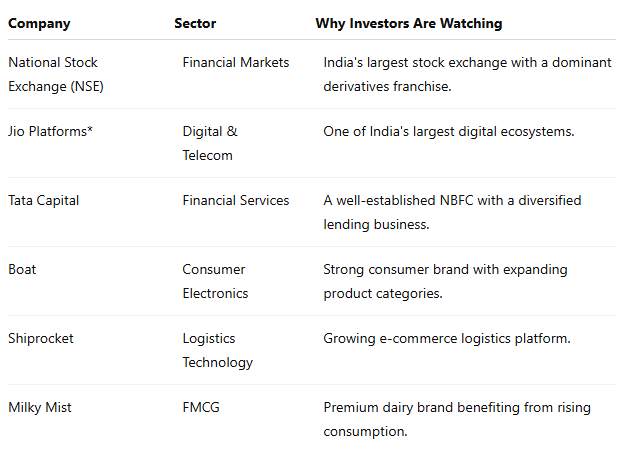
image *Indicative pipeline based on public reports and regulatory developments. Listing timelines may change.
If even a few of these companies come to market over the next year, India’s IPO landscape could witness another record-breaking phase.
The Valuation Question Nobody Should Ignore
A great business isn’t always a great investment.
That may sound contradictory, but valuation plays a crucial role in determining long-term returns.
Imagine buying shares in an excellent company at a price that already assumes years of future growth.
Even if the business performs well, your investment returns could remain modest because expectations were already too high.
This has happened across global markets countless times.
That’s why seasoned investors compare an IPO’s valuation with listed peers.
Questions worth asking include:
Is the Price-to-Earnings (P/E) ratio significantly higher than competitors?
Does revenue growth justify the premium?
Are profit margins sustainable?
Is the company generating free cash flow?
How much debt does it carry?
An expensive IPO can still become a successful business.
But that doesn’t automatically make it a successful investment.
What Retail Investors Should Focus On
Retail participation in India’s stock market has grown dramatically over the past few years.
Demat accounts have crossed record levels, SIP inflows continue to remain robust, and financial awareness has improved significantly.
Yet one mistake remains surprisingly common.
Many investors decide whether to apply for an IPO based solely on Grey Market Premium (GMP).
While GMP often reflects market sentiment, it isn’t an official indicator and should never replace fundamental analysis.
Instead, investors should evaluate five key areas:
1. Business Quality
Does the company operate in a growing industry?
2. Financial Performance
Are revenue and profits consistently increasing?
3. Corporate Governance
Does the management have a credible track record?
4. Valuation
Is the IPO reasonably priced compared with listed peers?
5. Purpose of the Issue
How will the company use the capital?
A disciplined checklist often leads to better decisions than chasing market excitement.
India’s IPO Story Is Bigger Than IPOs
Looking beyond the numbers, the revival of India’s primary market reflects something much larger.
Companies are increasingly choosing Indian exchanges over overseas listings.
Domestic institutions are capable of supporting multi-billion-rupee public offerings.
Retail investors have become an important force in capital formation.
Most importantly, Indian businesses now view public markets not merely as a source of capital but as a long-term partner in growth.
That represents a structural shift in how Indian companies are funded.
And if this trend continues, it could shape the country’s capital markets for years to come.
Pocketful Take
Every IPO promises growth.
Not every IPO delivers it.
The renewed momentum in India’s primary market is encouraging, but investors should resist the temptation to judge opportunities by subscription numbers or listing-day excitement alone.
The companies that ultimately create wealth are usually the ones with durable business models, disciplined capital allocation, strong management, and reasonable valuations.
India’s IPO pipeline suggests that confidence in the country’s economy remains strong. But successful investing has never been about owning every new listing.
It’s about identifying businesses that can continue compounding long after the headlines fade.
As the next wave of IPOs arrives, perhaps the best question isn’t “Should I apply?”
It’s “Would I still want to own this company five years from now?”
If the answer is yes, you’ve already moved beyond speculation—and one step closer to investing.
Lingo of the Week
Offer for Sale (OFS)
Definition: An Offer for Sale (OFS) is when existing shareholders such as promoters, private equity firms, or early investors sell their shares to the public through an IPO. Unlike a Fresh Issue, the money goes to the selling shareholders, not the company.
Example: If a private equity fund sells part of its stake during an IPO, it is an Offer for Sale (OFS).
Why It Matters: A higher OFS means existing investors are exiting, while a larger Fresh Issue indicates the company is raising capital for future growth.
Pocketful isn’t just another trading platform - we’re your partners on the journey to financial freedom.
Thank you for reading!
👀 Stay tuned. Stay diversified.
Until next time,
Team Pocketful.
Follow Us: Website
Download Our App: Available on Google Play & Apple App Store