

A Week When Indian Skies Turned Chaotic
IndiGo’s severe operational crisis in early December became one of the most disruptive moments in recent Indian aviation. Across major airports, passengers faced long queues, sudden cancellations and almost no clear information. IndiGo, which carries the majority of India’s domestic flyers, was caught unprepared for the new pilot duty and rest rules that took effect on 01 November. These rules were introduced to improve safety by preventing crew fatigue, but IndiGo’s scheduling systems and staffing levels were not ready for the transition. As a result, the airline’s network began to break down quickly.
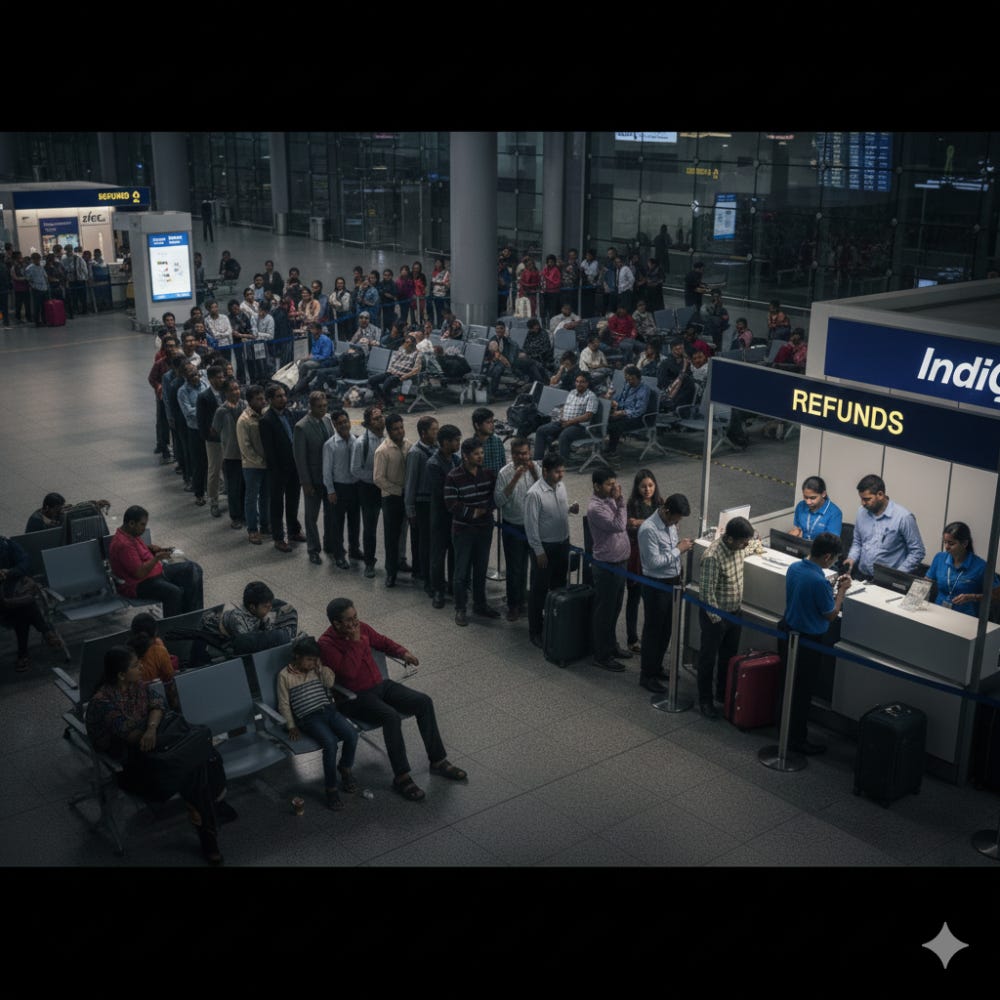
Between 01 December and 09 December, IndiGo cancelled more than 2,000 flights. On some days, the numbers were extraordinary. 03 December saw over 200 cancellations, and 05 December saw around 400 to 500 flights cancelled in a single day. Delhi, Mumbai, Bengaluru and Hyderabad experienced overcrowded terminals where travellers slept on floors, spent heavily on food and struggled to find alternate flights. Analysts estimated that more than 70,000 passengers were affected each day during the peak of the crisis.
The situation became so serious that the Directorate General of Civil Aviation sent an inspection team to IndiGo’s headquarters and stationed an 8 member group to monitor the airline’s daily operations. This is a rare step and reflected how deeply the disruptions had spread. IndiGo attributed the collapse to the new duty rules, a heavy winter schedule, weather delays, airport congestion and technical failures in rostering. Eventually, the government ordered the airline to cut 10 percent of its winter flights to help stabilize operations.
How New Safety Rules Triggered a Breakdown
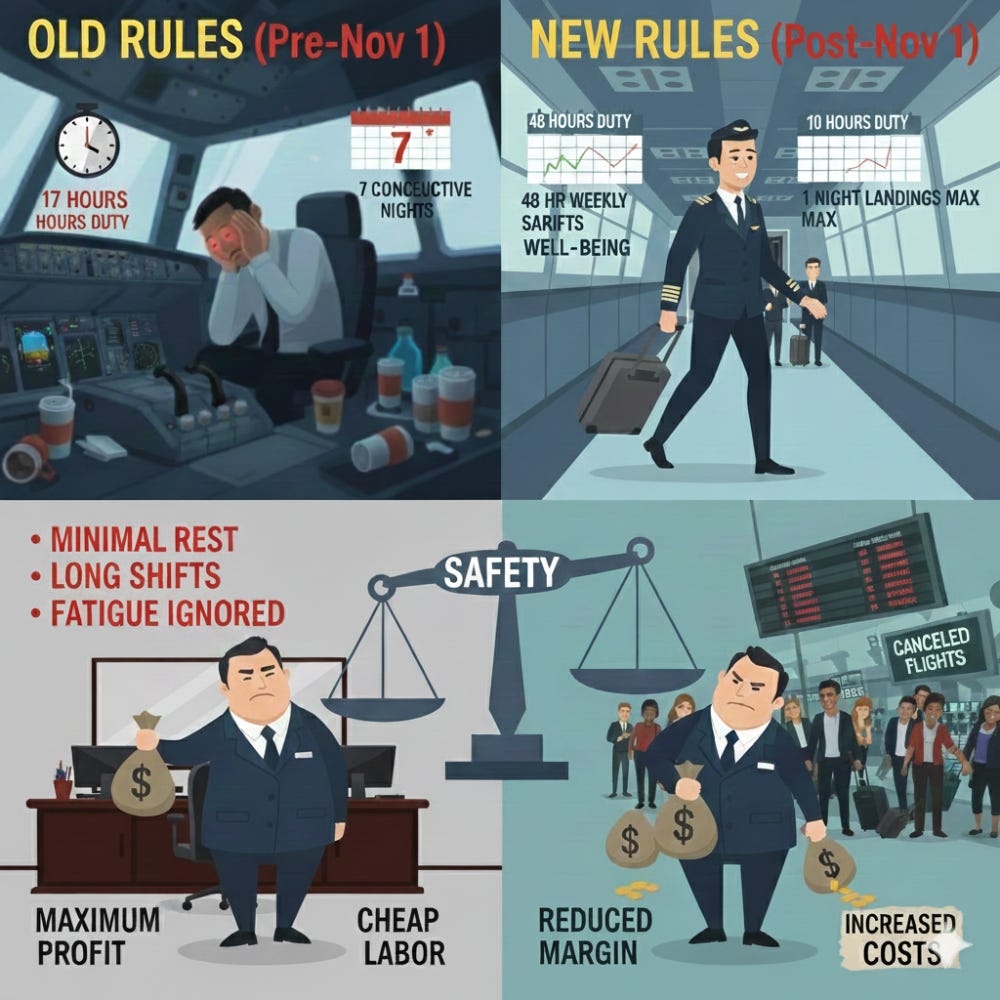
India’s updated Flight Duty Time Limitation (FDTL) norms, effective November 1, form the core of the recent aviation crisis. These rules mandate at least 48 hours of weekly rest, impose stricter limits on night duties, cap consecutive night landings at two, broaden what counts as total duty time to include pre- and post-flight tasks, and require additional rest after long-haul operations. The framework closely mirrors US FAA and European EASA standards, reflecting a global shift toward treating fatigue as a serious safety hazard. Modern safety science increasingly places inadequate rest in the same category as alcohol or sedatives because fatigue has been a factor in numerous global near-misses.
The intention behind the new norms is sound: rested pilots make fewer errors, and predictable rest cycles reduce the risk of cognitive lapses in high-stakes environments. However, the rollout exposed systemic weaknesses within IndiGo’s planning. Several reports suggest the airline did not expand its pilot workforce ahead of time, kept recruitment on hold for months, left compensation unchanged despite growing demand, and—according to industry chatter—participated in informal anti-poaching understandings that restricted pilot mobility during a crucial transition period. These decisions created a brittle operating model with little buffer for regulatory tightening.
When the new FDTL rules came into force, IndiGo found itself without enough crew to maintain its schedule, forcing widespread cancellations. The airline argued that the rules were introduced abruptly, and that the sudden withdrawal of earlier exemptions left them scrambling. Regulators rejected this framing, noting that carriers had been given advance notice and were expected to plan ahead, especially given the global direction of fatigue-management standards.
Regardless of which narrative one accepts, passengers experienced the consequences directly. Airports saw chaotic scenes, thousands of flights were cancelled or severely delayed, and communication from the airline was often limited or inconsistent. The episode illustrates how even well-intentioned safety reforms can expose operational fragilities when an airline lacks adequate staffing resilience. At its core, the crisis underscores a simple truth: safety regulations and capacity planning must evolve together, or the entire ecosystem becomes vulnerable to disruption.
Where Safety Goals and Airline Efficiency Clash
The crisis exposes a tension at the crossroads of passenger safety, crew wellbeing, and operational efficiency. Scientific evidence leaves little ambiguity: pilot fatigue raises the likelihood of errors, especially during night operations, long duty periods, and fast turnarounds that wear down attention and judgment. India’s updated FDTL norms were crafted to limit these risks by mandating more rest and stricter duty boundaries. On paper, this is the clearest route to safer skies.
The complication lies in the operating model of low-cost carriers, where efficiency depends on extremely lean systems. IndiGo’s strategy revolves around exceptionally high aircraft utilisation of roughly 14 hours a day, minimal roster slack, tight turnarounds, and very limited buffer capacity. That formula is profitable and reliable only when everything runs smoothly. Once mandatory rest hours increase or unexpected disruptions appear — weather delays, medical leave, or scheduling conflicts — the absence of surplus pilots creates a domino effect. Even small shocks ripple into widespread cancellations because the system has no elasticity.
A deeper policy tension becomes visible in this clash. Safety rules require airlines to hire more crew, invest in training, and maintain scheduling flexibility. But market pressures push carriers toward leanness, creating a structural collision between what safety demands and what efficiency rewards. Technology shortcomings made matters worse: IndiGo acknowledged its rostering software struggled with the new constraints, compounding crew shortages. Regulators set rules to protect passengers and crew, yet the airline’s operational infrastructure wasn’t ready to absorb them - leaving travellers to suffer the fallout.
The Market Structure That Turned a Problem Into a National Crisis
India’s aviation market played a major role in magnifying the crisis. IndiGo controls around sixty to sixty five percent of the domestic market. Air India and Vistara are merging, SpiceJet continues to struggle financially, and Akasa is still relatively small. This means India has a concentrated market with limited competition. When one large airline experiences problems, no other carrier has enough spare capacity to absorb the affected passengers.
During the IndiGo breakdown, the impact of this imbalance became very visible. When thousands of flights were cancelled, passengers attempted to switch airlines but found that no seats were available. Other airlines did not have extra aircraft or crew to add new flights. Many people were unable to travel for days. Last minute fares rose sharply because of sudden demand. Passengers felt trapped because they had no alternative carrier to rely on.
Regulators such as the Competition Commission of India have already shown interest in understanding whether IndiGo’s large market share contributed to the severity of the crisis. When one airline becomes so large that its internal problems affect national mobility, it raises important questions about market dominance and consumer protection.
Passengers and the Hidden Costs of Disruption
The people who suffered most in this situation were the passengers. Thousands missed weddings, exams, business meetings and medical appointments. Many lost money on prepaid hotel bookings and taxis. Families travelling with children or elderly relatives faced long waiting hours. Some passengers slept on airport floors because no alternate flights or accommodation were available. Communication from the airline was often slow, leaving passengers uncertain about their next steps.
IndiGo offered refunds for cancelled flights, and compensation was available when demanded. However most passengers did not know that they had the right to claim compensation beyond a basic refund. Indian consumer laws allow passengers to seek compensation for mental stress, financial losses, and other incidental costs. They can even approach consumer courts if airline negligence caused significant inconvenience. Yet awareness of these rights remains low, and airlines rarely highlight them.
This lack of awareness means passengers bear the financial and emotional costs of disruption even when the fault lies with the airline. In a more competitive market, airlines would have greater incentive to improve reliability and customer service. But in a concentrated market, passengers often have no choice but to accept poor experiences.
A Regulatory Dilemma and the Lessons Ahead
As the cancellations grew, the DGCA faced a difficult choice. Strict enforcement of the new safety rules meant continuing flight cancellations until IndiGo hired more crew and upgraded its systems. Relaxing the rules offered quick relief but weakened the long term safety message. Eventually, the regulator temporarily eased some parts of the new duty time rules for IndiGo so that flights could resume smoothly. This helped bring cancellations down, but it also raised concerns about whether safety reforms will be diluted whenever they create operational stress.
This situation shows that strong safety rules need strong planning and strong systems behind them. Regulators must coordinate with airlines so that implementation is realistic and does not threaten national mobility. Airlines must be honest about the cost of compliance and should invest in staff, technology and buffers. Market structures must support competition so that no single airline becomes too big to fail.
Aviation in countries like the United States and those in Europe benefits from multiple large carriers, strong pilot pipelines, and robust crisis management systems. These markets recover faster from disruptions because they have buffer capacity. India is growing rapidly as an aviation market, but its pilot supply is still limited and its airline structure is fragile. This makes the system more vulnerable when unexpected changes occur.
A Crisis That Revealed Deeper Fault Lines
The IndiGo crisis is not simply a story of one airline struggling with new rules. It is a larger story about how safety ambitions, operational practices, technology limits and market structures interact. The new duty time rules were introduced with the goal of protecting passengers and crew from fatigue risks. But the planning, hiring, technology and governance required to support these rules were not fully in place. When an airline as large as IndiGo fails to adjust to new requirements, the entire country feels the impact.
Passengers pay the price through stress, uncertainty and financial loss. Employees face long hours and unstable schedules. Regulators are forced to intervene in day to day operations instead of focusing on long term strategy. If this crisis has a positive side, it is that it highlights the need for systemic improvements. India needs stronger consumer protections, more resilient airline scheduling systems, a larger pool of trained pilots, clearer regulatory timelines and a more competitive airline industry.
The real test now is whether policymakers, regulators and airlines will treat this incident as a warning to strengthen the aviation ecosystem or whether the problems will return the next time a seasonal shock or rule change places pressure on an already stretched system.
Lingo of the Week - Operational Fragilities
These are the subtle weaknesses inside an organization that remain hidden when everything runs smoothly but emerge sharply during stress. They show where systems lack buffers, resilience, or coordination. Once exposed, small disruptions can rapidly escalate into widespread failures. Operational fragilities are important because they reveal the gap between how robust a system appears and how vulnerable it truly is.
Pocketful isn’t just another trading platform - we’re your partners on the journey to financial freedom.
Thank you for reading!
👀 Stay tuned. Stay diversified.
Until next time,
Team Pocketful.
Follow Us: Website
Download Our App: Available on Google Play & Apple App Store