


It started with a regulatory proposal but quickly turned into a stock-market shock. Within hours, insurance-linked stocks came under heavy selling pressure as investors assessed IRDAI’s proposed changes to insurance distribution commissions.
PB Fintech, Turtlemint, Max Financial Services and other insurance names faced sharp declines as concerns grew over their commission-driven revenue models. The proposal could reshape how insurers, brokers, digital platforms, banks and NBFCs earn from insurance distribution, making it one of the sector’s biggest regulatory developments this week.
IRDAI’s Commission Proposal: What Has Changed?
IRDAI’s proposal is more than just a commission cut. It attempts to reset the economics of insurance distribution from how much agents and brokers earn to how insurers account for expenses and how insurance is sold to customers.
Here are the seven changes that matter most:
1. Product-Level Commission Caps Are Back IRDAI has proposed bringing back commission limits based on the insurance product, distribution channel and policy duration. For individual life insurance, first-year commissions for distribution entities could range from 5% to 20%, while agent commissions could range from 6.25% to 25%, depending on the premium payment term.
2. Longer-Term Policies Get Different Treatment The proposed structure links commissions to the premium payment period. For life insurance policies with longer payment terms, the permissible first-year commission increases. At the same time, renewal commissions are proposed at lower levels, encouraging distributors to focus not only on acquiring a policy but also on policy persistence.
3. Health Insurance Commissions Could Face Tighter Limits Health insurance distribution would also come under defined commission caps. The proposal suggests first-year commissions of up to 15% for distribution entities and 20% for agents, with lower limits for renewals and portability. This could directly affect distributors that rely heavily on health insurance sales.
4. Motor Insurance Faces a Major Reset The proposed framework could significantly change motor insurance distribution. Third-party motor insurance would carry zero commission for distributors, while commissions on other motor-related products would also face defined limits. The move is significant because third-party motor insurance is mandatory, leaving less room for commission-led distribution economics.
5. Expense of Management Limits Will Tighten IRDAI has proposed a five-year glide path to bring insurers’ Expense of Management (EoM) under tighter limits. For life insurers, the proposed limit would move to 15% within two years and 12.5% within five years. For general insurers, the corresponding limits would be 25% and 20%. This could push insurers to improve operating efficiency and control distribution costs.
6. Incentives and Other Benefits Could Also Count as Commission The proposal aims to close the gap between headline commissions and other distributor payments. Incentives, rewards, selling-expense reimbursements and non-cash benefits could all be brought under the definition of commission. This means companies may have less flexibility to use additional payouts to compensate distributors beyond the prescribed limits.
7. Insurance Sales Could Become More Transparent The proposed reforms also target the way insurance is sold. IRDAI wants stronger safeguards against mis-selling and “dark patterns”, while also proposing restrictions on compulsory insurance bundling with loans. Banks and lenders selling insurance alongside loans could face commission caps of around 2%–5%, depending on the product.

Why Did Insurance Stocks Fall So Sharply?
The market reaction was immediate because commissions are a critical part of the economics of insurance distribution.
For distributors, a lower commission can directly reduce revenue earned from each policy sold. If operating expenses remain unchanged, lower revenue can translate into pressure on margins and earnings.
The concern is particularly significant for digital insurance platforms, where customer acquisition, technology, sales infrastructure and partner networks require substantial investment. A reduction in commission income could force these companies to increase policy volumes, improve operating efficiency or find additional sources of revenue.
IRDAI’s consultation paper highlights the scale of the issue. Between FY23 and FY25, new business premium generated through a sampled group of corporate agents increased 28% from ₹63,000 crore to ₹80,000 crore. However, total distributor remuneration increased 125%, from ₹9,580 crore to ₹21,600 crore.
In general insurance, broker commissions reportedly increased 173% between FY23 and FY25, while routed premiums grew at a considerably slower pace. IRDAI has used these trends to argue that distribution payouts need to be recalibrated.
This explains why investors reacted not only to the possibility of lower commissions but also to the potential structural change in the insurance distribution business model.
Which Companies Are Most Impacted?
The sharpest reaction was visible in insurance distributors, followed by insurers and financial companies with exposure to insurance distribution.
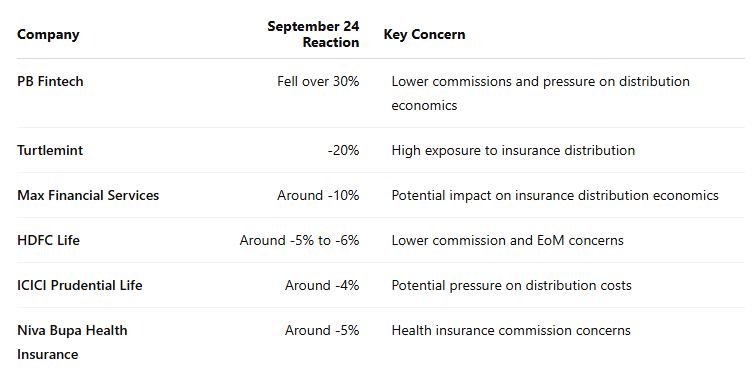
Market reports showed PB Fintech falling more than 30% during the September 24 session, while Turtlemint hit its 20% lower circuit. Max Financial Services also declined around 10%, while HDFC Life and ICICI Prudential Life faced significant selling pressure.
PB Fintech emerged as the biggest focus because Policybazaar operates as a large digital insurance marketplace and its economics are closely linked to insurance distribution. Analysts have warned that lower commission rates could put pressure on its earnings model. Jefferies estimated that a 10% reduction in new-business commission rates could translate into a 10–12% earnings decline for PB Fintech and Turtlemint.
Turtlemint also faced significant pressure because of its insurance distribution exposure. Its shares fell 20% to the lower circuit following the announcement.
Max Financial Services, HDFC Life and ICICI Prudential Life were also affected as investors assessed the potential impact of tighter distribution costs and commission structures on insurers’ business economics.
The impact is not limited to insurance companies. Banks and NBFCs that generate meaningful fee income through insurance distribution could also face pressure if commissions on bancassurance and loan-linked insurance decline.
How Could the Proposal Change Insurance Distribution?
The proposed rules could change the way insurance companies and intermediaries approach customer acquisition.
Historically, distributors have relied on commissions, incentives and other payments to build sales networks. If these payouts are reduced or capped, companies may have to focus more heavily on digital acquisition, renewals, customer retention and operating efficiency.
The proposal is particularly relevant to bancassurance. IRDAI has highlighted significant differences in distributor payouts across bank-insurer arrangements. It has also raised concerns around insurance being bundled with loans, particularly where customers may have limited choice in selecting an insurer.
The proposed framework could therefore affect banks and NBFCs alongside insurers and brokers.
Another major focus is transparency. IRDAI has proposed greater disclosure around distributor remuneration and stronger safeguards against practices known as “dark patterns” on digital insurance platforms. These measures are intended to make it easier for customers to understand insurance pricing, distribution and product choices.
IRDAI has also proposed greater use of digital infrastructure such as the Public Insurance Registry and Market Infrastructure Institutions to improve comparison, portability and access to insurance.
From a long-term perspective, the proposals could encourage a transition towards a more transparent and potentially more cost-efficient insurance distribution ecosystem. However, for companies currently dependent on high distributor payouts, the transition could create near-term challenges.
What Should Investors Watch Next?
The biggest question now is not simply whether insurance commissions will fall, but what the final regulatory framework will look like.
IRDAI has opened the consultation process until October 25, 2026. Stakeholders including insurers, brokers, agents, banks, NBFCs and digital platforms can submit their feedback before the regulator finalises the framework.
Investors should closely track the following developments:
Final commission caps: The final limits across life, health, motor and other insurance products will determine the direct impact on distributors.
Transition period: A longer implementation period could allow companies to gradually adjust their business models and cost structures.
New-business volumes: If commission income declines, investors will need to see whether higher policy volumes can offset lower revenue per policy.
Renewal economics: Renewal commissions and customer retention could become increasingly important as companies look for more stable revenue streams.
Bancassurance impact: Banks and NBFCs with meaningful insurance-related fee income could see changes in their revenue mix if loan-linked insurance and distribution commissions are restricted.
Digital distribution: Companies with scalable technology and lower customer acquisition costs may increasingly focus on digital-led distribution and direct customer relationships.
The market reaction has already highlighted the sensitivity of financial stocks to changes in insurance distribution economics. PB Fintech’s record single-day decline and Turtlemint’s 20% fall showed how quickly regulatory proposals can be reflected in valuations.
At the same time, investors should avoid treating the September 24 sell-off as the final measure of the proposals’ financial impact. The consultation process is still underway, and the eventual regulations could differ materially from the current draft.
For the insurance industry, IRDAI’s proposal represents a potential shift from a commission-driven distribution model towards greater cost discipline, transparency and customer-centric distribution. For investors, the focus will now move from the initial market reaction to how companies adapt to the proposed changes.
The next few weeks could therefore remain important for PB Fintech, Turtlemint, insurers, banks and NBFCs with insurance distribution exposure, as the industry responds to one of the most significant proposed changes to insurance distribution economics in recent years.
Lingo of the Week: Expense of Management (EoM)
EoM refers to the overall expenses an insurance company incurs to run its business, including distribution costs, commissions, operating expenses and other related costs.
Under IRDAI’s latest proposal, EoM limits could be tightened gradually, with life insurers moving towards 15% within two years and 12.5% within five years, while general insurers could move towards 25% and 20%, respectively.
In simple words: EoM tells investors how much of an insurer’s premium income is being spent on running and distributing the business.
Why it matters: Lower EoM limits could push insurers to improve cost efficiency and rethink their distribution models.
Pocketful isn’t just another trading platform - we’re your partners on the journey to financial freedom.
Thank you for reading!
👀 Stay tuned. Stay diversified.
Until next time,
Team Pocketful.
Follow Us: Website
Download Our App: Available on Google Play & Apple App Store