

What happens when the company that transformed how India accesses the internet decides to enter the stock market?
From making mobile data affordable to building one of the country’s largest digital ecosystems, Jio has reshaped India’s telecom landscape. Now, its upcoming IPO is drawing attention from investors eager to understand the next chapter of its growth story.
But Jio is no longer just about cheaper data and mobile connectivity. With ambitions spanning 5G, home broadband, enterprise technology, artificial intelligence and satellite connectivity, the company is positioning itself for a much bigger role in India’s digital future.
For investors, the opportunity goes beyond the excitement surrounding a high-profile listing. The real question is whether Jio’s massive customer base, expanding digital services and future growth ambitions can justify its valuation.
Is Jio’s IPO a chance to participate in India’s next digital growth story, or will its valuation leave investors with little room for error? Let’s break down the opportunity, the numbers and the risks.
Free Data to a Digital Empire
When Jio entered India’s telecom market in 2016, it disrupted an industry built around expensive data plans and voice charges. Affordable connectivity changed consumer behaviour, pushed competitors to rethink their pricing and accelerated India’s digital adoption.
Today, Jio is much more than a mobile network operator. Its business spans mobile connectivity, home broadband, digital entertainment, enterprise solutions and emerging technology services.
By June 30, 2026, Jio had approximately 533.3 million subscribers and accounted for around 60% of India’s data traffic, according to its IPO disclosures reported by Reuters.
That scale gives the company a significant advantage. Its existing network and customer relationships provide a platform to offer additional services, from broadband and entertainment to cloud-based solutions and AI-enabled products.
However, scale alone does not guarantee superior returns. The real test is whether Jio can turn its reach into sustainable revenue growth, higher profitability and stronger cash generation.
Jio IPO: The Numbers to Know
Before the subscription window opens, here are the key details investors should understand.
IPO size: Approximately ₹30,213 crore.
Price band: ₹1,065-₹1,119 per share.
Subscription dates: October 21–23, 2026.
Issue structure: Fresh issue of approximately 27 crore equity shares.
Implied valuation: Around ₹10.3 lakh crore at the upper price band.
Minimum retail application: One lot of 12 shares, requiring ₹13,428 at the upper price band.
Anchor investor bidding: Scheduled for October 19, 2026.
The offering is structured as a fresh issue, meaning the company will issue new shares rather than simply allowing existing shareholders to sell their holdings through an offer for sale. The final allocation and listing details should be checked against the official red herring prospectus.
At the upper end of the price band, Jio’s implied valuation is approximately $108 billion. That puts the IPO among the largest and most closely watched listings in Indian market history.
Where Will the IPO Money Go?
A major question surrounding any IPO is what the company intends to do with the funds it raises.
Jio Platforms plans to use up to ₹27,500 crore of the proceeds to repay or prepay borrowings at Reliance Jio Infocomm, its telecom operating subsidiary. The remaining amount is intended for general corporate purposes, including capital expenditure.
Reducing borrowings could help ease financing costs and strengthen the operating subsidiary’s balance sheet. At the same time, continued investment will be necessary to expand network capacity, develop digital services and support new technology initiatives.
For investors, the important distinction is that the IPO is not simply a fundraising event for a new business. It is also an opportunity to assess the value of an established digital ecosystem and its future investment requirements.

The Growth Story: What Comes After Telecom?
Jio’s next phase could depend on how effectively it expands beyond connectivity.
1. Home broadband and digital services
As more households adopt connected devices and digital entertainment, broadband and bundled services could create opportunities for recurring revenue. Jio can use its existing customer relationships to cross-sell additional products, although competition and pricing will influence profitability.
2. Enterprise and cloud computing
Businesses increasingly require cloud infrastructure, secure connectivity and digital tools. Jio’s network and technology investments could help it serve enterprises looking to modernise their operations.
3. Artificial intelligence
AI could create new opportunities in enterprise services, automation and digital applications. However, building AI capabilities also requires investment, and the commercial value will depend on customer adoption, pricing and returns on that spending.
4. A connected digital ecosystem
The broader opportunity lies in connecting mobile services, broadband, entertainment and business solutions. If customers use multiple Jio services, the company could deepen engagement and increase revenue per customer.
These opportunities make Jio’s story bigger than telecom. But each requires execution, capital and a clear path to profitable growth.
Meta, Google and the Global Investor Connection
Jio’s growth story has already attracted major international technology investors.
Meta and Google invested in Jio Platforms in 2020, alongside other global investors, as Reliance sought to expand its digital business. Their participation helped establish Jio as a company with ambitions beyond traditional telecommunications.
These investments also highlight the strategic importance of India’s digital economy.
However, the presence of well-known investors should not replace independent analysis. Their investment decisions were made at different times and under different terms. Public market investors must evaluate the IPO price, current financial performance, business risks and future growth prospects on their own merits.
A strong investor list can build confidence, but it cannot guarantee listing gains or future share-price performance.
The Valuation Question: Is Jio Worth ₹10 Lakh Crore?
This is where the IPO becomes particularly interesting.
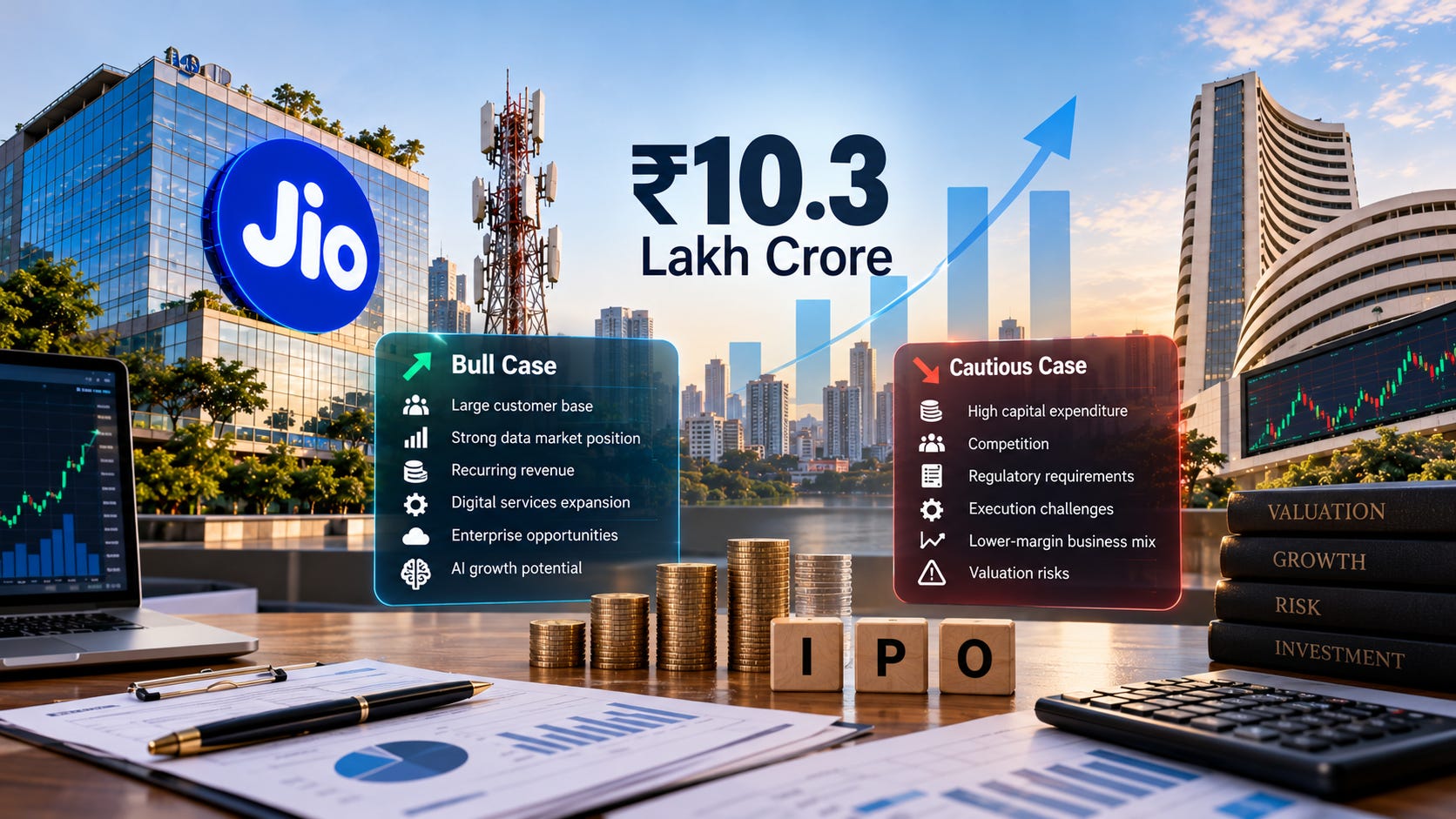
A valuation of approximately ₹10.3 lakh crore places Jio among India’s largest companies by market capitalisation. Investors will need to assess whether its earnings, growth potential and competitive position justify that price.
The bull case rests on Jio’s enormous customer base, strong position in India’s data market, recurring connectivity revenue and opportunities in digital services, enterprise technology and AI.
The cautious case focuses on capital expenditure, competition, regulatory requirements and the challenge of converting a large user base into higher-margin revenue.
Investors should examine revenue growth, operating margins, cash flows, debt at the relevant business entities and the valuation multiples implied by the offer price.
The most important question is not whether Jio is a successful company. It is whether the price investors pay adequately reflects its future growth and risks.
What Could Go Wrong?
Even a market-leading business faces risks.
Competition: Bharti Airtel and Vodafone Idea remain important competitors in telecom, while other technology providers compete in digital and enterprise services. Competitive pricing can affect margins.
Regulation and data privacy: Telecom rules, spectrum requirements and data-protection regulations may influence how Jio operates and monetises digital services.
High investment requirements: Network expansion, cloud infrastructure and AI capabilities require substantial spending. Returns may take time to materialise.
Valuation risk: A large, popular IPO can attract significant demand, but high expectations may limit future returns if growth falls short of what investors anticipate.
Market conditions: Overall market sentiment, liquidity and investor appetite for large offerings can influence subscription demand and listing performance.
These risks do not automatically weaken the investment case. They show why investors should examine both the opportunity and the price at which it is being offered.
Investor Takeaway: Opportunity or Hype?
Jio’s IPO represents a major moment for India’s capital markets. It gives public market investors an opportunity to evaluate a business that has played a central role in the country’s digital transformation.
Its scale, customer reach and expansion opportunities make the offering worth studying. But a large IPO is not automatically a good investment, and strong demand does not guarantee attractive long-term returns.
Before applying, investors should read the red herring prospectus, understand the use of proceeds, assess the company’s financials and compare its valuation with relevant listed businesses.
The real opportunity lies in Jio’s ability to move from being a dominant connectivity provider to a profitable, diversified digital platform.
The bottom line: Jio has already changed how India connects. The next challenge is proving how much that connectivity is worth to shareholders.
Lingo of the Week: Fresh Issue
Definition: A fresh issue is an IPO in which a company creates and sells new shares to raise capital.
In simple words: The money raised from newly issued shares goes to the company, subject to the stated use of proceeds.
Example: Jio Platforms plans to issue approximately 27 crore new shares as part of its IPO.
Why it matters: A fresh issue increases the number of shares outstanding and can dilute existing shareholders’ ownership percentage. Investors should also examine how the company plans to use the funds.
Pocketful isn’t just another trading platform - we’re your partners on the journey to financial freedom.
Thank you for reading!
👀 Stay tuned. Stay diversified.
Until next time,
Team Pocketful.
Follow Us: Website
Download Our App: Available on Google Play & Apple App Store