

🏢 Sectoral Performance
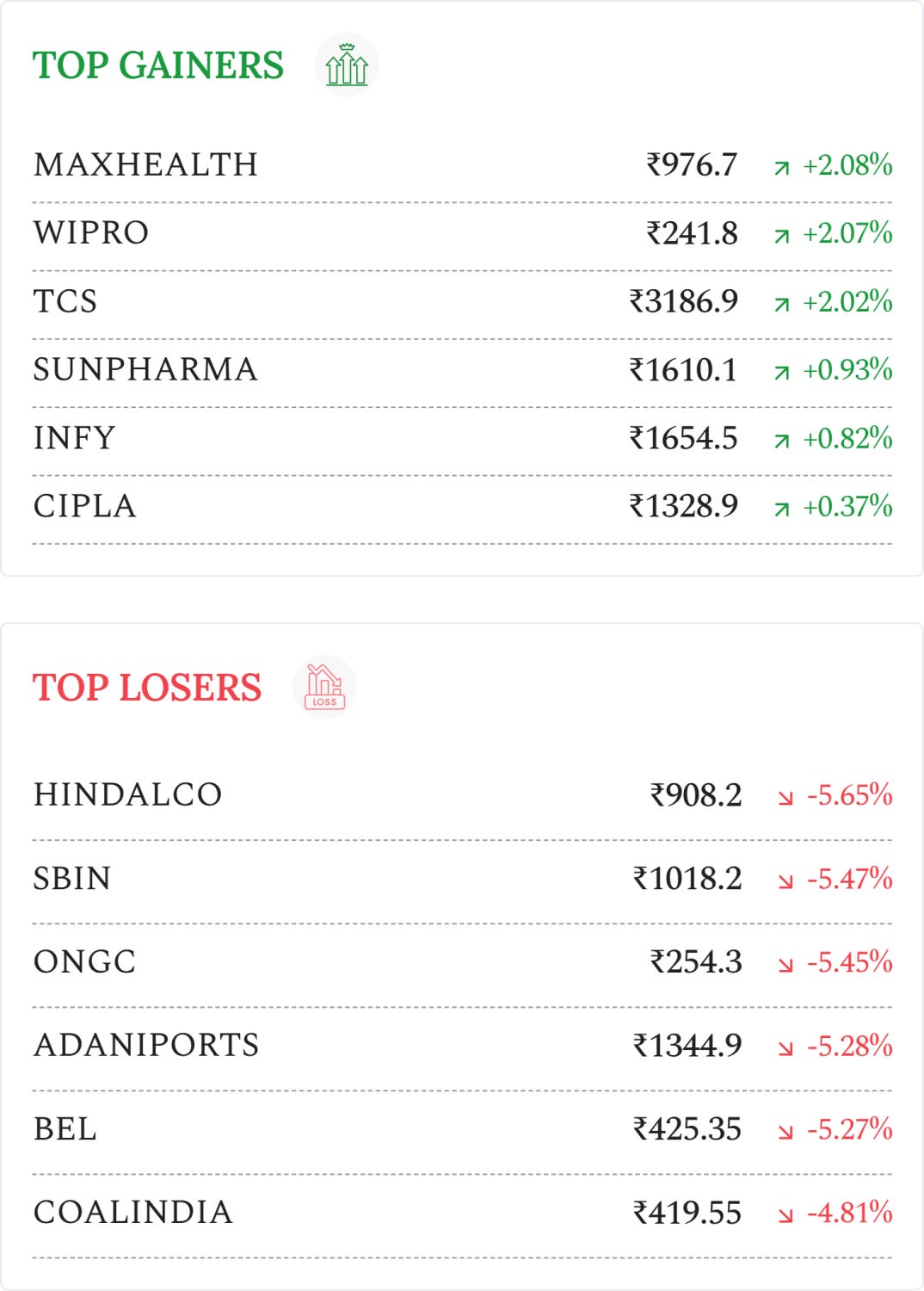
IT | Nifty IT (+0.57%): The index advanced today with 7 gainers and 3 loser, supported by selective buying in tech stocks after Budget 2026 tax incentives for IT and cloud services.
PSU Bank | Nifty PSU Bank (-5.57%): The index fell sharply during the Budget Session with 0 gainers and 12 draggers as investors grappled with concerns around merger plans and rising government borrowing.
Defence | Nifty India Defence(-5.09%): The index ended lower on the Budget Day with 17 out of 18 Stocks in the red and only 1 stock MTAR Tech ended green as Budget 2026 misses expectations on capex outlay.
Metal | Nifty Metal (-4.05%): The index moved lower today with 13 stocks ended in the red and 2 ended in green as the metals segment faced sharp correction on renewed commodity weakness and profit booking after recent gains.
🔍 Market Insights
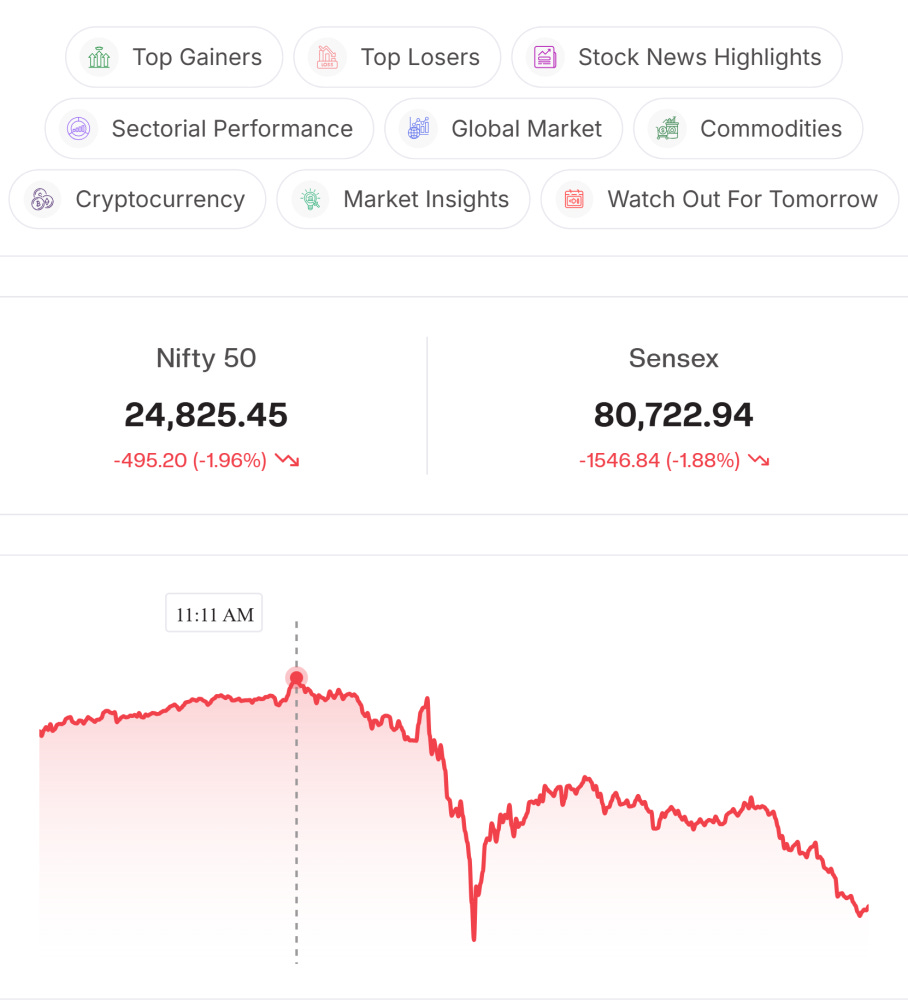
Technical Level: Today’s NIFTY session turned decisively bearish, with strong supply near 25,330–25,350 and recovery capped around 25,100–25,120. The breakdown below 24,900 accelerated selling, making it a key resistance, while 24,750–24,770 remains immediate support and 24,600–24,650 a deeper downside zone. Volatility stayed elevated as markets reacted ahead of the Union Budget, which begins at 11 AM, a period typically marked by sharp swings and fast intraday moves.
Advance-Decline Ratio: Market breadth remained negative with 1,057 advances against 2,073 declines, indicating broader buying interest despite selective selling pressure.
The Big Picture: OPEC+ is expected to keep its planned pause on oil output increases for March, sticking with a freeze on fresh production hikes amid worries over weaker seasonal demand and market stability. Brent crude prices have jumped toward six-month highs near $70 a barrel on geopolitical tensions and supply disruptions, even as delegates say no new policy beyond March is likely. The output pause reflects caution by major producers including Saudi Arabia and Russia.
FII/DII Activity (Jan 30, 2026): Market activity reflected mixed institutional flows, with DIIs selling ₹578 crore, while FIIs bought ₹2,478 crore, indicating selective domestic support amid cautious foreign participation.
Union Budget 2026–27: Key Highlights & Policy Direction
🌱 Growth Outlook & Fiscal Strategy
Government targets sustained economic growth of around 7% while maintaining macro stability.
Fiscal deficit for FY27 set at 4.3% of GDP, continuing gradual fiscal consolidation.
Debt-to-GDP ratio projected to ease to about 55.6%, improving long-term fiscal credibility.
Public capital expenditure raised to ₹12.2 lakh crore, reinforcing infrastructure-led growth.
🛡️ Defence & Strategic Preparedness
Defence allocation increased sharply to ₹7.85 lakh crore, marking over 15% growth year-on-year.
Focus on military modernisation, domestic defence manufacturing, and force readiness.
Higher capital outlay expected to benefit indigenous weapons, equipment, and defence PSU ecosystem.
🏭 Manufacturing, Industrial Policy & Strategic Sectors
Targeted policy support extended to seven priority sectors: semiconductors, biopharma, electronics, textiles, chemicals, capital goods, and allied industries.
Biopharma SHAKTI launched with ₹10,000 crore to position India as a global biologics hub.
India Semiconductor Mission 2.0 announced, expanding scope to equipment, materials, and Indian IP development.
Electronics Components Scheme outlay raised to ₹40,000 crore to deepen domestic value addition.
Dedicated Rare Earth Corridors planned in Odisha, Kerala, Andhra Pradesh, and Tamil Nadu.
₹10,000 crore Container Manufacturing Scheme introduced to strengthen logistics self-reliance.
Around 200 legacy industrial clusters to be upgraded with modern infrastructure and technology.
🧵 Textiles, MSMEs & Employment Creation
Integrated Textile Growth Programme to support the full value chain, including fibres, handlooms, skilling, and sustainability.
Mega Textile Parks to be developed through a competitive, challenge-based selection process.
₹10,000 crore SME Growth Fund announced to nurture high-potential “Champion MSMEs.”
Additional ₹2,000 crore allocated to the Self-Reliant India Fund for micro enterprises.
Mandatory TReDS usage for CPSE procurement from MSMEs to ease working capital stress.
Push to develop a secondary market for MSME receivables to improve liquidity.
🚆 Railways & Infrastructure Push
Record railway capital expenditure of approximately ₹2.93 lakh crore announced for FY27.
Seven new high-speed rail corridors proposed to reduce travel time and connect major economic hubs.
Key routes include Mumbai–Pune, Delhi–Varanasi, Chennai–Bengaluru, and Hyderabad–Bengaluru.
Infrastructure Risk Guarantee Fund to be created to crowd in private sector participation.
CPSE real estate monetisation to be accelerated through REIT structures.
20 new National Waterways announced; coastal shipping cargo share targeted to reach 12% by 2047.
City Economic Regions (CERs) planned for Tier II and III cities with ₹5,000 crore per region over five years.
⚡ Energy Transition & Climate Action
₹20,000 crore allocated for Carbon Capture, Utilisation and Storage (CCUS) projects.
Customs duty exemptions for nuclear power, lithium-ion battery storage, and solar glass inputs.
Promotion of biogas-blended CNG through excise duty relief to support cleaner fuels.
🏦 Financial Sector & Capital Markets
High-Level Committee on Banking for Viksit Bharat to review structural banking reforms.
Restructuring of PFC and REC to strengthen infrastructure-focused PSU NBFCs.
Introduction of market-making frameworks and total return swaps for corporate bonds.
Incentives announced to promote large municipal bond issuances.
Securities Transaction Tax (STT) on F&O increased to curb excessive speculation.
👩🎓 Education, Skills & Services Economy
Education-to-Employment Standing Committee to align skills with industry demand.
Target to achieve 10% share in global services exports by 2047.
One lakh additional seats planned for allied health professional training.
Medical Value Tourism Hubs to be developed across five regions.
New institutes announced for AYUSH, animal husbandry, and design education.
University townships planned near industrial corridors to integrate learning with employment.
Girls’ hostels to be established in every district for STEM institutions.
🌾 Agriculture, Rural Development & Inclusion
Bharat-VISTAAR launched as an AI-powered, multilingual advisory platform for farmers.
Special programmes for coconut, cocoa, cashew, sandalwood, and nut cultivation.
SHE-Marts to support scaling of women-led rural enterprises.
Dedicated schemes for Divyangjan skilling, assistive devices, and livelihood support.
Expansion of mental health institutes and trauma care infrastructure.
🧾 Direct Taxes, Customs & Trade
Income Tax Act, 2025 to come into effect from 1 April 2026 with simplified compliance
Interest on MACT compensation made tax-free.
TCS under LRS reduced to 2% for education, medical, and foreign travel.
Time limit for revising tax returns extended to 31 March.
One-time foreign asset disclosure scheme introduced for small taxpayers.
MAT reduced to 14% and made final; buyback taxation shifted to capital gains.
Customs duty rationalisation to support Make-in-India and exporters.
Courier export cap of ₹10 lakh removed to boost e-commerce exports.
Faster clearances under trust-based customs and expanded AEO benefits.
Overall, Budget 2026–27 reinforces India’s growth story through infrastructure scale-up, defence readiness, manufacturing depth, and human capital development—while maintaining a steady path of fiscal discipline.
👀 Stay tuned. Stay diversified.
Until next time,
Team Pocketful.