


Michael Burry has long occupied a rare place in finance, a figure defined by his willingness to confront consensus and trust only the numbers. He rose to prominence by identifying the 2007 mortgage bubble long before it burst, enduring years of criticism and doubt as he accumulated credit default swaps that seemed foolish to everyone but him. His eventual vindication was spectacular and cemented his status as an investor who sees what others miss.
Now, almost two decades later, Burry finds himself once again in conflict with a market gripped by optimism. The deregistration of his firm, along with his public comments and positions, suggests he believes another systemic unraveling may be forming beneath the surface. The question hanging over Wall Street is whether he has walked away out of exhaustion or is stepping aside strategically before the system cracks again.
How a Contrarian Was Forged
Burry’s career began far from Wall Street. Originally trained as a medical doctor, he spent nights posting his investment analyses online, gradually attracting readers who recognized his extraordinary ability to detect patterns others overlooked. He founded Scion Capital in 2000, navigating the dot-com collapse with discipline and skepticism while outperforming the broader market.
His defining moment emerged in the early 2000s as he immersed himself in mortgage datasets, loan agreements, and bond structures. What he found was a rot spreading through the housing market. Lenders were approving mortgages with virtually no verification, rating agencies were rubber-stamping dangerous securities as AAA, and Wall Street was packaging subprime loans into products that looked safe but were fundamentally unstable. Burry saw that the entire edifice would collapse once adjustable rates reset and defaults surged.
By 2005 he began buying credit default swaps against mortgage bonds, absorbing immense negative carry while the market continued rising. Investors doubted him, partners challenged him, and the pain of early losses was real. Yet the data remained undeniable. When the market finally cracked in 2007 and the global financial crisis erupted, Burry’s conviction produced one of the most iconic trades in history. His fund soared as the housing market collapsed, transforming him from an outlier into a legend.
The Bet Against AI and His Exit
In 2025, Burry issued warnings of a different kind. Instead of subprime mortgages, he argued that the new bubble lay within artificial intelligence infrastructure and the accounting used to justify record-high tech valuations. To translate his thesis into action, Scion Asset Management disclosed $1.1 billion in put options against the sector’s crown jewels: $912 million against Palantir and $187 million against Nvidia, representing roughly 80% of the fund’s portfolio by Q3 2025. He highlighted how major firms were extending the useful lives of data-center equipment, inflating earnings through depreciation manipulation even as chip cycles grew shorter, creating more than $170 billion in artificial profits and supporting trillions in market capitalization.
In October 2025, Burry shocked the financial world by announcing that Scion Asset Management would liquidate and return investor capital. His statement that the market’s assessment of value had “diverged from my judgment” echoed his earlier frustrations from 2006 but carried a different fatigue. The deregistration of Scion days later meant the firm was no longer required to file reports with regulators, removing the transparency that had allowed analysts to track his positions. Observers interpreted the move as either a retreat from public scrutiny or a prelude to a quieter, more flexible investment approach.
On social media, Burry added a cryptic signal. Posting a still of Christian Bale lying on the floor as him in The Big Short, Burry wrote, “Me then, me now. It worked out. It will work out.” For many, this was not just nostalgia. It was a warning.
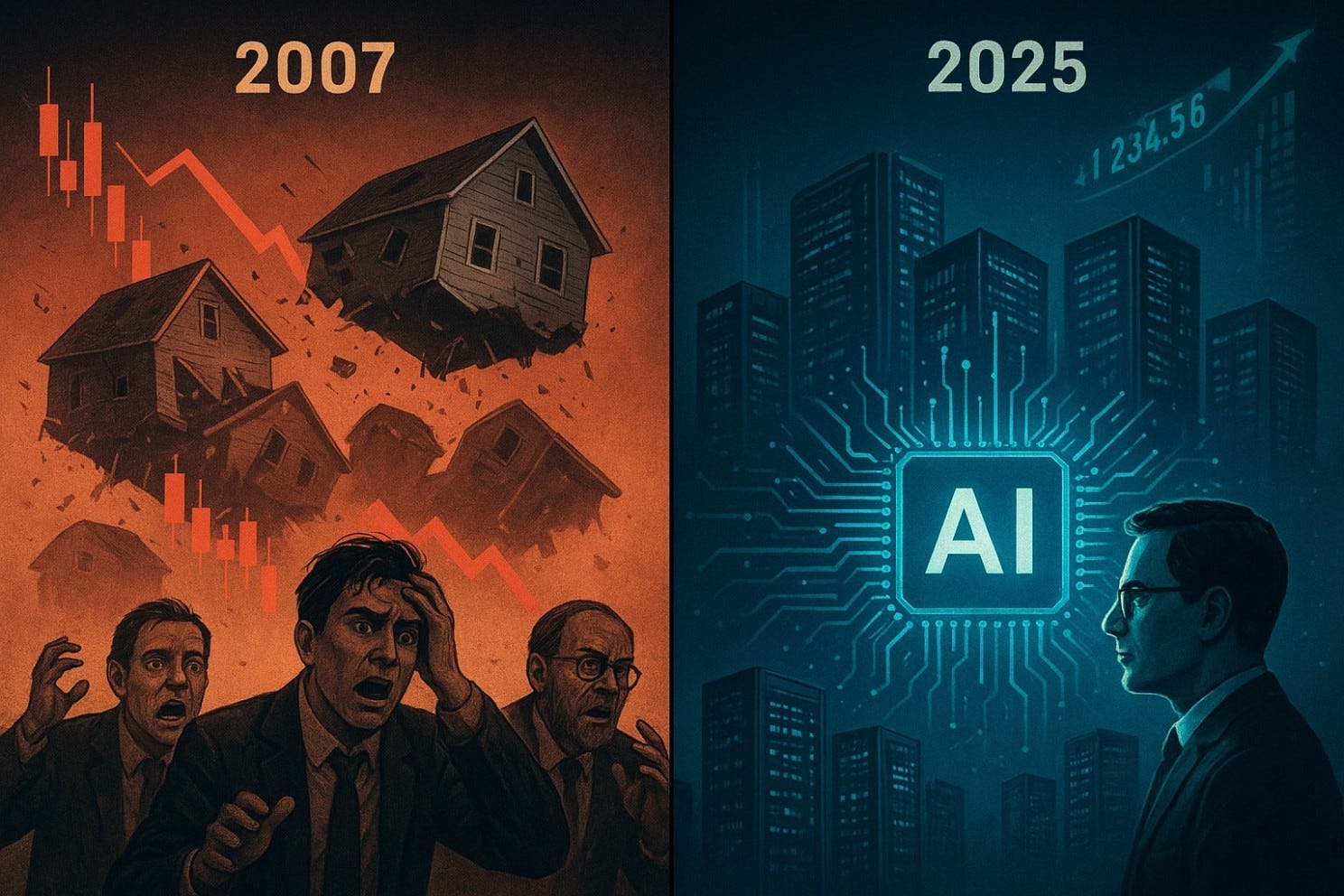
Echoes of 2007 in 2025
The similarities between the two eras are striking. In both cases Burry identified a market that had become irrational in its optimism. In both cases he studied fundamentals that contradicted the prevailing narrative. And in both cases he endured losses and criticism while waiting for reality to reassert itself.
During the housing boom, investors refused to believe that home prices could fall nationwide. Today, investors refuse to believe that AI spending could be over-built or that profits inflated by accounting choices might eventually come under pressure. In 2006, Burry paid painful premiums on swaps that initially looked like dead trades. In 2025, he paid the psychological price of watching his shorts move against him day after day. Once again he is confronting the same dilemma: being right too early can feel indistinguishable from being wrong.
The emotional and financial strain of negative carry looms over both stories. In 2007 the reckoning took years to arrive. In 2025 the market is repeating the pattern of celebrating growth while dismissing fundamental concerns. Burry appears unwilling to endure the same multi-year torture again, opting instead to step aside and let time reveal what the numbers already suggest.
Signs of Caution: Buffett and Central Banks
While Burry’s exit drew attention, he wasn’t the only heavyweight signaling caution. Warren Buffett has also shifted defensively, with Berkshire Hathaway’s cash reserves climbing to a record $381.7 billion in Q3 2025—despite operating earnings jumping 34%. Across insurance, rail, utilities, and manufacturing, the underlying businesses remained strong, yet Buffett refrained from repurchasing Berkshire shares for a fifth straight quarter, even as the stock fell nearly 12% following his announcement that he would step down as CEO by year-end. His decision to sell $6.1 billion in equities while allowing cash to build sent a quiet but unmistakable message: attractive valuations are becoming increasingly scarce.
Yet the most revealing signal comes from central banks, which have been buying gold at historic levels. Between 2022 and 2025 they accumulated more than one thousand tonnes per year, behavior typically associated with preparing for systemic risk. Gold’s surge toward four thousand dollars an ounce reflects this institutional shift away from traditional reserve assets. Central banks do not buy gold to speculate; they buy it when confidence in the monetary system itself is weakening.
Together these moves form a constellation of clues. Burry warns of inflated tech valuations. Buffett runs to cash. Central banks convert reserves into gold. Each action is discrete. Together they resemble a quiet vote that the cycle is nearing exhaustion.
The Road Ahead
The question now is whether Burry will be proven right again, and if so, when. Bubbles do not burst on schedules. They snap when confidence collapses or when cash flows can no longer sustain the illusion of growth. Tech today sits atop unprecedented spending, stretched valuations, and accounting that flatters earnings. For now, enthusiasm dominates reality, just as it did before 2007.
Could Burry be early? Almost certainly. Could he be wrong? It is possible. But markets are showing signs of fatigue, with AI expenditures far outpacing measurable returns. The gap between promise and profitability continues to widen. Historically such gaps close suddenly and violently.
Burry may have stepped back, but his reasoning lingers. The deregistration of his firm may signal exhaustion, or it may signal preparation. Either way, the structure he has outlined cannot support itself indefinitely. The only questions are how long the market can defy fundamentals and whether this time he will choose to profit quietly, privately, and without public scrutiny.
Lingo of the Week: Negative Carry
Negative carry refers to the ongoing cost of holding a position while waiting for it to pay off. Burry experienced severe negative carry in 2006 and 2007 while paying credit default swap premiums as housing continued rising. Those losses tested his conviction and nearly his solvency. In 2025 he faces the psychological version of the same phenomenon. Negative carry is the hidden tax that punishes investors who are early, even when they are ultimately right.
Pocketful isn’t just another trading platform - we’re your partners on the journey to financial freedom.
Thank you for reading!
👀 Stay tuned. Stay diversified.
Until next time,
Team Pocketful.
Follow Us: Website
Download Our App: Available on Google Play & Apple App Store
We should focus on using Cycle Indicators and make money month by month (like we do in my community), rather than trying to predict AI bubble (which everyone can agree on)