


India’s Shift: From Chip Consumer to Chip Builder
For decades, India was one of the world’s largest consumers of semiconductor chips but produced none of them domestically. Every smartphone, car system, telecom device, and computer relied on chips manufactured overseas.
India imported nearly $50 billion worth of semiconductors each year, making the country heavily dependent on global supply chains. When the global chip shortage hit in 2021, the vulnerability became obvious. Electronics prices rose, automobile production slowed, and supply chains were disrupted.
That moment triggered a major shift in policy.
India launched the Semiconductor Mission, committing around ₹76,000 crore in incentives to build a domestic semiconductor ecosystem. Fast forward to 2026, and the strategy is beginning to show real results.
More than 10 semiconductor projects worth ₹1.6 lakh crore have now been approved across six Indian states. Several of these facilities are already operational or entering pilot production.
India is no longer just discussing semiconductor manufacturing it is actively building it.
The First Wave: Micron and Kaynes
The first major milestone came in February 2026, when India’s first large semiconductor facility began operations.
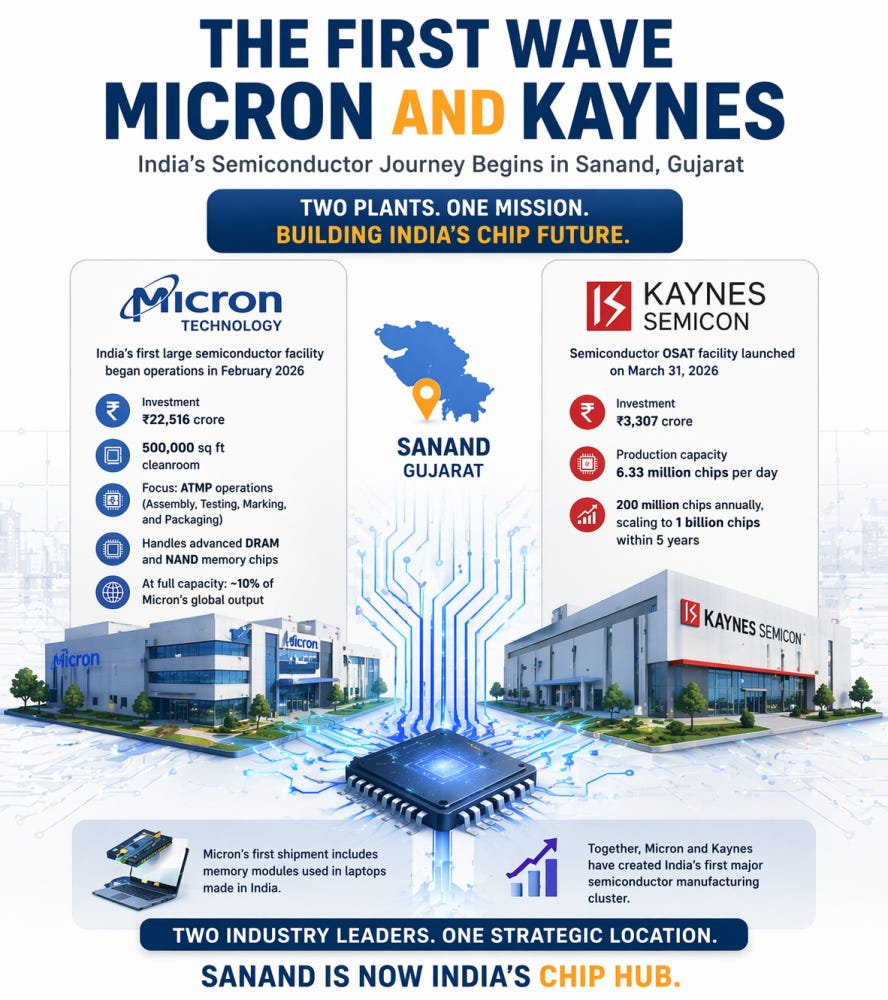
The plant was built by Micron Technology in Sanand, Gujarat, with an investment of ₹22,516 crore. This facility focuses on ATMP operations Assembly, Testing, Marking, and Packaging.
Instead of manufacturing raw silicon wafers, the plant processes finished wafers and converts them into packaged semiconductor chips ready for devices such as laptops and data centers.
The Micron plant features a 500,000 square-foot cleanroom, built in just 14 months. The facility will handle advanced DRAM and NAND memory chips, widely used in computing and artificial intelligence systems.
In 2026, the plant is expected to produce tens of millions of chips, with production scaling to hundreds of millions annually by 2027. At full capacity, the facility could contribute around 10% of Micron’s global output.
The first shipment from the plant already included memory modules used in laptops manufactured in India.
Just weeks later, another semiconductor plant joined the cluster.
On March 31, 2026, Kaynes Semicon launched its semiconductor OSAT facility, also located in Sanand. The project required an investment of ₹3,307 crore and is designed to produce 6.33 million chips per day.
Annual production is expected to reach 200 million chips, with plans to scale to 1 billion chips within five years.
Together, the Micron and Kaynes plants have transformed Sanand into India’s first major semiconductor manufacturing cluster.
The Quiet Expansion: CG Power
While Micron and Kaynes grabbed headlines, another player has been expanding more quietly.
CG Power began a pilot semiconductor program earlier and is expected to transition into commercial operations in 2026.
This facility forms part of the broader four-plant semiconductor rollout planned for 2026.
The focus remains on backend semiconductor operations—assembly, testing, and packaging—which are faster to deploy and require lower capital compared to full fabrication plants.
This strategy allows India to rapidly enter the semiconductor supply chain while preparing for the more complex stage of wafer fabrication.
Together, Micron, Kaynes, and CG Power aim to support India’s growing semiconductor demand, which currently stands around $45 billion annually and could rise to $110 billion by 2030.
Tata’s Big Bet: Assam and Dholera
While backend facilities are important, the most ambitious semiconductor investment in India comes from Tata Electronics.
The Tata Group is building two major semiconductor facilities—one in Assam and another in Dholera, Gujarat.
The Assam plant is an OSAT facility with an investment of ₹27,000 crore. Once operational, it is expected to produce 48 million chips per day.
Pilot production is expected in mid-2026, with full commercial operations planned by December 2026.
This plant will strengthen India’s chip packaging capabilities and support electronics manufacturing across the country.
However, the most significant project is the Tata-PSMC semiconductor fabrication plant in Dholera.
This project is a joint venture between Tata Electronics and Taiwan’s Powerchip Semiconductor Manufacturing Corporation (PSMC). The fab involves an investment of approximately ₹91,526 crore, making it one of the largest technology projects in India.
The facility will produce 50,000 wafers per month, using semiconductor technologies between 28nm and 110nm nodes.
These chips will be used across industries including:
Smartphones
Automotive electronics
Artificial intelligence systems
Industrial machinery
Construction began in 2024, pilot production is expected in 2027, and full-scale operations could begin in 2028.
Once operational, this plant will represent India’s first large-scale semiconductor fabrication facility.
New Entrants: HCL–Foxconn and Emerging Projects
India’s semiconductor ambitions extend beyond a few major companies.
Another major project is being developed through a joint venture between HCL Group and Foxconn. The facility will be located in Jewar, Uttar Pradesh, near the upcoming international airport.
The project involves an investment exceeding ₹25,000 crore and aims to produce around 20,000 wafers per month, translating to roughly 36 million chips monthly once operational.
The foundation stone for this project was laid in February 2026.
Several other semiconductor projects are also progressing across India.
One example is V Sundar (Del) Pvt Ltd, which is building a semiconductor unit in Uttar Pradesh with an investment of ₹3,706 crore.
Another project in Odisha focuses on compound semiconductors, used in electric vehicles, defense electronics, and solar technologies.
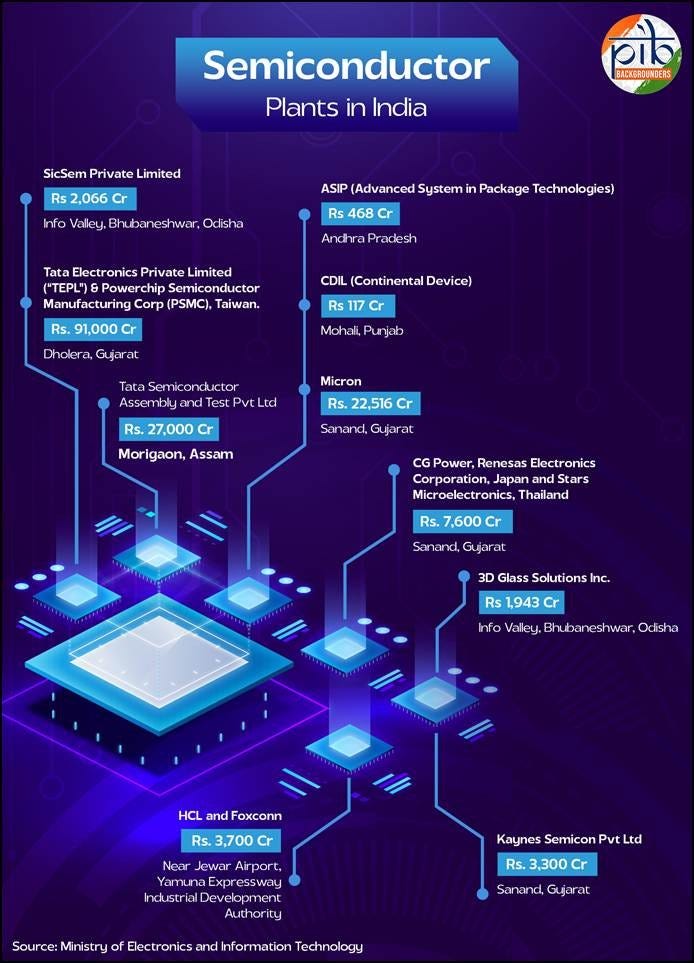
Overall, India has approved 10 semiconductor projects across six states, creating a geographically diverse semiconductor ecosystem.
The distribution currently looks like this:
Gujarat: Micron, Kaynes, Tata-PSMC
Uttar Pradesh: HCL-Foxconn, V Sundar
Assam: Tata OSAT facility
Odisha: Compound semiconductor plant
These projects together represent ₹1.6 lakh crore in investments.
The Numbers Behind India’s Chip Ambitions
The scale of India’s semiconductor push becomes clearer when looking at the numbers.
Total semiconductor investments approved so far stand at approximately ₹1.6 lakh crore.
The government is supporting these projects through incentives covering up to 50% of capital expenditure under the Semiconductor Mission.
Several plants already have defined production capacities.
The Micron Sanand facility could contribute up to 10% of Micron’s global production once fully operational.
Kaynes Technology plans to produce 6.33 million chips per day, scaling to 1 billion chips annually over time.
The Tata Assam plant aims for 48 million chips per day.
The Tata-PSMC Dholera fabrication plant will produce 50,000 wafers per month.
Meanwhile, the HCL-Foxconn facility is expected to manufacture around 20,000 wafers per month.
These projects will also generate significant employment.
Industry estimates suggest around 50,000 direct jobs and several hundred thousand indirect jobs across the semiconductor supply chain.
India is also investing in training programs expected to develop over 85,000 semiconductor engineers in the coming years.
The Bigger Picture: India’s Semiconductor Future
Semiconductors are often called the “brains of modern technology.”
From smartphones and electric vehicles to artificial intelligence and defense systems, chips power nearly every modern device.
India’s semiconductor market is currently valued at roughly $38 billion, and analysts expect it to grow to over $110 billion by 2030.
Developing domestic manufacturing capabilities will help India reduce dependence on imports, strengthen supply chain resilience, and support high-tech industries.
More importantly, semiconductor manufacturing has a powerful multiplier effect. A single chip plant can stimulate investments in chemicals, equipment manufacturing, logistics, research institutions, and engineering talent.
Countries such as Taiwan, South Korea, and Israel built their semiconductor industries over decades.
India is now attempting to accelerate that process through policy incentives, international partnerships, and domestic industrial investment.
The progress made in just a few years suggests that the strategy is gaining momentum.
Sanand’s semiconductor cluster is already active. Assam’s facility is preparing for production. New fabs are rising in Gujarat. Additional projects are emerging in Uttar Pradesh and Odisha.
The shift is clear.
India is no longer just assembling electronics it is beginning to manufacture the technology that powers them.
Lingo of the Week: ATMP, OSAT & Fab
Semiconductor manufacturing has three key stages. ATMP (Assembly, Test, Mark, Package) converts finished wafers into usable chips. OSAT companies specialize in outsourced chip assembly and testing, like the Kaynes facility. Fab (Fabrication Plant) is where chips are actually created from silicon wafers—such as the upcoming Tata-PSMC semiconductor fab in Dholera.
Pocketful isn’t just another trading platform - we’re your partners on the journey to financial freedom.
Thank you for reading!
👀 Stay tuned. Stay diversified.
Until next time,
Team Pocketful.
Follow Us: Website
Download Our App: Available on Google Play & Apple App Store