


India’s biggest exchange is about to enter the stock market and its listing could change the way investors value its biggest rival.
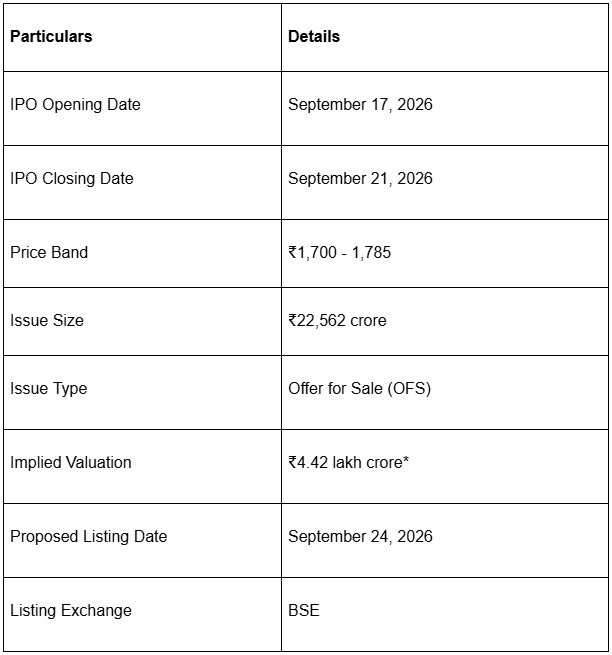
NSE’s much-awaited IPO opens on September 17, with a price band of ₹1,700-₹1,785 and a proposed listing on September 24. At the upper end, the exchange could command a valuation of around ₹4.42 lakh crore. But the bigger story may be what happens to BSE once NSE gets its own market price.
BSE shares have already fallen more than 3% after NSE announced its IPO price band, bringing the valuation gap between the two exchanges into sharper focus. With NSE soon becoming publicly traded, investors will have a direct benchmark to compare the exchanges on profitability, market share, trading volumes and valuations.
So, as NSE heads for the market, the question is: could its IPO reshape the valuation narrative for BSE and India’s broader exchange industry?
NSE IPO: The Numbers Behind the Listing
NSE’s IPO will comprise an offer for sale of approximately 12.64 crore existing shares, priced in the ₹1,700-₹1,785 range. At the upper end, the issue is expected to raise around ₹22,562 crore, giving NSE an implied valuation of approximately ₹4.42 lakh crore.
Since the issue is completely an OFS, the proceeds will go to existing shareholders rather than NSE. Among the selling shareholders are institutions such as State Bank of India, Canada Pension Plan Investment Board and other investors. The size of the offering was also reduced from the earlier proposal, with the number of shares being offered cut by more than 15%.
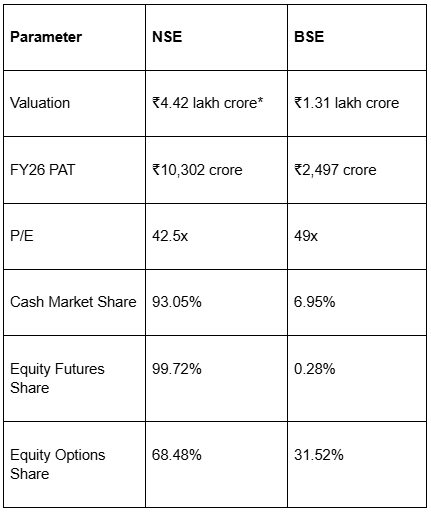
The IPO is significant not only because of its size but also because of the scale of the business behind it. NSE remains India’s dominant exchange by trading activity, particularly in derivatives. Its market share stands at around 93.05% in the cash market, 99.72% in equity futures and 68.48% in equity options, according to Financial Express.
Another notable feature is where the shares will list. NSE’s own shares are expected to list on BSE, creating an unusual situation in which one stock exchange will host the public-market debut of its biggest rival.
Why NSE’s IPO Matters for BSE
NSE becoming publicly listed changes the competitive landscape for BSE in one important way: investors will now have a direct market price for NSE.
Until now, BSE has effectively been the only major listed Indian exchange through which investors could gain direct exposure to the exchange business. NSE’s listing will introduce another publicly traded benchmark and allow investors to compare the two businesses using market-based valuations.
This is already influencing market sentiment. BSE shares declined more than 3% on September 11 after NSE announced its IPO price band. While a single-day move cannot be attributed entirely to one factor, the timing has brought the valuation gap between the two exchanges into sharper focus.
The comparison is particularly interesting because NSE is substantially larger in terms of profitability and trading dominance. Moneycontrol reported that, at the IPO valuation, NSE would be worth roughly 3.2 times BSE’s market capitalisation, while its FY26 profit after tax was more than four times that of BSE.
This could lead to a more detailed market assessment of what investors are actually paying for an exchange business - its market share, trading volumes, profitability, technology, product mix and future growth potential.
NSE vs BSE: The Valuation Gap Comes Into Focus
The most important consequence of NSE’s listing could be the creation of a direct valuation benchmark.
Based on the IPO valuation, NSE’s market capitalisation is around ₹4.42 lakh crore, compared with roughly ₹1.31 lakh crore for BSE. At the same time, Moneycontrol puts NSE’s FY26 PAT at approximately ₹10,302 crore, compared with around ₹2,497 crore for BSE.
That means NSE is considerably larger in both valuation and earnings. However, the comparison becomes more nuanced when looking at valuation multiples. Moneycontrol reported an implied P/E of around 42.5 times for NSE, against approximately 49 times for BSE.
This is where NSE’s listing could become particularly relevant for BSE.
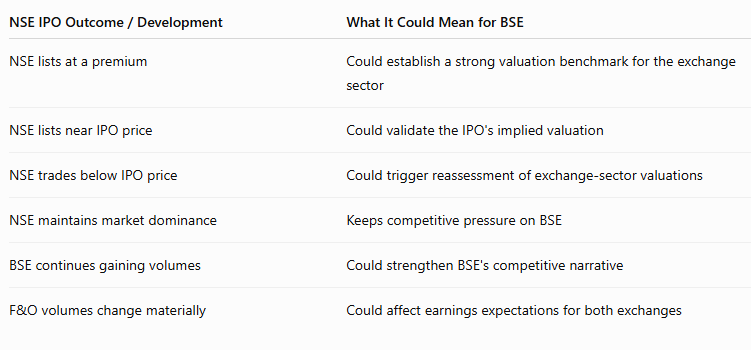
If NSE lists at or around its IPO valuation and subsequently trades at a premium, investors could view that as confirmation of the higher value being placed on NSE’s market leadership and earnings base. If the stock trades below the IPO valuation, however, it could raise questions about how much investors are willing to pay for exchange businesses amid changing trading patterns and regulations.
For BSE, this creates a new reference point. Its valuation will increasingly be viewed not in isolation, but alongside NSE’s publicly traded valuation.
Source: Moneycontrol and Financial Express.
Market Share and the Business Model Difference
The valuation comparison cannot be understood without looking at market share.
NSE has a commanding position in India’s equity and derivatives markets. Its reported market share of more than 93% in cash equities and almost 100% in equity futures highlights the scale of its trading ecosystem. Its strong position in options is also an important contributor to revenue.
BSE, meanwhile, has strengthened its position in recent years, particularly through growth in equity derivatives and increased trading activity. This makes the NSE IPO more than just a valuation event; it could bring greater attention to how the two exchanges compete for volumes and products.
However, NSE also faces an important question around its dependence on derivatives. Regulatory changes have affected options trading activity, while tighter rules around retail participation and derivatives have influenced market volumes. Reuters reported that NSE’s diversification into other businesses could gradually reduce the share of revenue coming from weekly options.
This makes the post-listing comparison more interesting. Investors will not only compare how much each exchange earns today, but also how sustainable those earnings are under changing market regulations and trading behaviour.

Could NSE’s Listing Create a New Benchmark for BSE?
The biggest potential impact on BSE may not come from investors switching directly from one stock to another. Instead, it could come from a change in the way the entire exchange sector is valued.
Once NSE is listed, investors can compare the two exchanges on several parameters: earnings growth, P/E multiples, market share, trading volumes, derivatives exposure, technology investments and revenue diversification.
For example, if NSE commands a higher valuation multiple after listing because of its dominant market share and stronger earnings, the market could use that premium as a benchmark when assessing BSE. On the other hand, if NSE trades at a lower multiple than expected, the same comparison could put pressure on valuations across the sector.
There is also an important distinction between market leadership and growth potential. NSE currently has a much larger profit base, but BSE’s smaller base means changes in volumes or market share can have a meaningful effect on its earnings growth.
Therefore, the NSE IPO does not necessarily represent a straightforward positive or negative event for BSE. Instead, it introduces a new price discovery mechanism for the Indian exchange industry.
The market will have to determine whether NSE deserves a significant premium because of its scale and dominance, or whether the changing regulatory environment limits the valuation investors are willing to assign to the exchange business.
What to Watch After NSE Lists
The NSE listing will provide several data points that could shape the market’s view of both exchanges.
The first will be NSE’s listing price compared with its ₹1,785 upper IPO band. A strong premium or discount could immediately influence how investors interpret the IPO valuation.
The second will be the NSE-BSE valuation spread. Once both companies are publicly traded, changes in their P/E multiples and market capitalisations will become much easier to track.
The third will be market-share trends. NSE’s current dominance gives it a significant advantage, but BSE’s ability to gain volumes in selected segments remains an important part of the competitive picture.
The fourth will be derivatives activity and regulation. Since derivatives remain an important source of exchange revenue, changes in options volumes, regulatory rules and retail participation could influence earnings expectations for both exchanges.
Finally, investors will watch whether NSE’s public listing changes the competitive dynamics of India’s exchange industry. With NSE becoming publicly traded and its shares listing on BSE, the relationship between the two exchanges will become more visible to the market than ever before.
The NSE IPO, therefore, is more than another large market debut. It could mark the beginning of a new phase in which NSE and BSE are continuously compared on valuation, profitability, market share and growth. The real story for BSE may emerge not on the day NSE lists, but in how the market values both exchanges in the months that follow.
Lingo of the Week: Price Discovery
Price discovery is the process through which the market determines the fair price of a stock based on demand and supply. With NSE becoming publicly listed, its market price will provide a real-time benchmark for comparing its valuation with BSE and understanding how investors value the exchange business.
Pocketful isn’t just another trading platform - we’re your partners on the journey to financial freedom.
Thank you for reading!
👀 Stay tuned. Stay diversified.
Until next time,
Team Pocketful.
Follow Us: Website
Download Our App: Available on Google Play & Apple App Store