

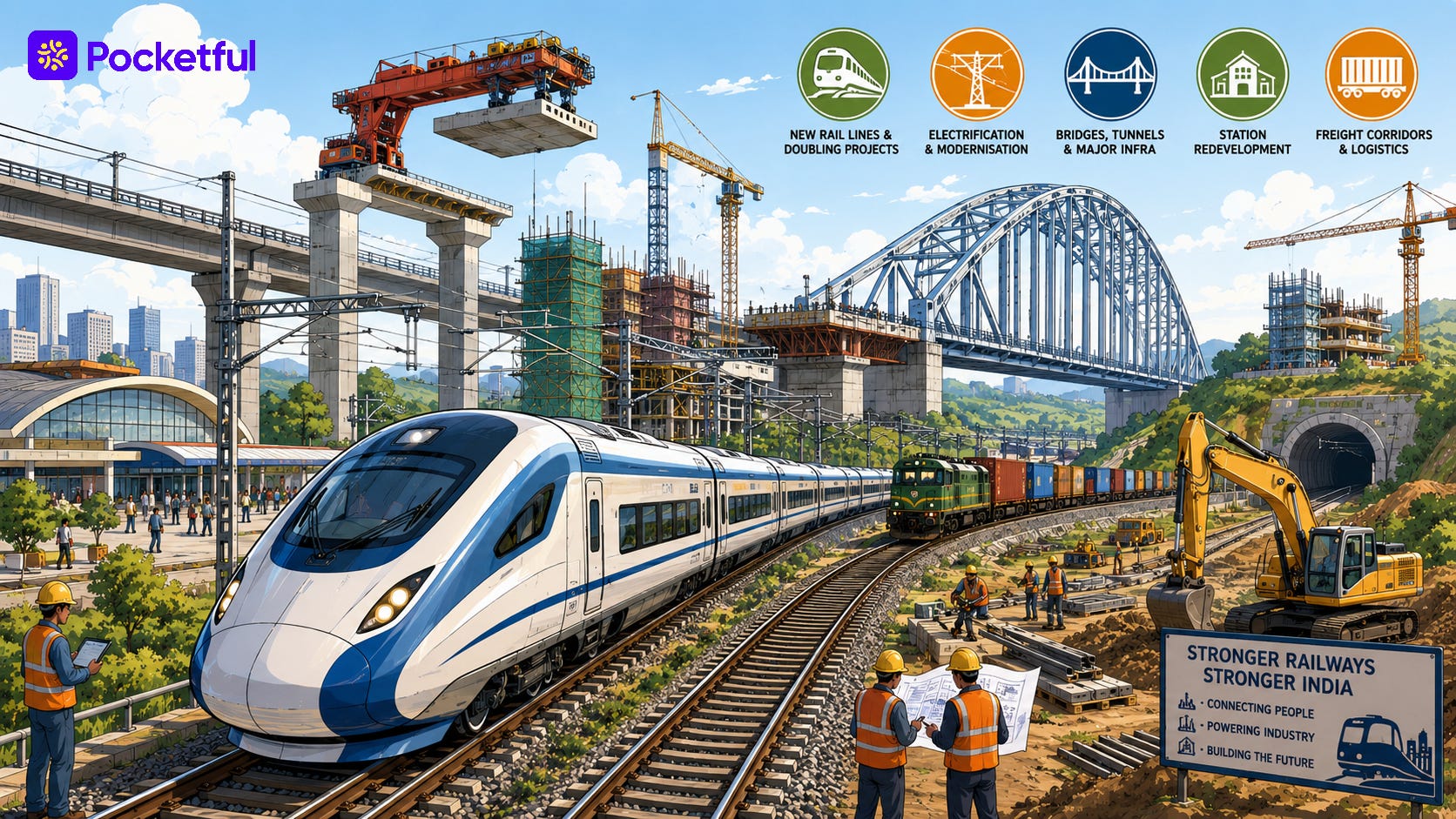
Imagine boarding a train today and comparing it with one from a decade ago. The difference is not just the train, it is the infrastructure underneath it. Tracks are being electrified, freight corridors are expanding, stations are being modernised and faster trains are connecting major cities.
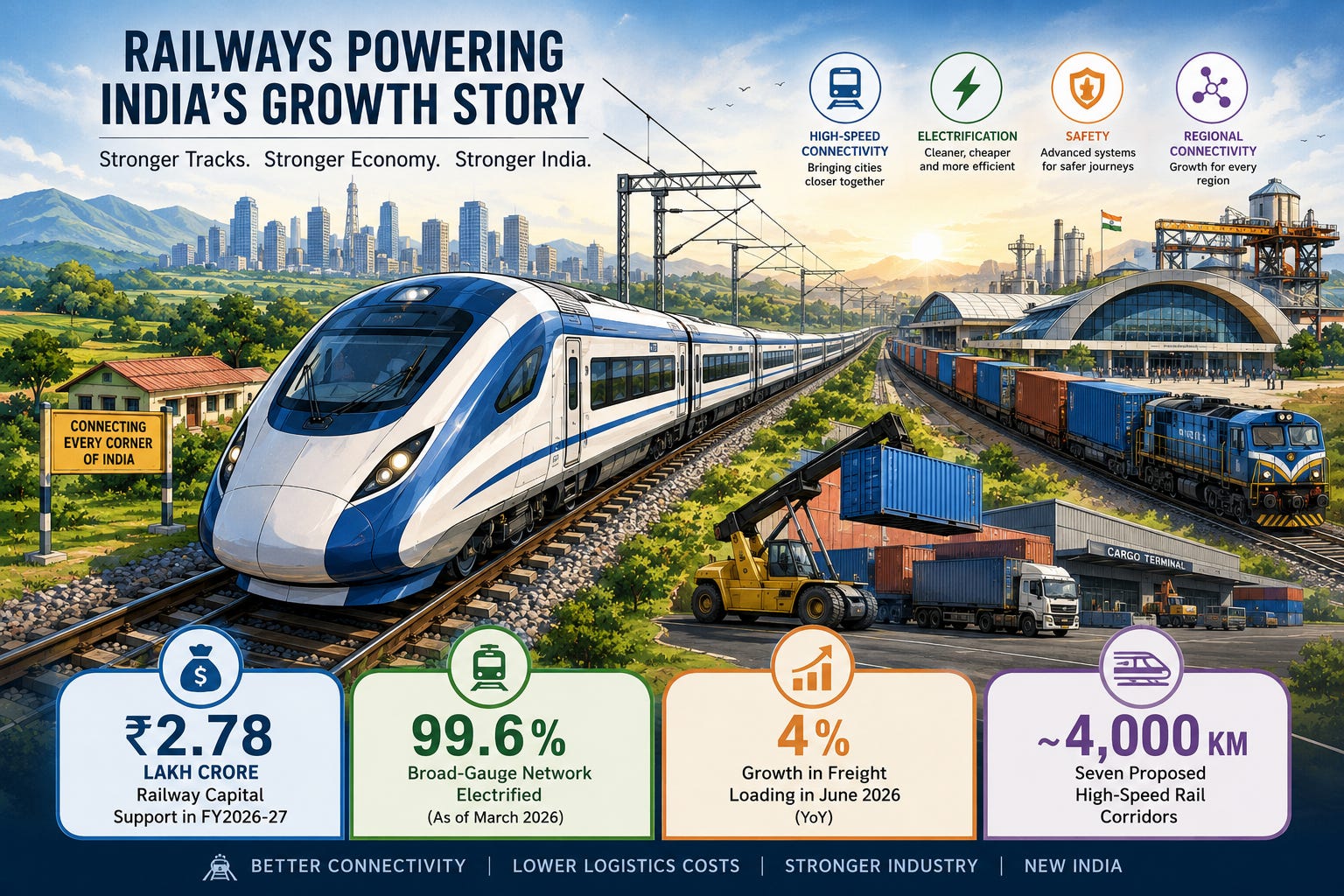
But the bigger story is happening behind the scenes. In FY2026-27, Indian Railways has received a record ₹2.78 lakh crore in Gross Budgetary Support for capital investment, while almost the entire broad-gauge network has already been electrified. At the same time, freight volumes are rising, new high-speed corridors are being planned and private investment is entering railway-linked logistics.
For investors, this raises an important question: Is India’s railway expansion creating a new long-term infrastructure opportunity?
India’s Railway Expansion Is Entering a New Phase
Indian Railways is no longer just a transportation network; it is increasingly becoming an important part of India’s broader infrastructure and logistics strategy.
The government has significantly increased capital support for Railways. Gross Budgetary Support for railway capital investment has risen from ₹29,055 crore in FY2013-14 to ₹2.78 lakh crore in FY2026-27. The 2026-27 allocation includes ₹79,072 crore for construction of new tracks, highlighting the focus on expanding capacity.
At the same time, Railways is focusing on removing bottlenecks on heavily used routes, improving freight movement and expanding connectivity to remote regions.
Key Railway Capex Data
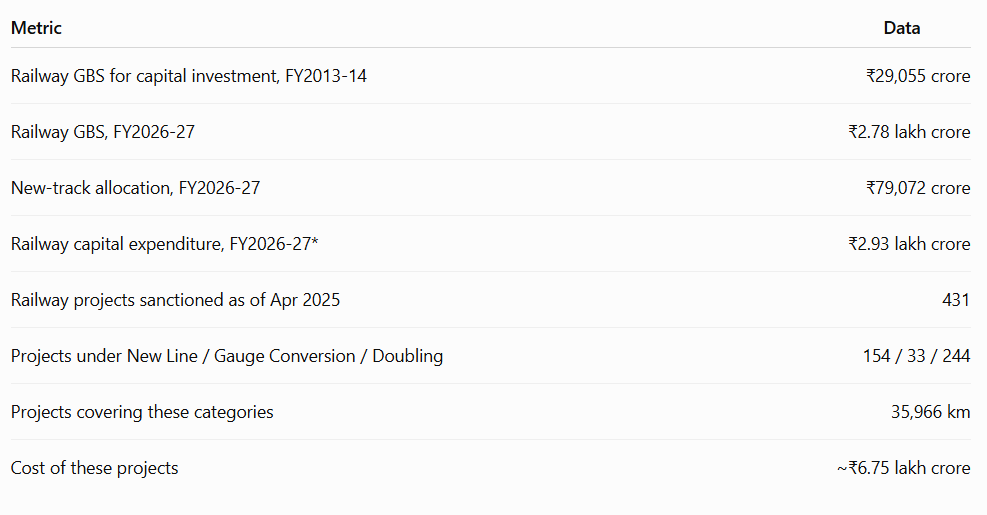
The scale shows why railway expansion is increasingly being viewed as an infrastructure investment cycle, rather than simply a transportation programme.
Electrification - India Is Almost There
One of the biggest transformations has happened quietly beneath the headlines: railway electrification.
Before 2014, only around 20% of India’s railway network was electrified. By March 2026, 69,873 route kilometres had been electrified, covering 99.6% of the 70,142-km broad-gauge network.
Railway Electrification Journey
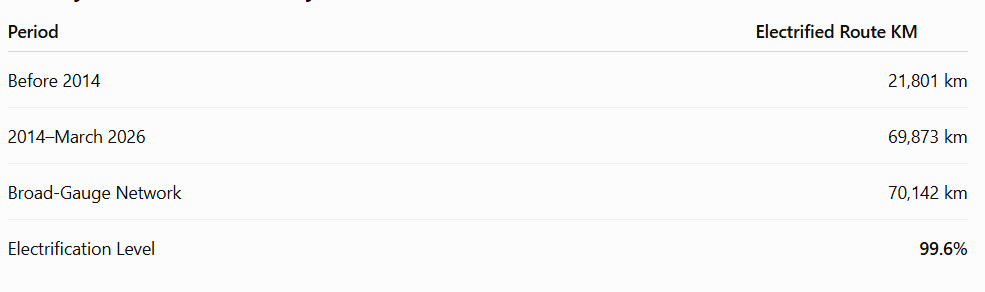
The impact goes beyond reducing diesel usage. PIB reported that electrification helped save approximately 180 crore litres of diesel in 2024-25, while electric traction is estimated to be around 70% more economical than diesel traction.
Diesel consumption for railway traction fell from 293 crore litres in 2015-16 to 108 crore litres in 2024-25, according to the Ministry of Railways.
This makes electrification important not only from an environmental perspective but also from an operating-cost and energy-security perspective.
From More Tracks to Faster Trains
The next stage of expansion is about capacity and speed.
Indian Railways has been adding new lines, doubling existing routes and upgrading busy corridors. Between 2014 and February 2026, around 54,600 km of tracks were renewed, while the network capable of supporting speeds of 110 kmph and above expanded significantly.
The government has also approved seven high-speed rail corridors under the 2026-27 Budget, including routes such as Mumbai-Pune, Hyderabad-Bengaluru, Chennai-Bengaluru, Delhi-Varanasi and Varanasi-Siliguri.
Major Transformation Areas
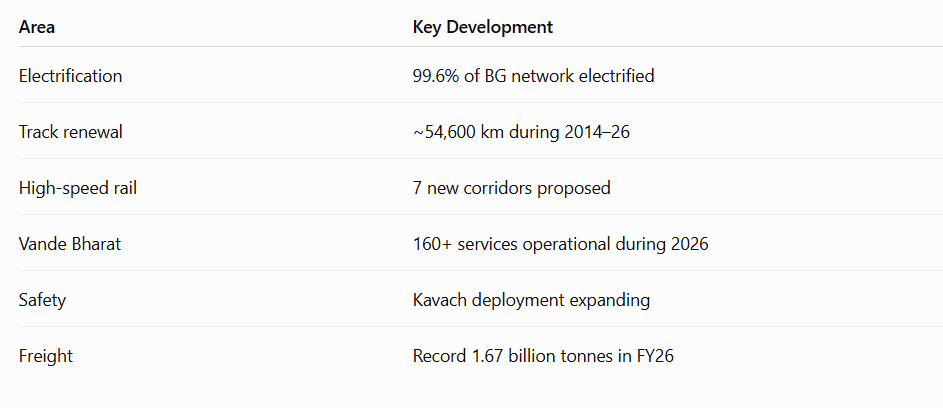
The latest operating data also remains encouraging. In June 2026, Railways carried 142 million tonnes of freight, registering 4% growth year-on-year. First-quarter FY2026-27 freight loading crossed 419 million tonnes. Fertiliser loading grew 19.1%, while iron ore and coal movement also increased.
Dedicated Freight Corridors, additional railway lines and port connectivity can further improve the movement of bulk commodities.
For the economy, this can mean lower logistics costs, faster cargo movement and better connectivity between manufacturing centres, mines, ports and markets.
Where Could Investors Find Opportunities?
The railway capex cycle does not benefit only one type of company.
A railway project can create demand for engineering and construction, wagons, locomotives, signalling, electrical equipment, financing and digital infrastructure.
Railway Investment Ecosystem
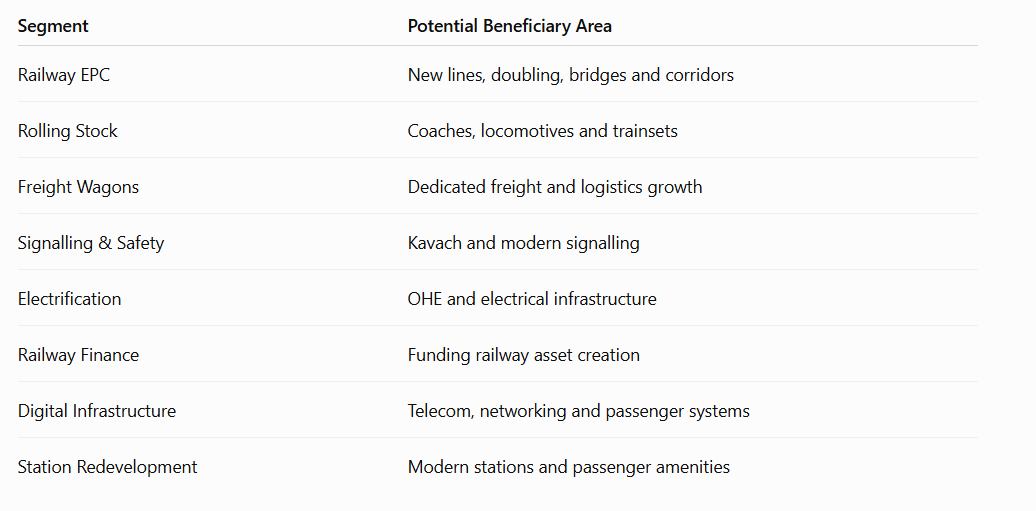
IBEF estimates India’s freight wagon market could almost double by 2031 to around ₹25,000-30,000 crore, driven by exports, technology upgrades and procurement.
Companies frequently associated with the railway investment theme include RVNL, IRCON International, IRFC, RailTel, Titagarh Rail Systems, Jupiter Wagons and Texmaco Rail, among others. Equitymaster’s railway-stock research has also highlighted companies such as IRFC, Texmaco Rail, IRCON and RVNL in the context of railway order books.
However, a large order book alone does not guarantee shareholder returns. Investors should also examine order execution, margins, working capital, debt, cash flows and valuations.
The Bigger Picture - Railway Capex and India’s Growth Story
The railway expansion story is ultimately bigger than railway stocks.
New railway lines can connect previously underserved regions with markets, jobs and essential services. Freight corridors can connect industrial centres to ports more efficiently. Electrification can reduce dependence on diesel. High-speed rail can shorten travel times between major economic centres.
A recent railway expansion programme approved around 6,000 km of new railway expansion in FY2025-26, with investment of about ₹1.53 lakh crore, according to the Ministry of Railways. More than 35 projects exceeded ₹1,000 crore, including major line-capacity projects such as Kasara-Manmad, Kharsia-Naya Raipur-Parmalkasa, Itarsi-Nagpur and Secunderabad-Wadi.
The government has also linked several projects with the Mission 3000 MT objective to increase cargo capacity, while railway projects in tribal and remote areas are intended to improve access to markets, healthcare, education and employment.
Investor Takeaway
India’s railway story is gradually moving from “building more railways” to “building a faster, cleaner, safer and more efficient railway ecosystem.”
The numbers tell the story:
99.6% electrification + ₹2.78 lakh crore railway capital support + 1.67 billion tonnes of FY26 freight + seven proposed high-speed corridors + continued track and capacity expansion.
For investors, this creates a long-duration infrastructure theme, but the opportunity should be evaluated company by company. Government capex can create demand, but execution, profitability and valuation ultimately determine whether that demand translates into shareholder value.
In short: India is not simply laying more tracks it is building the infrastructure for the next phase of economic growth.
Lingo of the Week: Capital Expenditure (Capex)
Capital Expenditure (Capex) refers to money spent by a company or government to build, upgrade or acquire long-term assets such as railway tracks, factories, roads, machinery and infrastructure.
In simple words: Capex is spending today to create assets that support growth for years to come.
Example: Indian Railways allocating ₹2.78 lakh crore for capital investment in FY2026-27 is a major example of government capex.
Pocketful isn’t just another trading platform - we’re your partners on the journey to financial freedom.
Thank you for reading!
👀 Stay tuned. Stay diversified.
Until next time,
Team Pocketful.
Follow Us: Website
Download Our App: Available on Google Play & Apple App Store