

This week, the Indian rupee came under strong pressure and touched record lows against the U.S. dollar before recovering slightly. The major trigger was a rise in global uncertainty and elevated crude oil prices, which increased India’s import bill and boosted demand for dollars. Since India imports a large share of its energy needs, higher oil prices typically weaken the rupee and increase inflation risks across the economy.
For investors and businesses, a weaker rupee means imported goods become costlier, overseas travel expenses rise, and inflation concerns start building.
RBI’s Response: Defending the Rupee Without Raising Interest Rates
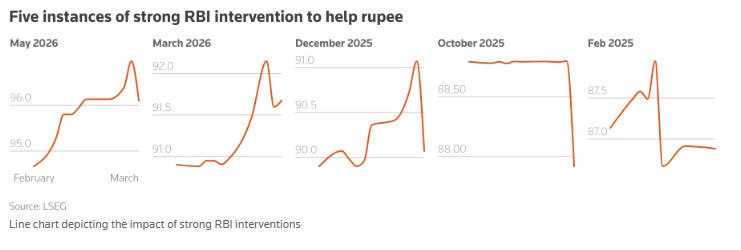
As the rupee weakened sharply, the Reserve Bank of India (RBI) took immediate action in the foreign exchange market. Reports suggest the central bank sold billions of dollars, with market participants estimating an intervention of nearly $2 - 3 billion within a short period. This proactive step helped the rupee recover from record lows and move back below the psychological 97-per-dollar mark.
What made this move particularly interesting was not just the intervention itself but the broader message it conveyed. Instead of relying on traditional monetary tools, such as increasing interest rates, RBI chose to use its foreign exchange reserves and liquidity management tools to stabilize the currency.
By doing so, RBI demonstrated that it is capable of managing short-term currency volatility without immediately altering borrowing costs for households and businesses. The decision indicates that the central bank considers the rupee’s current weakness to be a market-driven shock rather than a structural problem requiring drastic monetary tightening.
This approach has multiple advantages. Firstly, it stabilizes the currency in the short term, calming markets and investors. Secondly, it avoids unnecessary disruptions to domestic economic growth that could result from sudden rate hikes. And thirdly, it signals to global investors that India is prepared to actively manage currency volatility while remaining committed to a measured policy framework.
Why RBI Does Not Want Rate Hikes Right Now
Amid the rupee’s decline, speculation grew in markets that RBI could increase interest rates to defend the currency. Historically, higher interest rates can attract foreign capital, strengthen a currency, and manage capital outflows.
However, reports suggest RBI currently does not view rate hikes as the preferred solution. The central bank’s focus remains on managing inflation and supporting domestic growth, rather than defending a specific exchange rate level.
Why avoid rate hikes? The reasons are multi-fold:
Increased borrowing costs: Higher rates make loans for businesses and households more expensive.
Slower investment activity: Companies may delay expansion or capital expenditure due to higher financing costs.
Impact on economic growth momentum: Sudden rate hikes can slow consumption and industrial activity, which could dampen GDP growth.
Higher EMIs for consumers: Existing borrowers may face increased EMI burdens, reducing disposable income.
RBI’s current stance suggests a nuanced approach: currency stability is important, but not at the expense of domestic growth unless inflation risks become persistent. Temporary external shocks, such as elevated oil prices or dollar demand, do not automatically justify broad-based monetary tightening.
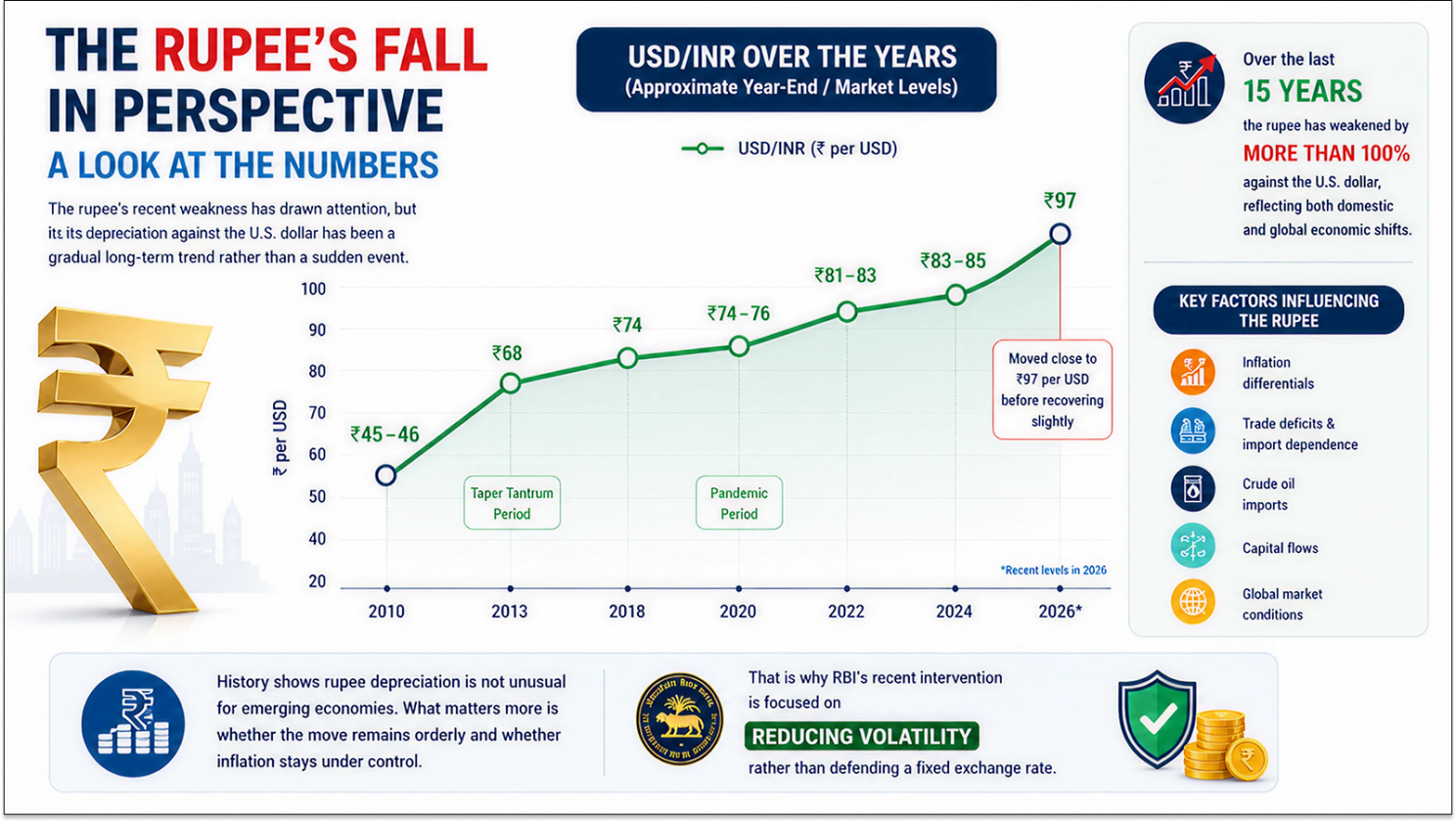
The Rupee’s Fall in Perspective - A Look at the Numbers
The rupee’s recent weakness has drawn attention, but its depreciation against the U.S. dollar has been a gradual long-term trend rather than a sudden event. Exchange rates are influenced by inflation, trade deficits, crude oil imports, capital flows, and global market conditions.
Here’s how the rupee moved over the years (approximate year-end / market levels):
2010: ₹45 - 46 per USD
2013 (Taper Tantrum period): ₹68 per USD
2018: ₹74 per USD
2020 (Pandemic period): ₹74 - 76 per USD
2022: ₹81 - 83 per USD
2024: ₹83 - 85 per USD
Recent levels (2026): moved close to ₹97 per USD before recovering slightly
Over the last 15 years, the rupee has weakened by more than 100% against the U.S. dollar, reflecting both domestic and global economic shifts.
But history also shows that rupee depreciation is not unusual for emerging economies. What matters more is whether the move remains orderly and whether inflation stays under control. That is why RBI’s recent intervention is focused on reducing volatility rather than defending a fixed exchange rate.
The Bigger Battle: Inflation vs Currency Stability
Central banks often face a delicate balancing act. If they aggressively defend the currency, growth may slow down. On the other hand, if they ignore a weak currency, imported inflation could accelerate, putting pressure on households and businesses.
India’s current challenge lies in balancing these two forces. The rupee’s recent weakness is largely driven by external factors, including global crude oil prices and geopolitical uncertainty. Policymakers must decide whether to intervene in the short term or allow market forces to play out.
Recent commentary from RBI officials and policymakers suggests that temporary external shocks may not immediately warrant aggressive monetary action. However, if inflationary pressures become broad-based and persistent, the central bank may be forced to adjust policy to prevent sustained price increases across essential goods and services.
This explains why RBI appears to prefer targeted intervention using forex reserves over broad policy tightening. By intervening in currency markets, the central bank can calm volatility while giving the domestic economy time to absorb external shocks without hurting growth.
What Investors Should Watch in the Coming Weeks
The coming weeks will be crucial for investors and market participants. Several key indicators can help gauge the rupee’s trajectory and RBI’s potential responses:
Crude oil prices: As India imports most of its oil, any decline in global oil prices could ease pressure on the rupee and reduce import costs.
USD/INR exchange levels: Close monitoring of the exchange rate will indicate whether RBI interventions are sufficient to stabilize the currency.
Inflation trends: CPI and WPI data will reveal whether imported inflation is beginning to spill over into the broader economy.
RBI policy commentary: Statements from the central bank will signal whether more intervention or policy adjustments are expected.
Foreign investment flows: Inflows and outflows of foreign portfolio and direct investment can impact the rupee’s demand-supply balance.
If oil prices cool and global market sentiment improves, pressure on the rupee may ease naturally. However, if external stress continues, RBI may remain active in the forex markets. Reports indicate that the central bank has already increased the scale of dollar sales this financial year compared to previous periods, highlighting its proactive stance.
Investors should also consider sectoral impacts: export-oriented companies may benefit from a weaker rupee, while import-heavy sectors could face margin pressure. Monitoring these trends will provide insights into market sentiment and potential investment opportunities.
Final Take: RBI Is Sending a Clear Message
This week’s developments highlight RBI’s approach of separating short-term currency management from long-term interest rate policy.
Instead of reacting with immediate rate hikes, the central bank is signaling confidence in using targeted market intervention to calm volatility while keeping inflation and growth as primary policy considerations.
For markets, the takeaway is straightforward: RBI is defending stability not chasing a fixed rupee level. While the rupee may continue to experience fluctuations in the short term, the central bank’s interventions aim to ensure these movements do not translate into broader economic instability.
For investors, businesses, and households, the coming weeks will reveal whether RBI’s approach of using forex reserves and liquidity tools alone is sufficient to stabilize the rupee. If global oil prices stabilize and investor sentiment improves, the rupee may recover gradually. Conversely, prolonged external pressures could require further interventions.
In conclusion, RBI’s actions this week reflect a calibrated, cautious approach aimed at maintaining market stability while protecting domestic growth and keeping inflation in check. The message is clear: currency weakness is being managed intelligently, not punished with sudden rate hikes, and the central bank is committed to ensuring that short-term volatility does not derail India’s economic momentum.
Lingo of the Week: Forex Intervention
Forex Intervention is when a central bank enters the foreign exchange market and buys or sells foreign currency, usually US dollars to reduce sharp movements in its own currency.
In simple terms: RBI uses its reserves to calm excessive rupee volatility and maintain financial stability without immediately changing interest rates.
Pocketful isn’t just another trading platform - we’re your partners on the journey to financial freedom.
Thank you for reading!
👀 Stay tuned. Stay diversified.
Until next time,
Team Pocketful.
Follow Us: Website
Download Our App: Available on Google Play & Apple App Store
Great share!