


What if the next big telecom battle in India takes place in space rather than on the ground?
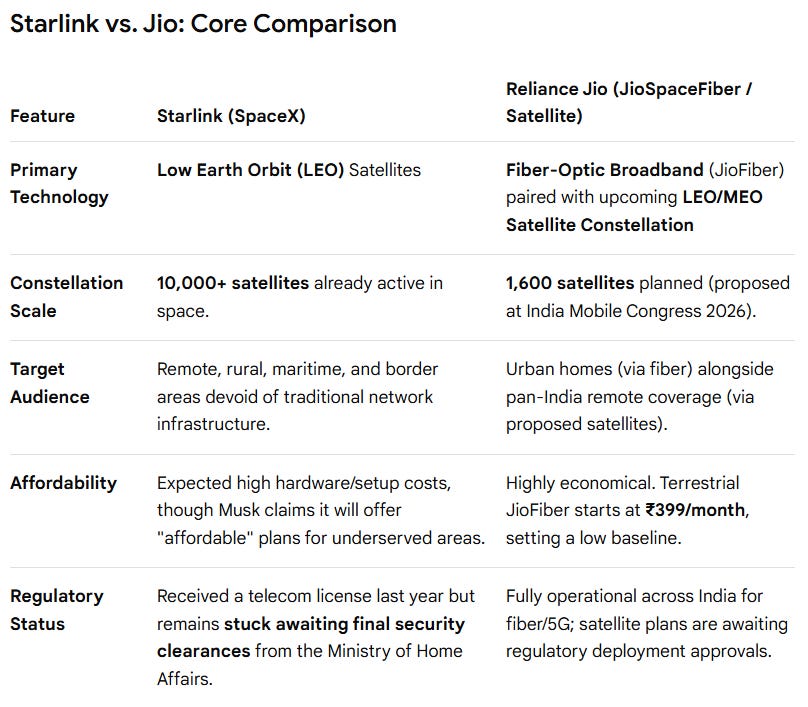
India’s satellite internet market is heating up as Elon Musk’s Starlink awaits final approvals to launch its services, while Reliance Jio has proposed a network of around 1,600 low-Earth-orbit satellites. Bharti Airtel, through its association with Eutelsat OneWeb, is also competing in this emerging space.
The rivalry gained attention this week after Musk alleged that vested interests were delaying Starlink’s entry into India. Meanwhile, Jio’s ambitious satellite plan signals that the competition could extend beyond traditional mobile and broadband services.
For India, this race could improve internet access in remote areas. For investors, it raises an important question: Who will lead India’s next phase of digital connectivity?
Why Starlink Is Waiting
Starlink, operated by SpaceX, aims to provide high-speed internet through a network of satellites in low-Earth orbit. Unlike traditional broadband, which depends heavily on cables and local infrastructure, satellite internet can reach locations where building conventional networks is difficult or expensive.
This makes India an attractive market, given its large population, expanding digital economy and geographical diversity.
However, Starlink has yet to begin commercial operations in India. Although the company has secured important licences and regulatory authorisations, it is still awaiting outstanding approvals, including security-related clearances.
These requirements are important because satellite communication involves more than simply providing internet access. Authorities must consider national security, lawful access, network operations and the handling of user data.
Musk has argued that Starlink has spent years complying with Indian requirements and should be allowed to compete. He also suggested that powerful business interests were trying to protect their market positions.
The Indian government has rejected allegations of unfair treatment. Officials have maintained that satellite operators are subject to the same regulatory framework and must meet the necessary conditions before launching services.
Therefore, the dispute should not be viewed as proof that any particular company has deliberately blocked Starlink. The immediate issue is whether the remaining regulatory requirements can be completed and commercial services can begin.
The outcome matters because an early launch could help Starlink establish relationships with customers, businesses and distribution partners before competition intensifies.

Source: X
Jio’s 1,600-Satellite Plan
Reliance Jio is not limiting its ambitions to mobile connectivity and fibre broadband. The company is also pursuing a satellite-based network designed to expand internet access and strengthen its position in India’s digital infrastructure market.
Jio has proposed a constellation of around 1,600 low-Earth-orbit satellites. Its plans also include ground stations to support communications between satellites and terrestrial networks.
According to reports, the proposed system could offer a total capacity of approximately 4.5–5 terabits per second. The project has received a favourable technical assessment from India’s space regulator, IN-SPACe, but technical evaluation does not mean that the complete network is already operational or that every approval has been secured.
The ambition is straightforward: use satellite technology to provide connectivity in areas where fibre and mobile networks are difficult to extend.
For example, a business operating in a remote industrial location may struggle to obtain reliable broadband. A satellite connection could help it access cloud software, communicate with customers and manage operations without waiting for extensive terrestrial infrastructure.
Satellite connectivity could also support mobile network backhaul, which allows telecom operators to connect remote mobile towers to their core networks.
However, building such a network is a massive undertaking. Satellites must be manufactured, tested, launched and maintained. Ground infrastructure and customer equipment must also be developed, while the company must secure the necessary orbital rights and regulatory permissions.
This means Jio’s plan is a long-term infrastructure project rather than an immediate commercial opportunity.
Its success will depend on execution, costs and how quickly the company can turn its proposal into a reliable service.
Airtel’s Position in the Race
The satellite internet market is not simply a contest between Jio and Starlink. Bharti Airtel also has a position through its investment in Eutelsat OneWeb, a satellite communications company with an established low-Earth-orbit constellation.
This gives Airtel access to an existing satellite network rather than requiring it to build an entire constellation from scratch.
However, having satellites in orbit does not automatically guarantee a commercially successful broadband service. Operators still need the necessary permissions, spectrum arrangements, ground infrastructure, compatible customer equipment and an effective distribution model.
The three players also have different strengths.
Starlink: SpaceX has extensive experience deploying and operating a large satellite constellation. Its existing infrastructure gives it a substantial head start in scale and operational experience.
Jio: The company brings a large Indian customer base, established telecom infrastructure, distribution capabilities and an ambitious domestic satellite-network proposal.
Airtel: Its association with Eutelsat OneWeb provides access to an established satellite network, while Airtel can use its existing relationships with businesses and telecom customers.
Each approach has advantages, but the ultimate winner will not necessarily be the company with the most satellites.
Coverage, connection quality, pricing, service reliability, customer support and the cost of user equipment will all influence adoption.
Competition could also take different forms. Companies may compete for consumers in remote locations, but they could also target enterprises, government agencies, maritime users and industries that need dependable connectivity in difficult terrain.
For India, having several capable providers could improve choice and reduce dependence on a single network.
What It Means for India’s Digital Economy
Satellite broadband could address a gap that conventional telecom infrastructure cannot always fill economically.
Building fibre networks across mountains, islands, forests and sparsely populated regions can be expensive. Installing mobile towers in remote locations also requires power, backhaul connectivity and regular maintenance.
Satellites offer another way to reach these areas, potentially improving access to digital services where conventional infrastructure is limited.
The benefits could extend across several sectors.
Education: Schools in remote areas could access online learning platforms, digital libraries and educational resources.
Healthcare: Better connectivity could support telemedicine, remote consultations and the transfer of medical information.
Businesses: Small enterprises in underserved regions could access online marketplaces, cloud tools and digital payment systems.
Industrial operations: Mining sites, shipping operations, energy projects and other remote facilities could benefit from more dependable communications.
Disaster response: Satellite connectivity may help restore communications when floods, cyclones or other emergencies disrupt terrestrial networks.
There is also a broader strategic dimension. Developing domestic satellite capabilities could strengthen India’s space and telecommunications ecosystem, encourage investment in related technologies and support technological self-reliance.
However, satellite internet is not automatically affordable for every household. Customer terminals, installation expenses, subscription prices and network capacity will determine how accessible these services become.
Satellite systems are also not a complete replacement for fibre or mobile networks. In densely populated areas, conventional infrastructure may remain more cost-effective for serving large numbers of users.
The most likely outcome is a complementary model in which fibre, mobile broadband and satellite connectivity serve different needs.
Investor Takeaway: Opportunity With Risks
India’s satellite broadband market presents a long-term opportunity, but investors should separate the industry’s potential from the commercial prospects of individual companies.
The first factor to watch is regulatory progress. Final security clearances, spectrum allocation and other permissions will determine when services can begin and how quickly providers can expand.
The second is execution. Jio’s proposed satellite constellation requires substantial investment, manufacturing capacity, launch arrangements and ground infrastructure. Delays or higher-than-expected costs could affect its commercial viability.
The third is pricing and demand. Satellite internet must offer sufficient value to attract customers. Businesses in remote locations may be willing to pay more for reliable connectivity, but household adoption will depend heavily on affordability.
The fourth is competition. Starlink’s established network, Jio’s domestic scale and Airtel’s association with OneWeb create different competitive advantages. Partnerships could also emerge alongside rivalry.
Investors should monitor announcements about launch timelines, network deployment, capital expenditure, customer adoption and the economics of satellite services. For listed companies, the financial impact will depend on the scale of investment, revenue contribution and profitability not simply on ambitious project announcements.
It is also important to distinguish between a long-term industry trend and an immediate stock-market catalyst. A satellite project may take years to generate meaningful revenue, and positive headlines do not guarantee share-price gains.
The bottom line: India’s satellite internet race could reshape how the country connects its most remote regions and expands its digital economy. But the winners will be determined by execution, affordability, regulation and sustainable business models.
For investors, the opportunity is worth tracking, but patience and a close watch on actual commercial progress remain essential.
This newsletter is for educational and informational purposes only and is not investment advice.
Lingo of the Week: Satellite Broadband
Definition: Satellite broadband is an internet connection delivered through satellites orbiting the Earth instead of relying entirely on traditional cables or mobile towers.
In simple words: It helps people access the internet in remote areas where fibre broadband and mobile networks may have limited coverage.
Example: Starlink, Jio and Airtel-linked satellite services are part of the growing satellite connectivity space in India.
Why it matters: Satellite broadband could expand internet access, support businesses in remote locations and create new opportunities in the telecommunications industry.
Pocketful isn’t just another trading platform - we’re your partners on the journey to financial freedom.
Thank you for reading!
👀 Stay tuned. Stay diversified.
Until next time,
Team Pocketful.
Follow Us: Website
Download Our App: Available on Google Play & Apple App Store