

What if the company sitting at the heart of the Tata Group finally gets its own stock market price?
Tata Sons, the holding company behind some of India’s biggest businesses, is once again moving closer to a potential public listing. The development has already put Tata Chemicals, Tata Investment Corporation and other Tata Group stocks under the spotlight.
The RBI’s rejection of Tata Sons’ request to surrender its Core Investment Company registration has pushed the company towards regulatory compliance and a possible listing. However, the final structure, valuation and timeline are still uncertain, while Tata Trusts has opposed the listing and called for alternatives to be explored.
So, if Tata Sons does go public, what could it mean for the Tata stocks already listed on the exchanges?
Tata Sons Goes Public? What It Could Mean for Tata Group Stocks
What happens when one of India’s most powerful business groups brings its holding company to the stock market?
For years, Tata Sons has remained behind the scenes. It owns stakes in some of the country’s most recognisable businesses, receives dividends from group companies and sits at the centre of the Tata Group’s unique ownership structure. Yet, unlike many of the companies it controls, Tata Sons itself has remained privately held.
That could now change.
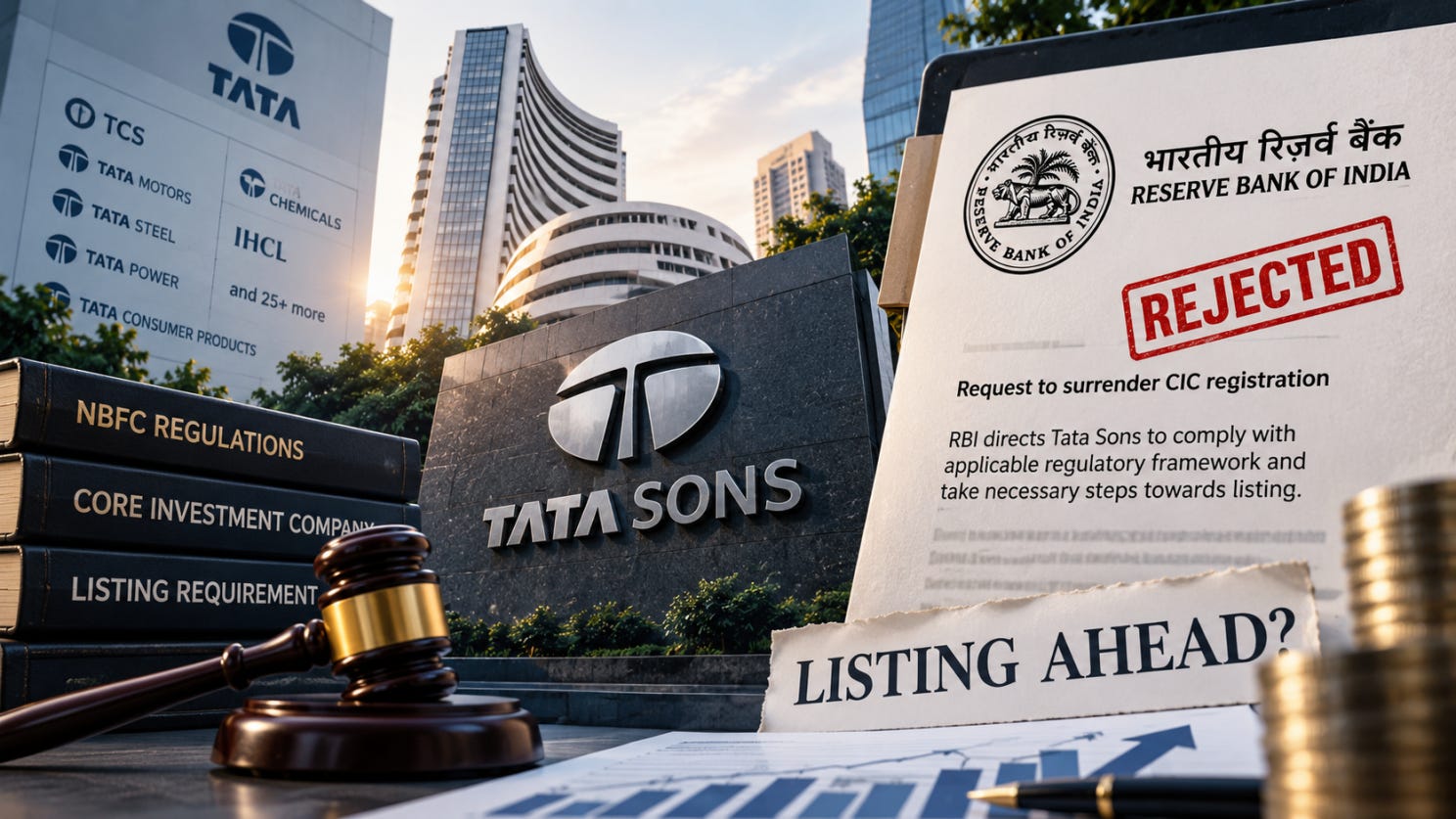
The Reserve Bank of India rejected Tata Sons’ request to surrender its registration as a Core Investment Company on September 11, pushing the holding company closer to complying with the regulatory framework that requires certain large upper layer NBFCs to be listed. A few days later, the Tata Sons board decided to initiate steps to comply with the RBI’s direction and proceed with the process required for a possible listing.
The development has already caught the attention of stock market investors. Shares of Tata Chemicals, Tata Investment Corporation, Tata Motors Passenger Vehicles and Tata Steel have moved sharply as investors assess what a public valuation for Tata Sons could mean for their own holdings.
But there is an important distinction. Tata Sons has moved towards the listing process, but the final structure, valuation and timing are not yet known. Tata Trusts has also publicly stated that it has not agreed to the listing and wants alternatives to be examined.
So, what exactly could change for Tata Group stocks if Tata Sons eventually reaches Dalal Street?
Why Tata Sons Is Being Pushed Towards a Listing
The Tata Sons listing story is not entirely new. The issue goes back to the RBI’s regulatory framework for large Core Investment Companies and upper layer NBFCs.
Tata Sons was classified as an upper layer NBFC and subsequently sought to surrender its registration, which would have allowed it to avoid the listing requirement. The RBI rejected that request on September 11 and directed Tata Sons to take the necessary steps to comply with the applicable regulatory framework.
This decision is significant because Tata Sons is not a conventional operating company. It is the principal holding company of the Tata Group and has stakes across a large number of businesses.
Reuters reported that Tata Sons had standalone assets of around ₹1.75 lakh crore as of March 2025 and owned stakes in 31 Tata Group companies. Under the RBI framework, large upper layer NBFCs that meet the relevant asset and public fund criteria can face mandatory listing requirements.
The Tata Sons board has now moved towards compliance. However, the process still has several stages ahead.
That means investors should view the current development as the beginning of a potentially important corporate restructuring story rather than an already announced IPO with a fixed date and price.
Tata Sons Is at the Centre of the Tata Ownership Structure
To understand why the market is paying attention, it is important to understand what Tata Sons actually represents.
Tata Sons sits at the centre of the Tata Group’s ownership structure. Tata Trusts owns about 66% of Tata Sons, while the Shapoorji Pallonji Group owns about 18.37%. Various Tata Group companies and other shareholders own the remaining portion.
This structure makes Tata Sons very different from a conventional listed holding company.
A large part of its economic value comes from its investments across the Tata ecosystem. These include stakes in major listed businesses such as Tata Consultancy Services, Tata Motors, Tata Steel, Tata Power, Tata Consumer Products and Indian Hotels, among others.
That is why a Tata Sons listing could introduce something the market currently does not have: a publicly traded valuation for the holding company itself.
At present, investors can observe the market value of Tata Group companies individually. However, Tata Sons remains private, making it harder for the market to establish a continuously visible value for the parent company and its underlying investments.
A listing could therefore create a new layer of price discovery.
The question is how that value would eventually flow through to the Tata companies that already trade on Indian exchanges.
Tata Chemicals and Tata Investment Come Into Focus
The immediate market interest has centered on companies that directly own shares in Tata Sons.
Tata Chemicals is one of the most closely watched names because it owns around 2.5% of Tata Sons. Tata Investment Corporation is another important company because of its investment exposure to the Tata ecosystem.
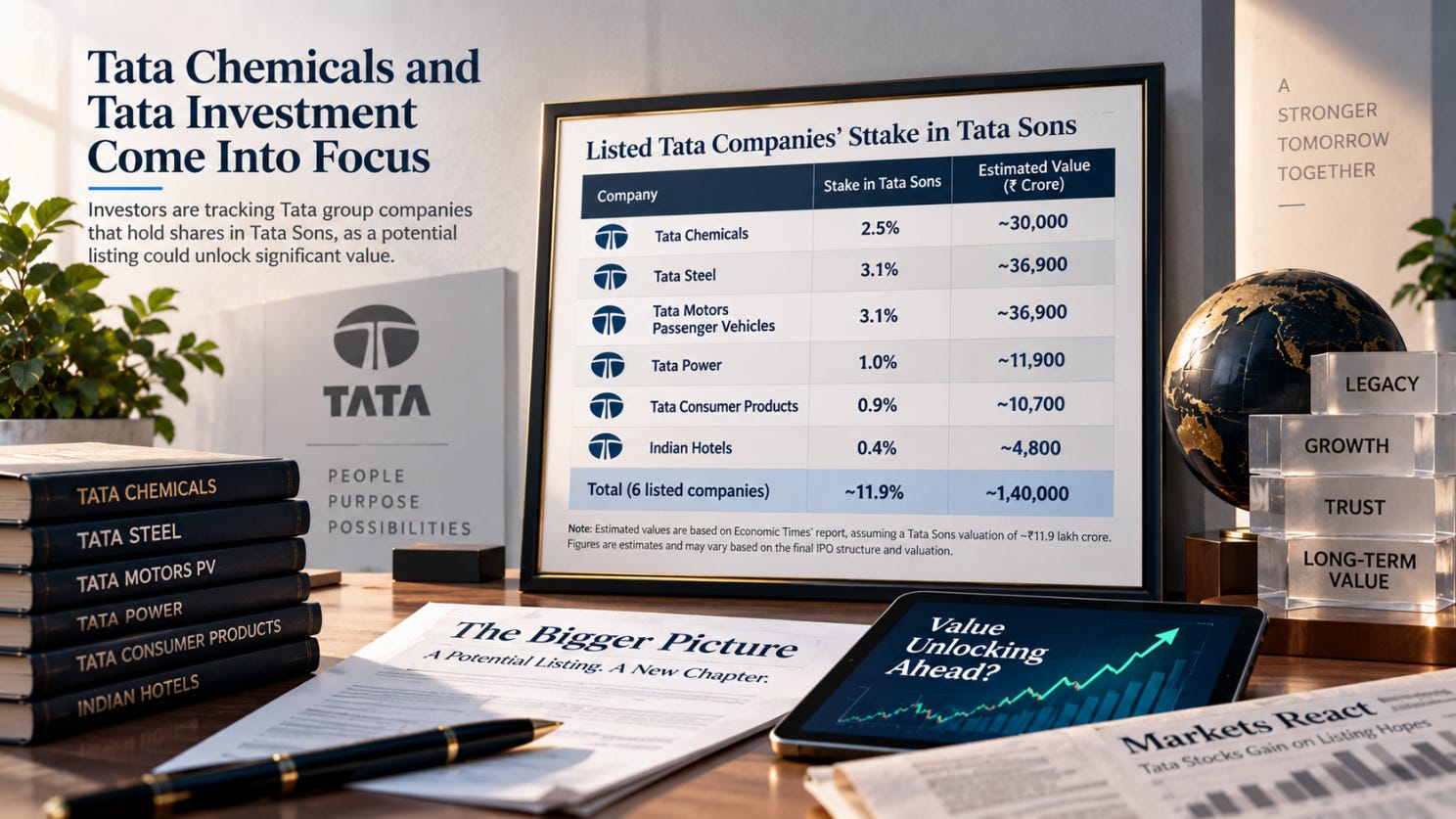
According to Economic Times, six listed Tata Group companies collectively hold an estimated ₹1.4 lakh crore stake in Tata Sons. Tata Chemicals holds around 2.5%, while Tata Steel and Tata Motors Passenger Vehicles each hold around 3.1%. Other companies, including Tata Power, Tata Consumer Products and Indian Hotels, also have smaller holdings.
This is where the potential value unlocking argument comes from.
If Tata Sons receives a transparent market valuation after listing, investors could use that valuation to reassess the value of Tata Sons shares held by these listed companies.
For example, Economic Times estimated Tata Chemicals’ Tata Sons holding at around ₹30,000 crore based on its valuation assumptions. The report also estimated Tata Sons’ overall market value at around ₹11.9 lakh crore based on the value of its stakes in group companies.
These figures are estimates and should not be confused with an official Tata Sons valuation.
The actual outcome could be very different depending on the eventual IPO structure, valuation and holding company discount.
The market reaction nevertheless shows why investors are paying attention. On September 17, Tata Chemicals gained about 6.5%, Tata Investment Corporation rose 5.5%, Tata Motors Passenger Vehicles gained 4.5% and Tata Steel advanced 2.8%, according to Times of India.
Could a Tata Sons Listing Unlock Value Across the Group?
The biggest potential change is valuation transparency.
Imagine an investor owning a holding company whose major assets are publicly traded companies. The value of those investments can be calculated, but the holding company itself may trade at a discount because its shares are not publicly listed and investors cannot easily buy or sell them.
This is commonly referred to as a holding company discount.
A Tata Sons listing could reduce some of that uncertainty by establishing a public market price.
For companies such as Tata Chemicals, Tata Steel and Tata Motors Passenger Vehicles, the impact could be particularly relevant because they hold meaningful stakes in Tata Sons.
However, value unlocking should not be interpreted as an automatic increase in share prices.
The market could apply a discount to Tata Sons even after listing. The valuation of the IPO could also be lower or higher than estimates currently circulating in the market. There could also be tax implications, changes in ownership and other structural considerations.
Mint reported that Tata Chemicals’ approximately 2.5% Tata Sons holding could become more visible after a listing, but also highlighted that the ultimate impact would depend on Tata Sons’ listing valuation and the materiality of each company’s holding.
This distinction is important.
A public listing creates price discovery. It does not guarantee that the market will assign full value to every underlying asset.
For investors, the eventual valuation will therefore matter just as much as the listing itself.
The Tata Trusts Factor Could Shape the Road Ahead
There is another part of the story that makes this potential listing more complicated.
Tata Trusts owns the majority of Tata Sons and has publicly opposed the idea of listing the company.
In a statement released on September 17, Tata Trusts said it had not agreed to the listing and that all available options should be examined. The Trusts also pointed out that Tata Sons had previously decided in March 2024 to remain unlisted and that the Sir Dorabji Tata Trust and Sir Ratan Tata Trust had reiterated that position in 2025.
The disagreement means that the regulatory requirement and the Tata Group’s internal ownership structure are now closely connected.
The Tata Sons board has moved towards compliance, but shareholder approval and corporate governance considerations remain important.
The situation is also relevant because the Shapoorji Pallonji Group, which owns about 18.4% of Tata Sons, has backed a potential listing.
Tata Trusts has also proposed an alternative route involving the potential monetisation of a portion of the Shapoorji Pallonji Group’s Tata Sons stake, with a proposed transaction that could generate at least ₹25,000 crore. The proposal includes a selective capital reduction process and other funding avenues.
This means the final route could involve more than a straightforward IPO.
For investors, the next developments around regulatory compliance, shareholder discussions and the eventual structure will be crucial.
What Investors Should Watch From Here
The Tata Sons story has moved from speculation into a more serious regulatory and corporate process, but there are still several unanswered questions.
The first is the valuation.
Market estimates have placed Tata Sons’ potential value in the range of several lakh crore rupees, but these are estimates rather than an official IPO valuation. The final number will depend on the value of its listed and unlisted investments, liabilities, ownership structure and the discount investors assign to the holding company.
The second is the IPO structure.
Investors will want to know whether the listing would involve an offer for sale, fresh capital or another structure. The amount of shares available to public investors could also influence the eventual valuation and liquidity.
The third is the impact on Tata companies holding Tata Sons shares.
Tata Chemicals, Tata Steel, Tata Motors Passenger Vehicles and Tata Investment Corporation are among the names that could receive greater market attention because of their direct exposure. Other Tata companies with smaller holdings could also see their investments reassessed.
The fourth is the Tata Trusts position.
The Trusts’ majority ownership means their stance will remain central to the eventual outcome. Their opposition to listing and the board’s decision to proceed create an important governance issue that investors will continue to monitor.
For now, the Tata Sons story is less about predicting which Tata stock will benefit and more about understanding how a potential listing could change the way the market values the entire Tata ecosystem.
A public Tata Sons could bring greater transparency, establish a market price for the holding company and potentially make previously difficult to value investments more visible.
But the final impact will depend on the details.
For investors watching Tata Group stocks, the most important numbers in the months ahead may not simply be quarterly earnings or share price movements. The Tata Sons valuation, listing structure, shareholder decisions and regulatory roadmap could become equally important.
The Tata Group has spent more than a century building a distinctive ownership structure. If Tata Sons eventually enters the public market, it could mark one of the most significant changes to that structure in modern times.
And for the Indian stock market, it would create something equally interesting: a new way to put a market price on the company sitting at the centre of one of India’s largest business groups.
Lingo of the Week: Holding Company Discount
A holding company discount refers to the difference between the market value of a holding company and the value of the investments it owns.
In simple terms, if a company owns valuable stakes in several businesses, the market may still value the holding company at less than the combined value of those investments.
Example: If the investments owned by a holding company are worth ₹1,00,000 crore, but the holding company is valued at ₹70,000 crore, the ₹30,000 crore difference represents a 30% holding company discount
Pocketful isn’t just another trading platform - we’re your partners on the journey to financial freedom.
Thank you for reading!
👀 Stay tuned. Stay diversified.
Until next time,
Team Pocketful.
Follow Us: Website
Download Our App: Available on Google Play & Apple App Store