


A shareholder complaint.
A Swiss gold refinery.
One of India’s largest jewellery exporters.
And ₹15.15 lakh crore of reported revenue now under regulatory scrutiny.
Over the past few weeks, Rajesh Exports has found itself at the centre of one of the biggest corporate governance stories in India’s stock market. The company, known for reporting some of the highest revenues among listed Indian firms, is facing allegations from SEBI that approximately ₹15.15 lakh crore of revenue linked to its overseas subsidiaries may have been misrepresented between FY21 and FY25.
The company has denied the allegations and maintains that its financial disclosures accurately reflect its global operations. While the investigation is still underway, the developments have sparked discussions around financial transparency, corporate governance, and the importance of understanding where a company’s reported growth is coming from.
At first glance, the figure itself appears shocking. However, the real significance of this case lies not in the size of the number, but in the questions it raises about financial reporting and investor confidence.
The Rise of a Global Gold Giant
Rajesh Exports built its reputation as one of India’s leading gold and jewellery companies. Starting as a jewellery exporter, the company gradually expanded its footprint across refining, manufacturing, and international trading operations.
A defining moment came in 2015 when it acquired Valcambi, a Switzerland-based precious metals refinery regarded as one of the largest gold refiners in the world. The acquisition transformed Rajesh Exports into a globally integrated precious metals business and significantly increased its international presence.
Over the following years, the company consistently reported enormous revenues, often ranking among India’s highest revenue-generating listed firms. Its business model relied heavily on high-volume precious metals trading and refining, where large transaction values naturally translated into substantial revenue figures.
For many investors, these numbers represented the scale and reach of the company’s operations. However, some market participants often questioned whether profitability, cash generation, and shareholder returns were growing at a pace that justified the headline revenue figures.
While those questions largely remained in the background for years, recent developments have brought them back into focus.
What Triggered SEBI’s Investigation?
Interestingly, the controversy did not begin because the company reported losses or a sharp decline in revenue.
According to various reports, concerns were initially raised regarding disclosures and unusually large receivables. What started as a routine concern gradually attracted regulatory attention and led to a deeper examination of the company’s financial statements and subsidiary operations.
SEBI subsequently initiated a forensic review and began examining the company’s overseas operations, particularly entities associated with Valcambi and other foreign subsidiaries.
The investigation focused on understanding how revenues were being reported and whether disclosures provided investors with a sufficiently transparent picture of the group’s operations.
Like many multinational corporations, Rajesh Exports reports consolidated financial statements that combine the performance of the parent company and its subsidiaries. These consolidated numbers are often the primary source of information investors use to evaluate the overall business.
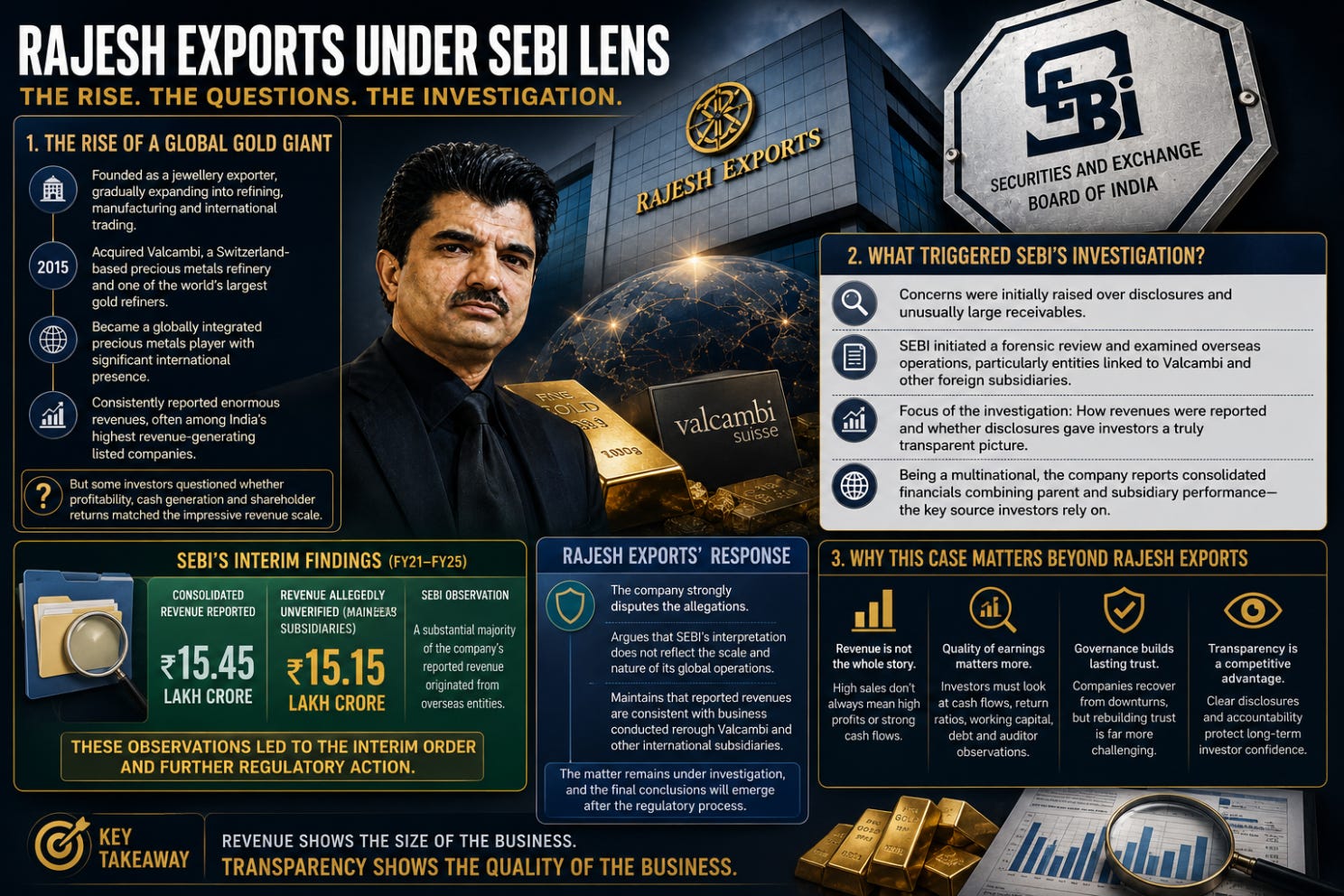
According to SEBI’s interim findings, Rajesh Exports reported approximately ₹15.45 lakh crore of consolidated revenue between FY21 and FY25. The regulator alleges that nearly ₹15.15 lakh crore of this revenue, largely attributed to overseas subsidiaries, could not be adequately substantiated through records and disclosures reviewed during the investigation.
SEBI also observed that a substantial majority of the company’s reported revenue originated from overseas entities. These observations eventually led to the interim order and further regulatory action.
Rajesh Exports has strongly contested the allegations. The company argues that the regulator’s interpretation does not accurately reflect the scale and nature of its global operations and maintains that the reported revenues are consistent with business conducted through Valcambi and other international subsidiaries.
As of now, the matter remains under investigation, and the final conclusions will emerge only after the regulatory process is completed.
Why This Case Matters Beyond Rajesh Exports
The Rajesh Exports case is about far more than a single company.
It highlights an important challenge that investors face when evaluating businesses. Revenue is often the first metric people look at. It is simple, easy to understand, and frequently used to compare companies across industries.
However, revenue alone rarely tells the complete story.
A company can generate enormous sales while producing relatively modest profits. It can report strong growth while generating weak cash flows. It can appear impressive on paper while raising important questions about transparency, disclosures, and governance.
This is why experienced investors spend time analysing much more than revenue. They examine cash flows, return ratios, debt levels, auditor observations, working capital trends, and management credibility.
The Rajesh Exports investigation serves as a reminder that understanding the source and quality of revenue is often more important than focusing solely on the size of the number.
The case also highlights the importance of corporate governance. During strong market cycles, governance often takes a back seat to growth narratives. Investors become focused on expansion plans, future opportunities, and rising revenues.
Yet history has repeatedly shown that governance concerns can have a lasting impact on investor confidence. Companies can recover from weak demand, economic slowdowns, and disappointing earnings. Rebuilding trust, however, is often far more challenging.
That is why transparency remains one of the most valuable assets any listed company can possess.
The Bigger Question for Investors
Perhaps the most interesting aspect of this story is how it reportedly began with a question.
Not a market crash.
Not a business failure.
Not a sudden collapse in earnings.
Just a question about disclosures and financial reporting.
That question eventually led regulators to examine subsidiary operations, financial statements, and reported revenues more closely. Whether SEBI’s allegations ultimately hold or not, the episode demonstrates how a single unanswered question can evolve into a much larger issue.
For investors, this serves as an important reminder.
Financial statements are more than collections of numbers. They are a reflection of how a business operates, communicates with shareholders, and builds trust over time.
It is easy to be impressed by large revenues and ambitious growth stories. It is much harder—but often far more rewarding to understand the quality of that growth.
As the investigation progresses, markets will continue to watch for answers. The company will continue to present its defence, and regulators will continue their examination.
But regardless of the final outcome, the case has already reinforced an important investing principle.
Successful investing is not about finding the company with the biggest numbers.
It is about finding businesses where the numbers, the disclosures, and the underlying story all move in the same direction.
Because in the stock market, growth attracts attention, profits create excitement, but trust is what creates long-term value.
Lingo of the Week
Forensic Audit - A forensic audit is an in-depth investigation of a company’s financial records to detect fraud, accounting irregularities, or compliance violations. It is typically conducted when regulators, investors, or authorities suspect that financial statements may not accurately represent business activities.
Pocketful isn’t just another trading platform - we’re your partners on the journey to financial freedom.
Thank you for reading!
👀 Stay tuned. Stay diversified.
Until next time,
Team Pocketful.
Follow Us: Website
Download Our App: Available on Google Play & Apple App Store