

Did you notice what just happened right next door in Asia? While most of us were busy tracking the daily swings of domestic mid-caps or chasing the great American Nvidia rally, we completely missed a massive wealth-creation event.
The benchmark South Korean stock index, the KOSPI, has been on an absolute tear. It recently blew past the 7,000-point mark for the first time in history. To put that into perspective, the index is up over 70% this year alone, making it one of the hottest performing markets on the entire planet.
The buying frenzy became so intense during a recent trading session that the stock exchange actually had to trigger a “sidecar” halt. That is a rare emergency brake used to stop trading when prices shoot up way too fast. Last year, the index also delivered a massive 76% gain.
It has been a historic, face-melting run. Yet, it flew right under the radar for the average Indian retail investor. We were looking the other way. Let’s talk about why this quiet market is suddenly booming and why it matters to your portfolio.
The Invisible AI Monopoly
If you read the mainstream news, you might easily assume the artificial intelligence boom is strictly an American story. The narrative is always the same: US tech giants design the cutting-edge chips, build the massive data centers, and write the game-changing software.
But there is a massive catch to that story. None of that American software or processing power actually works without South Korean physical manufacturing.
This historic market rally isn’t happening because the broader Korean economy is experiencing some miraculous boom. It is almost entirely a hyper-concentrated story about just two companies: Samsung Electronics and SK Hynix.
Together, these two tech titans control roughly 90% of the entire global market for a highly specialized component called High-Bandwidth Memory (HBM). They do not just participate in the AI boom. They hold a functional monopoly on the single most important physical bottleneck in the global supply chain.
Every single time a US tech giant like Microsoft, Google, or Meta spends billions of dollars to build a new AI data center, a massive chunk of those dollars flows straight into Seoul.
The High-Bandwidth Fuel Pump
So, what exactly is this memory, and why are tech giants desperate to buy it?
Think of an advanced AI processor like a massive, incredibly powerful sports car engine.
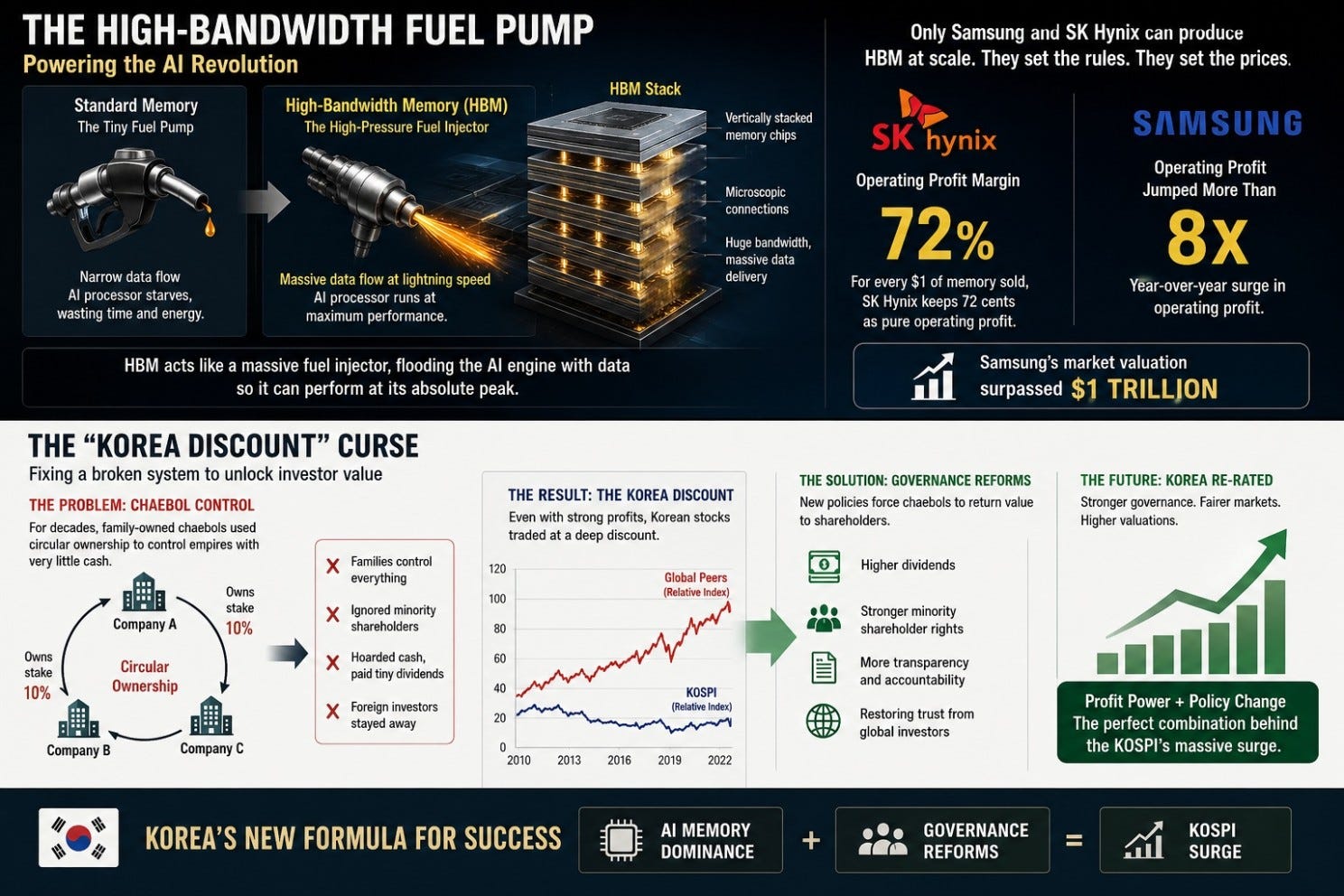
Standard computer memory is like a cheap, tiny fuel pump. No matter how big and powerful the engine is, if the fuel pump can only send a few drops of gas per second, the car will not go fast. The processor simply sits there, wasting precious time and electricity, waiting for data to arrive. In a world where AI companies are spending billions on energy and data center space, wasting time is not an option.
High-Bandwidth Memory fixes this problem. It acts like a massive, high-pressure, industrial fuel injector. Instead of laying memory chips flat on a board, engineers stack them vertically like floors in a skyscraper, connecting them with microscopic wires. This floods the engine with massive amounts of data at lightning speeds, allowing the AI processor to run at its absolute maximum capacity.
Manufacturing this vertically stacked memory is insanely difficult. Because only Samsung and SK Hynix can produce it reliably at scale, they essentially dictate the global market and command premium prices.
The financial results of this dominance are staggering. SK Hynix recently reported a jaw-dropping operating profit margin of 72%. That means for every single dollar of memory they sell, they keep 72 cents as pure operating profit.
Meanwhile, Samsung’s operating profit recently jumped more than eight times compared to the previous year. This massive cash flow just pushed Samsung’s total market valuation well past the historic one trillion dollar mark.
The “Korea Discount” Curse
So, South Korea effectively owns the monopoly on AI memory. That perfectly explains the rising profits for those two tech giants. But booming tech profits are only half the story behind the KOSPI’s massive surge.
The other half of the story involves fixing a deeply broken financial culture. For decades, global investors hated buying South Korean stocks. Even when Korean companies made billions of dollars in profit, their stock prices stayed stubbornly, frustratingly low. Financial experts called this phenomenon the “Korea Discount”.
This discount existed because the Korean economy is heavily dominated by “chaebols”. A chaebol is a massive, family-owned business conglomerate. Famous global brands like Samsung, Hyundai, and LG are all chaebols.
The founding families of these groups figured out a clever way to control massive corporate empires using very little of their own money. They used a confusing system called circular ownership.
Imagine a family owns a small 10% stake in Company A. Company A uses debt to buy a stake in
Company B. Company B buys a stake in Company C. Finally, Company C buys shares back in Company A. It forms a giant loop. This allowed a single family to act like absolute kings over dozens of companies.
Because these families had total, unquestioned control, they routinely ignored the interests of regular retail investors. They hoarded massive piles of cash and paid out miserable, tiny dividends. Foreign investors eventually got completely tired of this behavior and took their money elsewhere.
The Plot Twist & The Value-up Program
Then came the plot twist. The South Korean government finally realized this massive valuation discount was hurting the national economy. So, they stepped in and launched a fierce, no-nonsense campaign called the “Corporate Value-up Program”.
This was not a gentle suggestion. Regulators are aggressively forcing these giant companies to be financially efficient and to treat minority shareholders fairly. They passed new rules forcing companies to cancel their hoarded “treasury shares”.
When a company cancels these shares, it is exactly like tearing up pieces of a pie so that the remaining slices become bigger and more valuable for the regular investors holding the stock.
The government also pushed for massive dividend tax cuts, dropping the top rate from 45% down to a maximum of 30%. This heavily incentivized these giant corporations to finally stop hoarding cash and pay it out to shareholders. If a company does not comply, they risk losing these major tax benefits and facing public shame from regulators. It is a brilliant, heavy-handed move.
The aggressive reform worked flawlessly. Companies representing over half of the entire Korean market’s value have announced formal plans to improve returns. Samsung and SK Hynix alone are canceling tens of millions of treasury shares.
Seeing this massive cultural shift, foreign money is flooding back into Seoul. Global investors are realizing the infamous “Korea Discount” is disappearing for good.
The Climax & The Bottom Line
So, what does this mean for the Indian retail investor? You might think that after a 70% rally, the boat has sailed and the market is way too expensive. But the math says otherwise.
Even after this historic run, the KOSPI still trades at a dirt-cheap valuation of just 8.8 times forward earnings for 2026. For context, the Indian Nifty 50 trades at a much more premium 22 times earnings. Cheap is still cheap.
While Indian residents cannot buy the KOSPI directly, and local international mutual funds often face strict RBI investment caps, there is a clean workaround. Using the Liberalised Remittance Scheme (LRS), you can buy US-listed Exchange Traded Funds (ETFs) from India.
The big takeaway? The most explosive wealth creation stories are often found outside our home borders. Sometimes, you just have to look where everyone else isn’t.
Lingo of the Week
High-Bandwidth Memory (HBM) HBM is a specialized computer chip that stacks memory vertically like floors in a skyscraper, instead of spreading them out flat. This design allows massive amounts of data to travel back and forth to AI processors incredibly fast, making it the absolute backbone of modern artificial intelligence.
Pocketful isn’t just another trading platform - we’re your partners on the journey to financial freedom.
Thank you for reading!
👀 Stay tuned. Stay diversified.
Until next time,
Team Pocketful.
Follow Us: Website
Download Our App: Available on Google Play & Apple App Store