

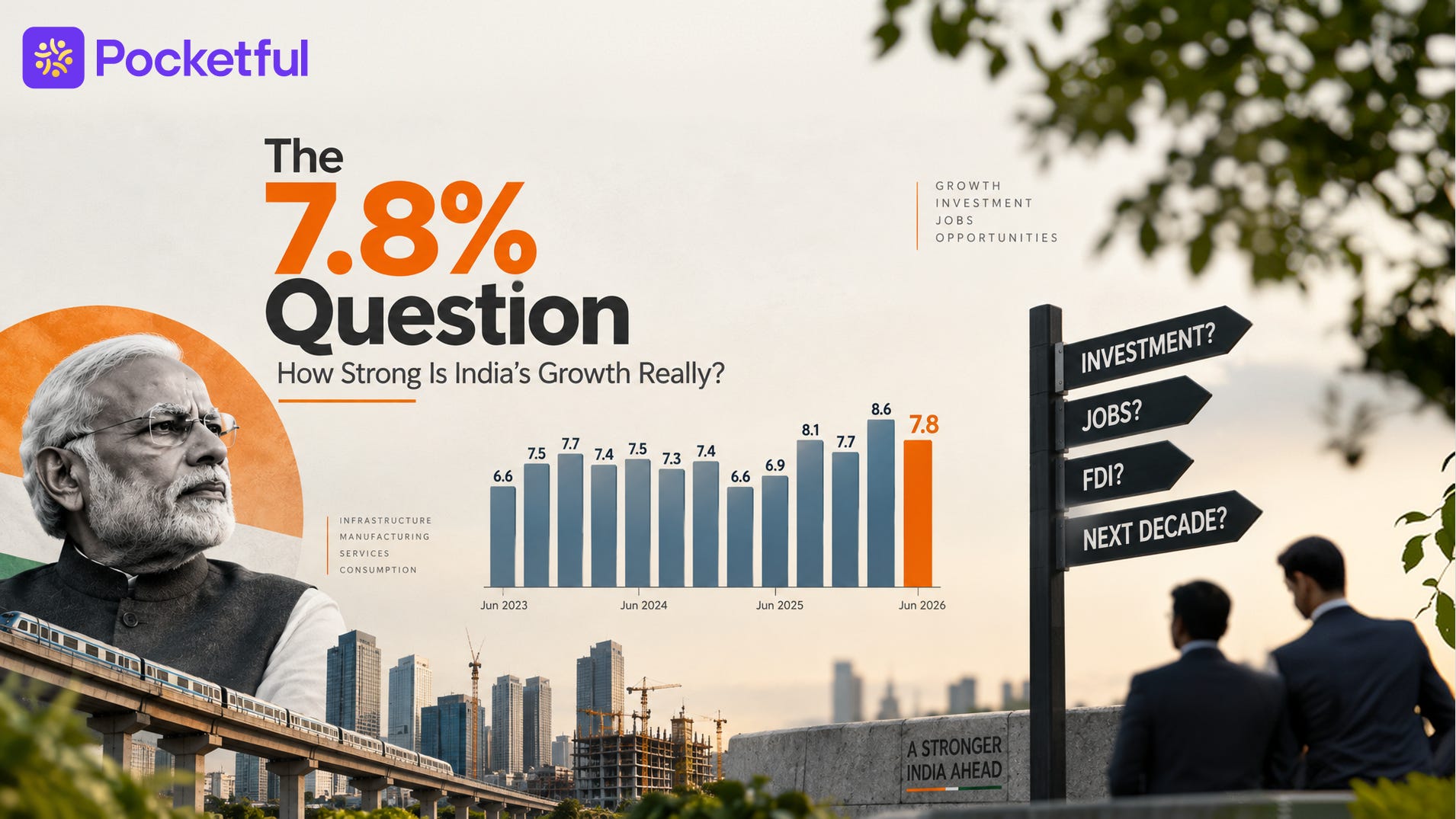
India’s economy is growing at nearly 8%. Sounds impressive. But here’s the catch: if growth is this strong, why aren’t private investment, foreign capital and jobs growing at the same pace?
India’s real GDP grew 7.8% year-on-year in Q1 FY2026-27, beating expectations of around 7.1% and rising from 6.9% a year earlier. On the surface, the numbers point to a resilient economy, supported by domestic demand, manufacturing, services and investment.
Yet, the latest GDP figure has sparked a bigger debate among economists and investors. The question is not simply whether the 7.8% figure is accurate, but what is driving this growth and whether it is translating into stronger investment, employment and household incomes.
To understand India’s growth story, we need to look beyond the headline number.
India’s GDP: Where Does the Economy Stand Now?
The latest GDP data puts India’s real GDP at ₹81.36 lakh crore in Q1 FY2026-27, compared with ₹75.46 lakh crore in Q1 FY2025-26. That translates into real growth of 7.8%. In nominal terms, GDP stood at approximately ₹88.27 lakh crore, growing 10.3% year-on-year.
The latest number becomes more interesting when viewed against the broader growth trajectory.
Under the new GDP series with 2022-23 as the base year, real GDP growth was estimated at 7.2% in FY2023-24, 7.1% in FY2024-25 and 7.6% in FY2025-26. The latest Q1 FY2026-27 figure of 7.8% therefore indicates that the economy has entered the new financial year with considerable momentum.
However, there is also a sequential moderation. Q4 FY2025-26 growth was estimated at 8.6%, meaning the latest 7.8% figure represents a slowdown of 80 basis points from the previous quarter, even though it remains higher than a year earlier.
So the headline is not that India has suddenly moved from weak growth to strong growth. Rather, India has sustained a relatively high growth rate over several quarters.
The bigger question is what is sitting underneath that growth.
What Is Driving the 7.8% Growth?
The latest numbers show that the growth story is not coming from just one part of the economy.
Manufacturing expanded by around 9.2%, while the services sector grew by approximately 10%. Gross fixed capital formation, a measure of investment in productive assets such as infrastructure, machinery and equipment, increased by around 11.9% in real terms. Private consumption also remained healthy, rising about 7.1%.
This combination is important.
A growth cycle supported simultaneously by consumption, manufacturing, services and investment is generally healthier than one dependent on a single engine. The services economy continues to provide a major contribution, while manufacturing has become an increasingly important part of the expansion.
The government’s new GDP series also points to sustained strength in manufacturing over recent years. According to the Ministry of Statistics and Programme Implementation, manufacturing has been a major contributor to economic performance following the rebasing of the national accounts.
There are also signs outside the GDP numbers that support the argument that economic activity is genuinely strong. Robust vehicle sales, bank credit and tax collections have provided evidence of underlying domestic activity. Reuters also noted that several high-frequency indicators are consistent with a relatively strong economy, even as some indicators, including the latest manufacturing PMI, have softened.
Therefore, it would be too simplistic to dismiss the 7.8% growth rate as merely a statistical phenomenon.
There is clearly real economic activity behind the number.
But that does not mean the debate ends there.
Why Is the 7.8% Number Raising Bigger Questions?
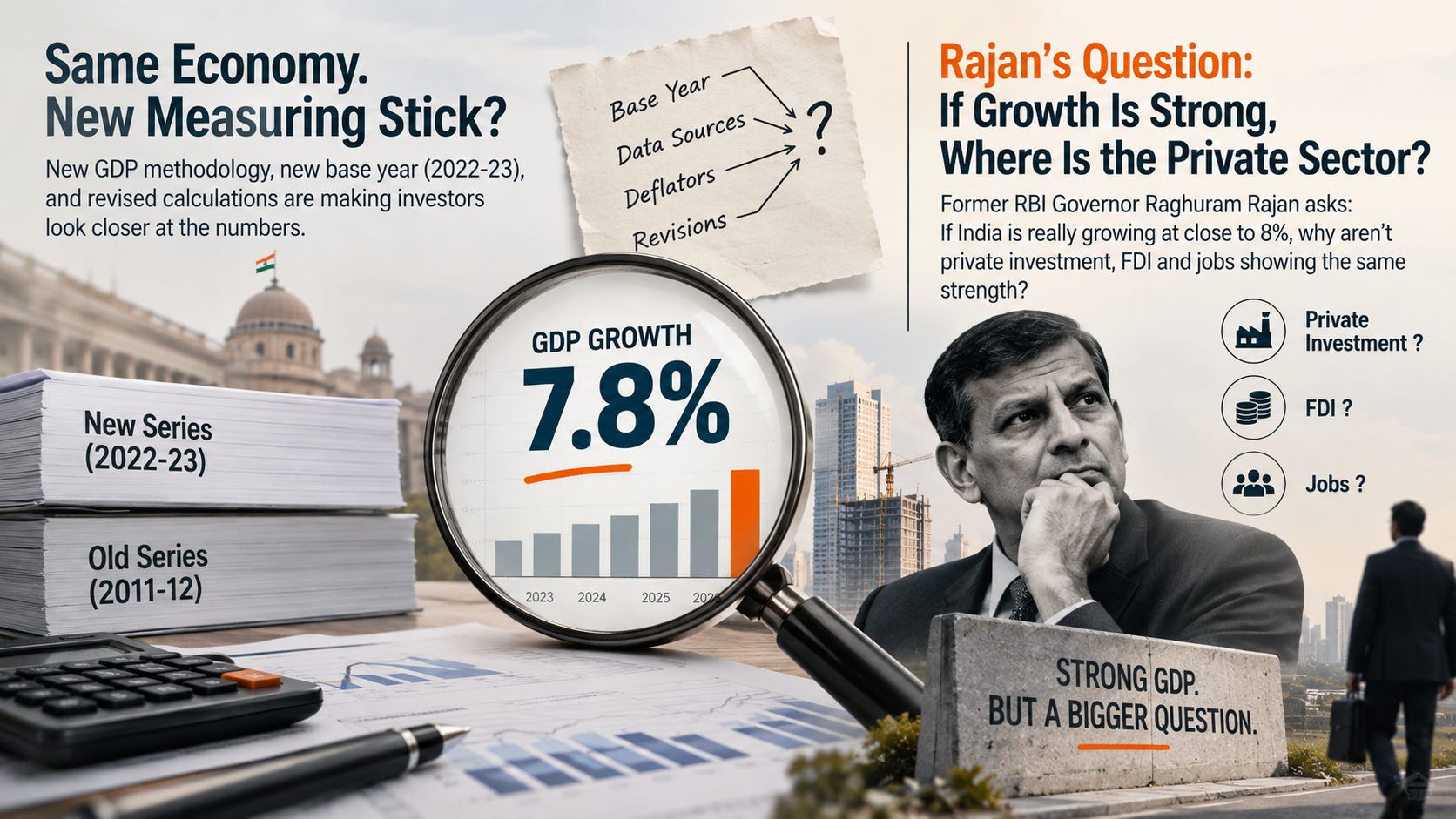
The controversy begins with the new GDP methodology and the revisions accompanying it.
India recently introduced a new national accounts series with 2022-23 as the base year, replacing the earlier 2011-12 base. The methodology also incorporates changes in data sources and price measurement, including a more granular Producer Price Index-based approach and additional deflators.
These changes are intended to improve the quality and relevance of GDP measurement. The government has defended the revised methodology, arguing that the changes reflect better data and updated economic structures rather than an attempt to artificially inflate growth. Statistics Secretary Saurabh Garg has also pointed out that revisions in previous years have moved in both directions.
Yet the methodological change has created a difficult communication problem.
Some economists and former officials have questioned whether the revised base and deflators have made the current growth rate appear stronger than it would under the previous framework. Reuters reported concerns that the new calculations, particularly the relatively low GDP deflator, could be contributing to the unusually strong real growth number.
This is where an important distinction needs to be made.
Questioning the methodology is not the same as proving that GDP growth is fake.
GDP is a complex statistical estimate. It is revised over time, depends on multiple data sources and requires adjustments for inflation. A change in methodology can change historical estimates without implying that the underlying economic activity never existed.
The more useful question is therefore not simply, “Is 7.8% real?”
It is:
“Does the broader economic evidence support a growth rate anywhere close to that level?”
There are certainly indicators that do.
But there are also areas where the picture appears less convincing.
The Rajan Question: If Growth Is Strong, Where Is the Private Sector?
This is where former Reserve Bank of India Governor Raghuram Rajan has added an important dimension to the debate.
Rajan has clarified that he has neither questioned nor endorsed the GDP figure itself. His concern is different: if India is genuinely experiencing such strong economic growth, why are some other indicators not showing an equally powerful response?
The questions revolve around private investment, foreign direct investment and employment.
This is a critical distinction.
Government-led infrastructure spending can stimulate economic activity and create demand across construction, engineering, logistics and manufacturing. But for a high-growth economy to become sustainable, the private sector eventually needs to take over a larger part of the investment cycle.
Businesses need to build factories, expand capacity, hire workers, increase research and development and commit capital for the long term.
That is where the GDP debate becomes more consequential.
If GDP is growing close to 8%, investors would naturally expect stronger corporate confidence and a sustained private investment cycle.
Similarly, if the economy is expanding rapidly, employment creation should ideally strengthen alongside it.
Rajan’s argument therefore shifts the conversation away from the accuracy of a single quarterly number and towards a much broader question:
Is India producing enough high-quality economic opportunities from its growth?
This is particularly important because GDP measures the value of economic output. It does not automatically tell us how evenly that output is distributed, how many jobs are being created, how wages are changing or whether businesses are confident enough to commit capital for the next five to ten years.
A country can record strong GDP growth while still facing challenges in employment and investment.
That does not invalidate GDP growth. It simply means GDP is only one measure of economic health.
The Growth Paradox: Strong GDP, Uneven Economic Signals
India’s current situation can therefore be described as a growth paradox.
On one side, the evidence is encouraging.
GDP growth is strong. Manufacturing is expanding. Services are growing at double-digit rates. Fixed investment has accelerated. Private consumption remains resilient. The government’s infrastructure push has created demand and improved connectivity.
On the other side, the economy still faces questions around the quality and breadth of the expansion.
The latest manufacturing PMI data showed factory growth slowing to a five-year low in August, pointing to softer demand momentum after the strong first quarter.
External conditions also remain uncertain. Geopolitical tensions, energy prices, global trade policies and tariffs can affect exports, inflation and corporate investment decisions.
Then comes the investment question.
Public investment has played a significant role in supporting growth, but the next phase requires stronger private-sector participation. A sustained investment cycle is important because it creates capacity today that can generate production, productivity and employment tomorrow.
The same applies to foreign investment.
India remains an attractive long-term destination because of its large domestic market, expanding digital economy, manufacturing ambitions and relatively strong growth prospects. But attracting capital is not enough. The country needs that capital to translate into factories, supply chains, technology, exports and jobs.
Ultimately, the strongest version of India’s growth story is not simply an economy growing at 7-8%.
It is an economy where 7-8% growth produces rising incomes, stronger employment, higher productivity, greater private investment and deeper integration into global supply chains.
That is the benchmark investors and policymakers should watch.
Takeaway: Look Beyond the 7.8%
The 7.8% GDP figure deserves to be taken seriously, but it should not be viewed in isolation.
India has entered FY2026-27 with strong economic momentum. The latest data shows that growth is supported by multiple sectors rather than being entirely dependent on one component. Manufacturing, services, consumption and fixed investment are all contributing to the expansion.
At the same time, the debate over the GDP methodology is legitimate and worth following as more data and revisions become available. The government has defended the new methodology as an improvement in national accounting, while critics have raised concerns over the effect of the revised base and deflators.
But perhaps the most important takeaway is that India does not need to choose between believing the GDP number and questioning the quality of growth. Both can be true.
The economy can genuinely be growing rapidly while still struggling to convert that growth into enough private investment and jobs.
For investors, the next few quarters should therefore be about looking beyond the headline GDP rate.
Watch private capital expenditure, employment trends, foreign investment, corporate capacity utilisation, consumption and manufacturing demand. If these indicators strengthen alongside GDP, confidence in the durability of the growth story will increase.
If they remain disconnected, the debate over the quality of growth will only become louder.
The 7.8% number is impressive.
But the more important question for India is not how fast the economy is growing today.
It is whether this growth can become broad-based, investment-led and job-rich enough to sustain India’s economic ambitions for the next decade.
That is the real 7.8% question.
Lingo of the Week: GDP Deflator
GDP Deflator is a measure used to track the overall change in prices of goods and services produced within an economy.
In simple terms, it helps economists separate real economic growth from growth caused by rising prices.
Why does it matter?
If prices are rising slowly, the difference between nominal GDP and real GDP can become important. A lower GDP deflator can result in a higher estimate of real GDP growth.
In the current 7.8% growth debate, the GDP deflator is important because some economists have questioned whether the relatively low deflator is making India’s real growth rate appear stronger.
Pocketful isn’t just another trading platform - we’re your partners on the journey to financial freedom.
Thank you for reading!
👀 Stay tuned. Stay diversified.
Until next time,
Team Pocketful.
Follow Us: Website
Download Our App: Available on Google Play & Apple App Store