

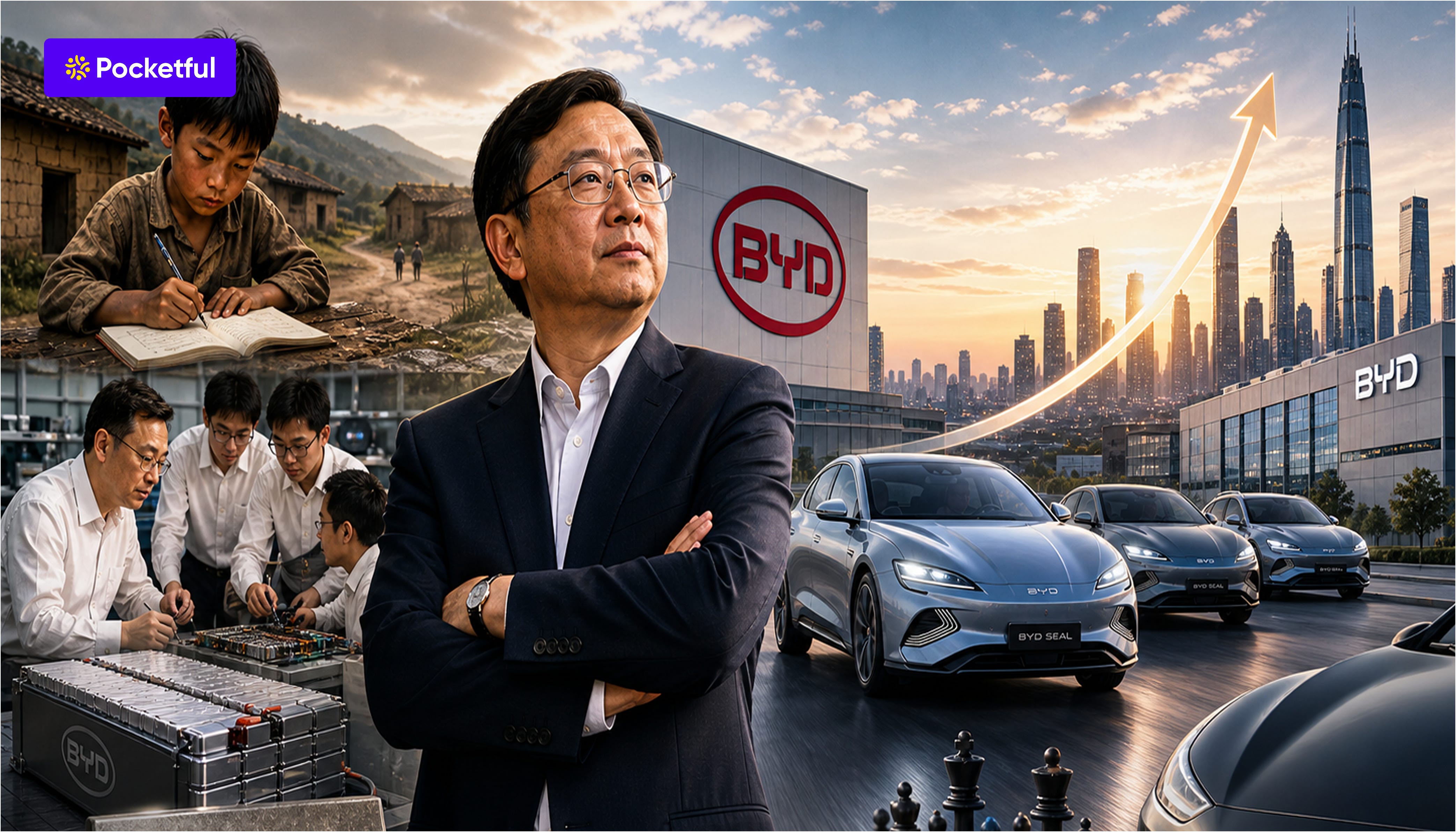
Picture this. It is 2008, and Warren Buffett’s team is visiting a relatively unknown Chinese battery company. They are trying to decide if they should invest $232 million into the business.
The company’s CEO, Wang Chuanfu, desperately wants to prove that his batteries are completely safe and eco-friendly. So, what does he do? He pours a glass of the battery’s chemical fluid and literally drinks it right in front of the shocked American investors.
They thought he was crazy. But today, that “crazy” man runs BYD, which stands for Build Your Dreams. In 2024, BYD officially overtook Tesla to become the largest manufacturer of electric vehicles in the world.
But how did an orphan from a small farming village build a company that beats Elon Musk at his own game? Grab a cup of coffee. Let’s connect the dots.
The Hustle and The Hidden Moat
Wang Chuanfu did not start out building cars. He was an orphan who studied metallurgy, which is the science of metals. His older brother and sister-in-law sold their personal jewelry just to buy him textbooks.
In 1995, he took a $300,000 loan from his cousin and started a company to make batteries for old-school mobile phones. At the time, he could not afford the multi-million dollar Japanese robots needed for his assembly line.
So, he reverse-engineered the machines. He broke down the complex robotic movements into simple steps and hired hundreds of workers to do them by hand. This aggressive DIY attitude became BYD’s biggest superpower.
By 2003, Wang bought a failing state-owned car company and started putting his batteries into vehicles. People laughed at him. But Wang knew something others did not. He knew that in an electric vehicle, the battery is everything.
This brings us to BYD’s ultimate weapon. They use a business model called complete vertical integration.
Think of traditional car makers like Apple assembling an iPhone. They buy screens from Samsung, glass from Corning, and then put it all together. Tesla does a bit of this too, buying their raw battery cells from outside suppliers like Panasonic.
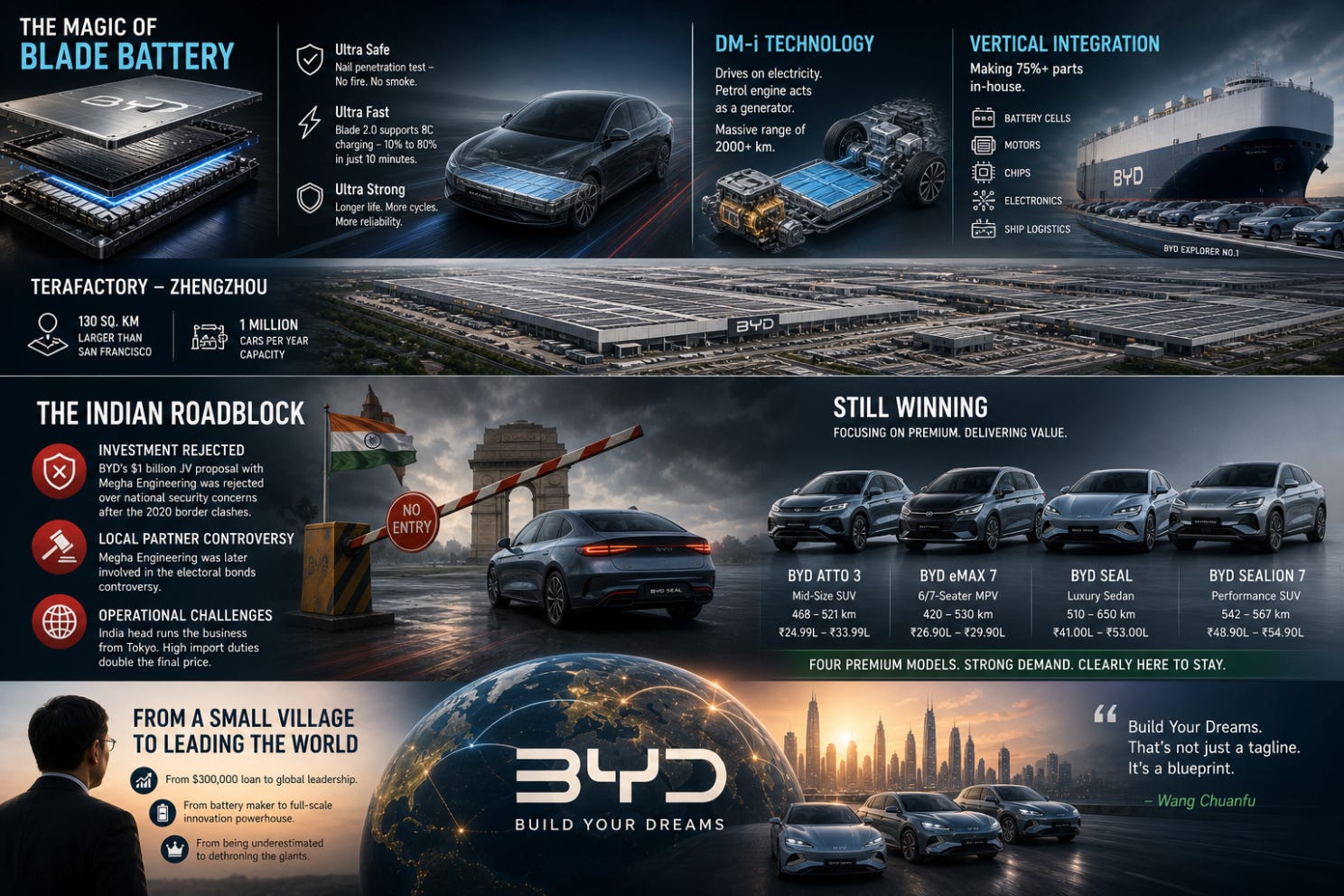
BYD operates like a restaurant that not only cooks your meal but also grows the vegetables and raises the chickens. They make 75% of their car parts entirely in-house. They manufacture their own semiconductor chips, electric motors, and battery cells. They even bought their own massive cargo ships to transport the cars across the ocean. This extreme control makes their cars incredibly cheap to build.
The Magic of the Blade Battery
But it is not just about being cheap. BYD’s underlying technology is genuinely mind-blowing.
While Tesla focused on “NCM” batteries that use expensive nickel and cobalt, BYD went all-in on “LFP” batteries. Think of Tesla’s battery like a sprinter. It gives explosive power but gets very hot. BYD’s LFP battery is like a marathon runner. It is highly stable, lasts forever, and stays cool.
BYD shaped these batteries into long, thin rectangles called Blade Batteries. Because they are flat, they can be stacked tightly together, saving tons of space inside the car.
They are also ridiculously safe. If you drive a steel nail through a normal EV battery, it bursts into violent flames. When scientists do the exact same nail test on a Blade Battery, it does not even smoke.
Now, BYD has launched the Blade 2.0 battery. It supports 8C ultra-fast charging, which means it can charge from 10% to 80% in an unbelievable 10 minutes. It is practically as fast as filling up a petrol tank!
They also cracked the code on hybrid cars with their 5th-generation DM-i technology. Most older hybrids use the petrol engine to drive the wheels, with a tiny electric motor helping out.
BYD flipped the script entirely. The car drives on electricity almost all the time. The petrol engine just sits quietly in the background, acting like a built-in power bank to recharge the battery while you drive. This clever trick gives their cars a massive range of over 2,000 kilometers on a single charge and a full tank.
To build all of this, they are finishing a massive “Terafactory” in Zhengzhou, China. This single factory covers 130 square kilometers, making it physically larger than the entire city of San Francisco. It will pump out 1 million cars a year.
The Indian Roadblock and The Big Picture
So, if BYD is this massive, why don’t we see them everywhere on Indian roads? Well, they certainly tried.
In 2023, BYD proposed a $1 billion joint venture with an Indian infrastructure company called Megha Engineering. They wanted to build a massive EV plant in Hyderabad to manufacture 15,000 cars a year right here in India.
But the Indian government said a flat “No”.
Why did this happen? After the 2020 border clashes, India changed its rules to strictly monitor investments from countries sharing a land border. Officials cited national security concerns. To make matters worse, their local partner, Megha Engineering, later got caught up in the electoral bonds controversy.
Because they cannot build cars in India, BYD faces massive hurdles. Their India head literally has to run the business from Tokyo because he could not get a work visa.
Since they have to import their cars fully built, they are slapped with massive import taxes. These taxes effectively double the final price of the vehicle for the Indian consumer.
But here is the crazy part. BYD is still winning.
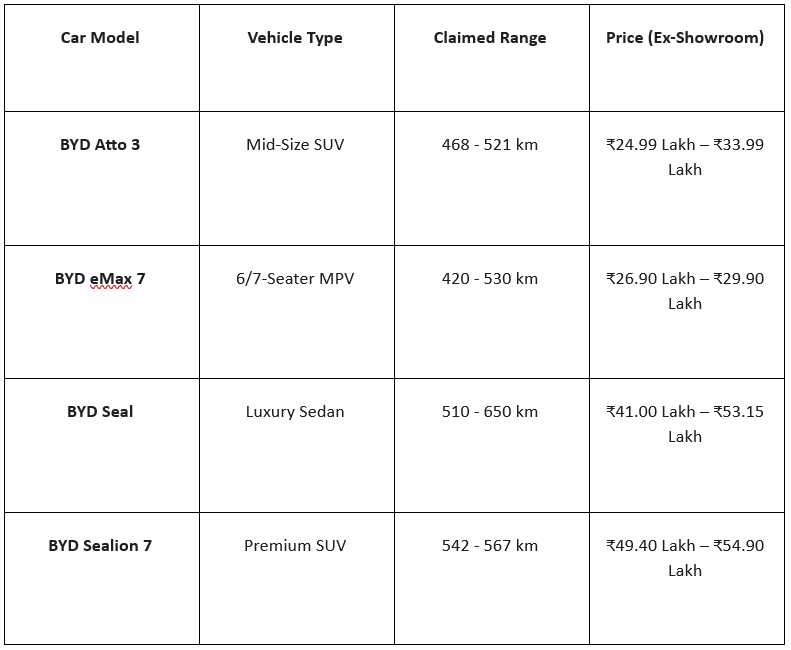
Instead of fighting for the budget market, they pivoted to wealthy buyers. They currently sell four premium models in India, and the pricing shows they are not backing down.
While Tesla has only managed to sell around 225 cars in India since debuting, BYD sold nearly 6,000 cars in 2025 alone. That is an 84% jump from the previous year, far outpacing the overall EV market growth.
They are aggressively expanding their physical presence, too. They just opened their biggest
Indian showroom in Moti Nagar, Delhi, spanning an impressive 10,000 square feet. They now have 48 showrooms across 40 cities.
The big picture is fascinating. India’s strict rules might protect local companies and national security in the short term. But BYD’s battery tech is so far ahead of the curve that Indian consumers are willingly paying double the price just to get their hands on it.
If BYD can grow 84% with one hand tied behind its back, just imagine what happens if the trade rules ever change.
Lingo of the Week: Vertical Integration
Imagine you run a lemonade stand. Instead of buying lemons and sugar from the supermarket, you plant your own lemon trees and grow your own sugarcane.
That is Vertical Integration. It means a company owns its entire supply chain, making its own parts instead of buying them from others, which saves money and gives them total control.
Pocketful isn’t just another trading platform - we’re your partners on the journey to financial freedom.
Thank you for reading!
👀 Stay tuned. Stay diversified.
Until next time,
Team Pocketful.
Follow Us: Website
Download Our App: Available on Google Play & Apple App Store
https://www.ourchinastory.com/en/13225/BYD's-founder-Wang-Chuanfu:-Two-people-changed-his-whole-life