

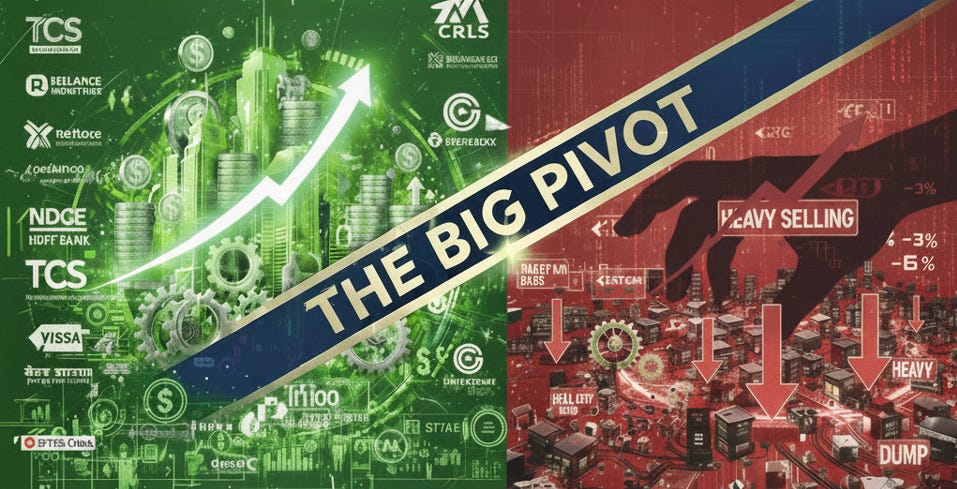
Imagine this - Nifty is hitting new highs, social media is buzzing with screenshots of index returns, and business channels celebrate “record markets”. But when you open your own portfolio, it doesn’t feel like a party. A few large names are green, but a long list of smaller stocks are either flat or in the red. You double-check the index level, then your P&L, and the numbers simply don’t add up in your mind.
Welcome to the strange world of a large-cap dominated market, where a handful of giants do the heavy lifting while the rest quietly struggle in the background. For many investors, this has been the story of the last few years – especially around 2018–2019, then again during the inflation scare of 2022, when risk-off sentiment and global worries pushed money into size, safety and liquidity.
Today, a new question is starting to surface: what if the next leg of this cycle doesn’t belong to the giants at all? What if the market is quietly preparing for a pivot, where small-caps – the ignored, the under-owned, the volatile – become the new leaders? That shift in leadership, from large-caps to small-caps, is what we’re calling “The Big Pivot.”
This is the story of how we got here, what history says about such rotations, and how a cycle-aware investor can navigate the size divide without losing sleep.
Two Markets, One Screen
On the surface, there is just “the market”. One index, one chart, one number that flashes every day. But beneath that single number sit two very different ecosystems: large-caps and small-caps.
Large-caps are the market’s blue-bloods – the top layer of companies by market capitalization, usually the top 100 by size. They are well analyzed, widely owned by institutions, and have deep liquidity. In bad times, they are treated almost like financial fortresses: big banks, large consumer companies, top IT exporters, infrastructure giants. These are the names people rush into when the world looks risky.
Small-caps live on the other side of the spectrum. They’re often younger, more domestically focused, more sensitive to credit and demand cycles, and much more volatile. Some will become the large-caps of tomorrow; many will fade away. When risk appetite disappears, they’re the first to be dumped. When sentiment improves, they’re often the first to double.
The fascinating part? Both groups sit on your screen, trading on the same exchange, reacting to the same budget, the same RBI decision, the same global headlines. But they don’t react in the same way, because they occupy different places in the emotional hierarchy of investors. Large-caps represent safety and visibility. Small-caps represent growth and optionality.
Understanding the Big Pivot starts with understanding this split.
The Years of the Giants
To see why this pivot matters, we have to rewind.
From around 2018 onward, Indian markets entered a phase where large-caps quietly tightened their grip on performance. A series of shocks – IL&FS and NBFC stress, trade-war worries, patchy domestic growth – made investors cautious. When fear rises, money doesn’t leave the market entirely; it often just moves upward in size. In those years, the Nifty 50 and other large-cap indices held up reasonably well, but small-cap indices suffered long stretches of underperformance and drawdowns.
Something similar happened globally. In the US, the S&P 500 and especially a handful of mega-cap tech names pulled far ahead of the broader market in 2018–2019 and again post-2020, while smaller companies lagged. Owning the index, or better yet a few of its top stocks, felt like the only strategy that worked. Missing those leaders felt like failure.
This is the classic signature of a narrow, large-cap led market:
Indexes look fine.
Breadth weakens – fewer stocks participate in rallies.
Concentration rises – more of the index is controlled by fewer names.
The problem with such a structure is simple: it cannot last forever. Either earnings in the rest of the market eventually catch up – which is the small-cap revival – or the leaders eventually disappoint and pull the index down.
The Covid Shock and the Small-Cap Whiplash
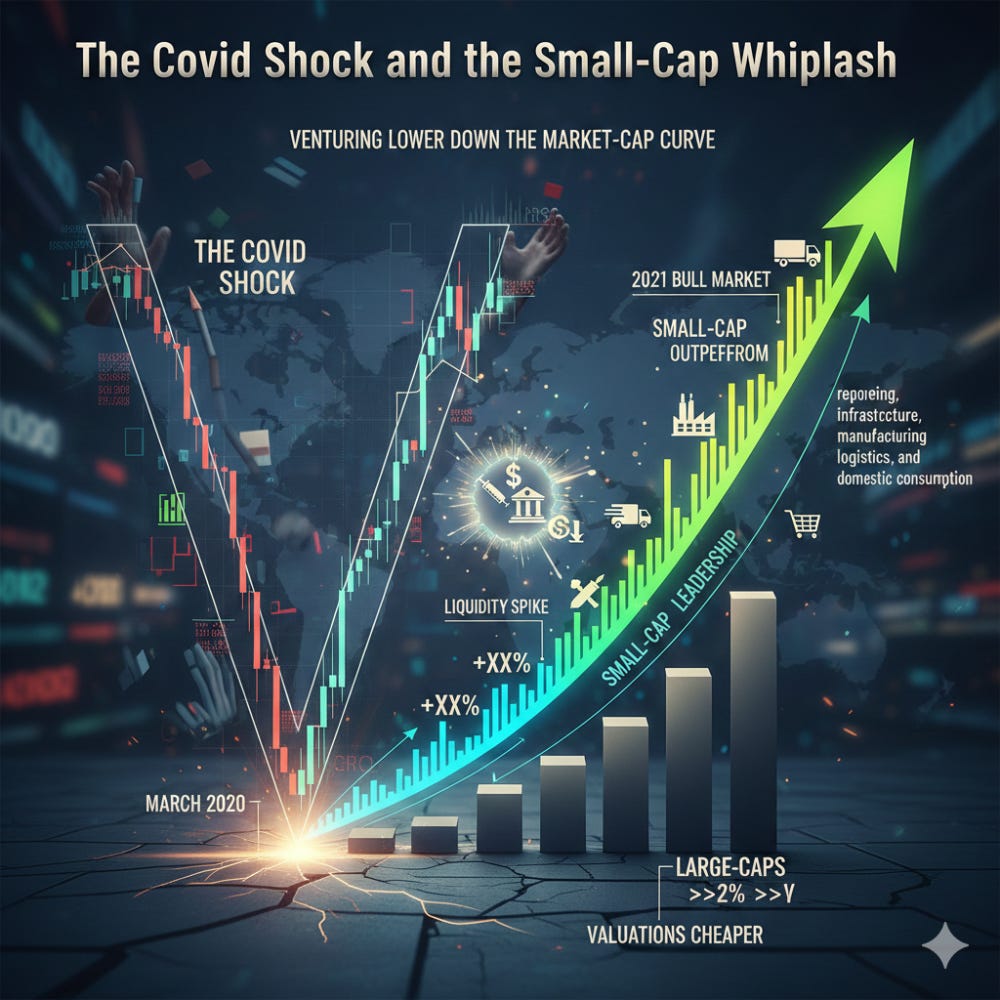
Then came March 2020.
The world shut down. Markets crashed. For a brief period, everything was correlated to one thing: panic. Large-caps, small-caps, defensives, cyclicals – everything sold off together. It was less about size and more about survival and liquidity.
But as brutal as that drop was, what came next was even more revealing.
Once central banks slashed rates, liquidity spiked and governments rolled out stimulus, risk appetite returned faster than anyone expected. From the March 2020 lows into 2021, a strange reversal unfolded: the least loved segment of the prior years – small-caps – started outperforming sharply.
Why? Two reasons.
First, they had fallen more. Small-caps, already beaten down from their 2018–2019 underperformance, entered the Covid crash from a position of weakness. When everything fell, they went down harder. That meant they were also trading at much cheaper valuations relative to their historical norms and their earnings potential.
Second, they were more sensitive to the kind of recovery the market was expecting. As investors bet on reopening, infrastructure, manufacturing, logistics and domestic consumption, it wasn’t just the giants that would benefit. Many of the real growth stories – specialty manufacturers, engineering firms, niche lenders, capital goods suppliers – sat in the small-cap and mid-cap buckets.
The result: small-cap and mid-cap indices massively outpaced large-caps in percentage terms over the next 12–18 months. For a brief, intense window, the market said clearly: “You were paid for hiding in big names in 2018–2019; now you will be paid for venturing lower down the market-cap curve.”
That was a small-cap leadership phase inside the same broader bull market.
Inflation, Rates, and the Return of Safety
Of course, no leadership lasts forever.
As inflation began to spike globally in 2021–2022 and central banks pivoted from stimulus to rate hikes, the market’s mood flipped again. Rising rates and worries about global recession hit high-growth, high-beta pockets hardest. In that environment, strong balance sheets, cash generation and pricing power became more valuable than pure growth stories.
Large-caps regained their crown.
In India, big banks, established IT firms and consumer majors once again outperformed a long tail of smaller names as investors sought quality and visibility. Globally, the S&P 500 and other large-cap benchmarks, while volatile, generally held up better than small-cap indices during the sharpest rate fears.
If you zoom out over the last seven years, you can see the pattern clearly:
2018–2019: Large-cap dominance, small-caps derated.
2020–2021: Small-cap catch-up and outperformance from bombed-out levels.
2022: Large-caps reclaim leadership during the inflation and rate-hike scare.
This is style rotation in action – not just between “growth vs value,” but between size segments. And that brings us to the present moment.
What a Real Pivot Looks Like
So how do you know when a genuine pivot – from large-caps back to small-caps – is happening, instead of just a noisy bounce?
It rarely announces itself with a single day’s move. Instead, it appears as a set of quiet, repeating clues:
Relative performance flips: on rolling 3–6 month windows, small-cap indices start outperforming large-cap indices, not just on isolated big green days.
Breadth improves: more stocks are making new highs, not just a small list of index heavyweights. Healthy bull legs have wide participation.
Sector leadership broadens: winners are no longer restricted to a few defensives or exporters. Domestic, cyclical, and capital-intensive sectors with plenty of small-cap representation begin to show strong price and volume action.
Valuation gaps close: the extreme discount at which quality small-caps were trading relative to large-caps begins to shrink as re-rating takes place.
When this combination persists, not for days but for months, you are likely living through a real Big Pivot – a change in who the market chooses to reward.
Why This Pivot Matters for You
On paper, all of this can sound abstract. In practice, it has a simple implication:
If you stay permanently married to only one side – “I’m a large-cap investor” or “I only buy small-caps” – you will go through long cycles of disappointment. The market doesn’t care about fixed identities. It cares about where risk is being rewarded in this phase of the cycle.
The years where large-caps dominated rewarded people who stayed anchored in safety. The post-Covid rebound rewarded those who were willing to shift some capital into smaller names when fear was still high but valuations and earnings were turning. The inflation scare rewarded those who had again respected the need for quality and fortress balance sheets. Each phase benefited a different set of behaviors.
If the next 12–24 months genuinely mark a pivot toward broader participation and improving small-cap earnings, then portfolios heavily chained to only the largest names may underperform even if they feel “safer.” The risk is not just losing money; it is losing opportunity.
A Cycle-Aware Way to Think About Size
The goal is not to time the top or bottom of any segment perfectly. That’s impossible. Instead, the goal is to become cycle-aware in how you allocate between large-caps and small-caps.
In fear-heavy periods, when macro uncertainty is high and liquidity conditions are tight, it makes sense for large-caps to form the bulk of your equity exposure. They anchor the portfolio and help you survive.
When data, earnings and breadth suggest that growth is broadening and smaller companies are starting to deliver, it makes sense to gradually redirect some of that capital lower down the market-cap curve. Not by betting on every micro-cap rumour, but by owning:
diversified small-cap or mid-cap baskets,
sector funds tied to domestic themes, or
handpicked businesses where you understand the balance sheet and cash flows.
Think of large-caps as the foundation and small-caps as the floors you add during the right weather. You don’t remove the foundation. You just decide how high to build based on the environment.
The Mindset Shift: From “Forever” to “For This Phase”
Perhaps the most important change the Big Pivot demands is mental, not mathematical.
Instead of thinking “large-caps are always safer” or “small-caps are always better for returns,” it helps to ask a different question:
“Given where we are in the cycle today – in terms of growth, liquidity, inflation, rates and breadth – which part of the market is currently being rewarded for the risks it takes?”
In some years, the answer will be large-caps. In others, it will be small-caps. Most of the time, it will be a mix, with the weight shifting gradually as the cycle evolves. Being willing to move with that shift – without chasing every short-term move or abandoning basic risk controls – is what separates cycle-aware investors from those who feel like the market is always one step ahead of them.
The past decade has already given the blueprint: narrow large-cap phases, explosive small-cap catch-up phases, and periods where safety reclaims its premium. The Big Pivot we are watching now is not a completely new story. It is the next chapter in the same book.
Lingo of the Week: Style Rotation
Style rotation is the term used when the market gradually changes its favorites – for example, from large-caps to small-caps, or from growth stocks to value stocks. You don’t spot it from a single big day. You spot it when, over months, one group of stocks consistently beats another and new names keep appearing in the list of top performers while old leaders begin to lag. Recognizing a style rotation early doesn’t remove risk, but it helps you position for the market that is emerging, rather than staying stuck in the one that has already passed.
Pocketful isn’t just another trading platform - we’re your partners on the journey to financial freedom.
Thank you for reading!
👀 Stay tuned. Stay diversified.
Until next time,
Team Pocketful.
Follow Us: Website
Download Our App: Available on Google Play & Apple App Store