

What if I told you that one of India’s most important technology companies doesn’t sell a single product under its own brand?
Sounds unusual, doesn’t it? We often assume the logo on a smartphone, television or laptop belongs to the company that made it. In reality, many of the world’s biggest brands rely on specialized manufacturers to bring their products to life. Hidden behind the familiar names on store shelves is an entire industry that most consumers never notice.
One of the biggest players in this space is Dixon Technologies. It doesn’t chase the spotlight or compete for brand recognition. Instead, it quietly powers some of the world’s leading electronics companies, proving that sometimes the businesses creating the most value are the ones working behind the scenes.
Choosing the Factory Instead of the Brand
When Sunil Vachani founded Dixon Technologies in 1993, India’s electronics market looked very different from today. Imported products dominated shelves, domestic manufacturing was limited and becoming a consumer brand seemed like the obvious path to success.
Dixon made a different choice.
Rather than spending years building a retail brand, the company focused on becoming exceptionally good at manufacturing. It started with colour televisions but gradually invested in production capabilities, quality systems and operational efficiency instead of advertising budgets. At a time when many businesses wanted customers to recognize their logo, Dixon wanted global companies to trust its factories.
That decision shaped the company’s future.
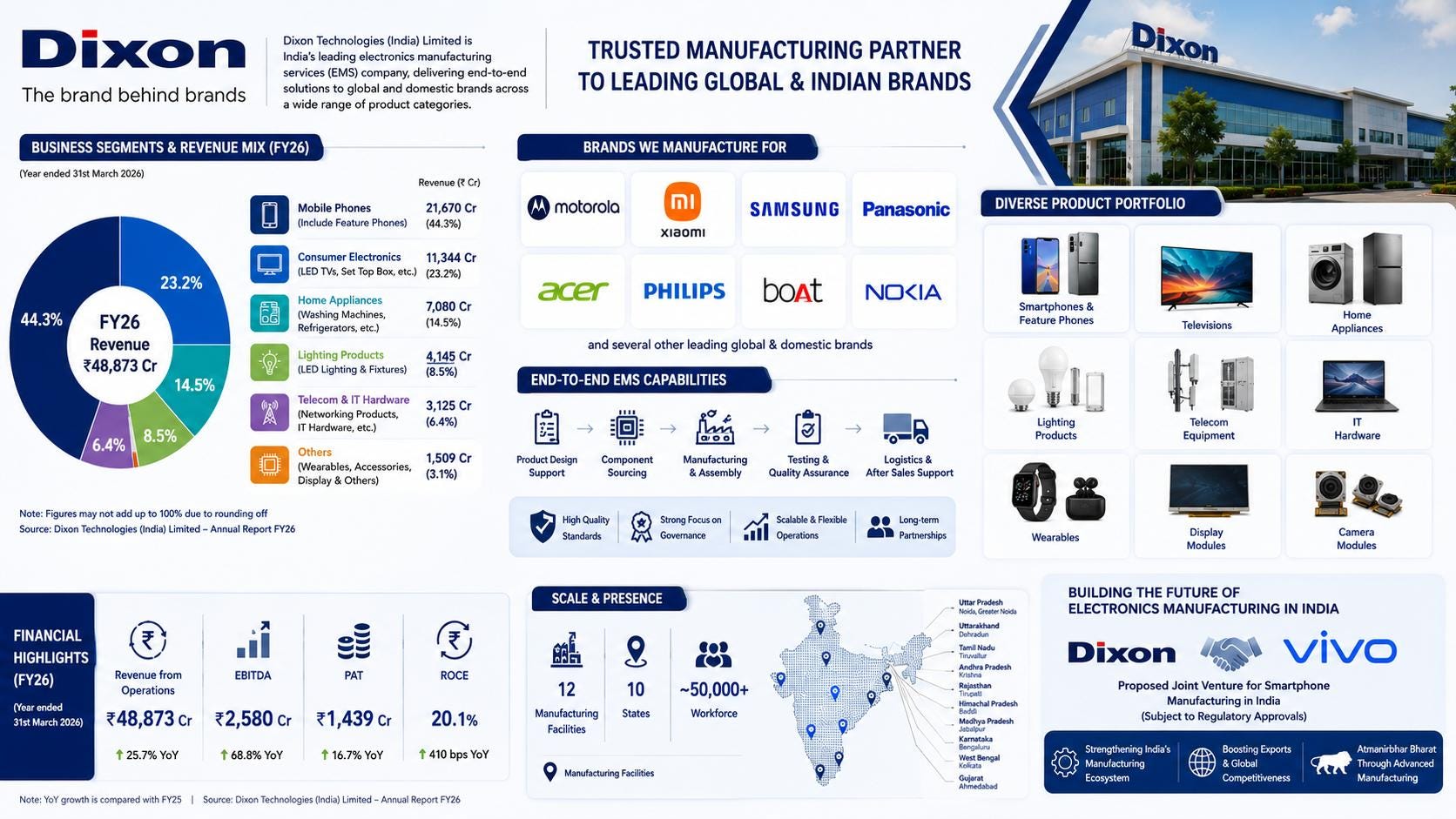
Over the years, Dixon expanded far beyond televisions into smartphones, feature phones, lighting products, washing machines, refrigerators, telecom equipment, IT hardware, wearables and display modules. Today, while consumers may never notice its name, many of the products they use every day have passed through a Dixon manufacturing facility before reaching store shelves.
The company succeeded by doing something surprisingly simple allowing other brands to shine while quietly becoming indispensable to them.
The Business Behind the Brands
To understand Dixon, it’s important to understand the business it operates in.
Imagine you have designed an excellent smartphone. You have the software, the marketing strategy and the distribution network ready. The only problem is manufacturing. Setting up a modern electronics factory requires enormous capital, highly skilled workers, sophisticated machinery, strict quality controls and an efficient supply chain capable of sourcing thousands of components from around the world.
For many companies, building all of this simply doesn’t make economic sense.
This is where Electronics Manufacturing Services (EMS) companies come in. They manufacture products on behalf of brands, allowing those brands to focus on innovation, design and customer relationships. It is similar to how a publishing house hires a professional printing company instead of owning its own printing press. Each participant specializes in what it does best.
As more electronics companies adopted this asset-light model, manufacturers like Dixon became increasingly valuable. Producing for multiple brands also creates economies of scale, enabling manufacturers to improve efficiency while keeping costs competitive. Over time, this specialization has transformed EMS into one of the fastest-growing segments of the global electronics industry.
Dixon’s business model demonstrates an important principle: sometimes the most successful companies are not the ones consumers see, but the ones enabling everyone else to succeed.
Why India’s Manufacturing Story Is Changing
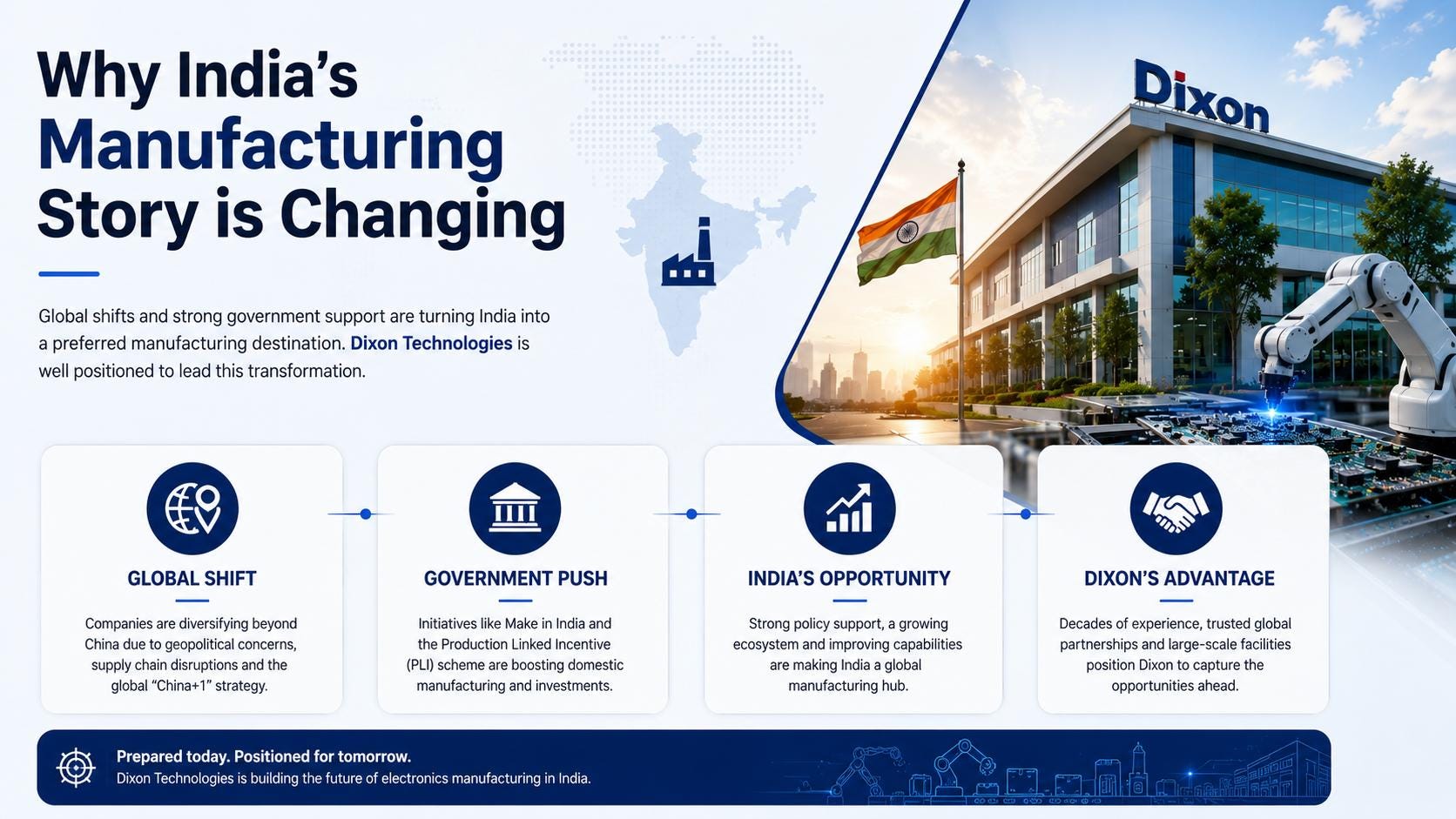
For decades, global electronics manufacturing was concentrated largely in China because of its established supplier ecosystem, skilled workforce and world-class infrastructure. However, recent geopolitical developments, supply chain disruptions and the global “China+1” strategy have encouraged companies to diversify manufacturing across multiple countries.
India has emerged as one of the biggest beneficiaries of this shift.
Government initiatives such as Make in India and the Production Linked Incentive (PLI) scheme have encouraged companies to expand domestic manufacturing by rewarding higher production and investment. These policies are not just aimed at assembling products they seek to create a complete manufacturing ecosystem involving suppliers, component makers, logistics providers and technology companies.
For Dixon Technologies, this created the perfect environment to grow. Unlike newer players entering the industry, Dixon already had decades of manufacturing experience, strong relationships with global brands and large-scale production facilities. As companies searched for reliable manufacturing partners in India, Dixon was well positioned to capture the opportunity.
Its growth wasn’t driven by a single breakthrough product or one lucky contract. Instead, it was the result of years spent quietly building capabilities before the market fully recognized their importance. In business, preparation often matters just as much as opportunity.
Back in the Spotlight
Although Dixon has steadily expanded over the years, the company recently returned to the spotlight following two major developments that highlighted the growing importance of India’s electronics manufacturing sector.
The first was the Government’s approval of a ₹62,500 crore mobile phone manufacturing scheme, designed to strengthen domestic production and encourage further investment across the electronics value chain. The announcement reinforced India’s long-term commitment to becoming a global manufacturing destination and created optimism for companies operating in the EMS industry.
Shortly afterwards, global brokerage upgraded Dixon Technologies, citing improved earnings visibility and stronger long-term growth prospects under the new manufacturing framework. The market reacted positively, with the company’s shares gaining nearly 7% in a single trading session.
While the headlines focused on the stock’s movement, the bigger story was the industry’s direction. These developments reflected growing confidence that India is moving beyond being a large consumer market and steadily establishing itself as an important manufacturing base for global electronics brands.
For Dixon Technologies, this wasn’t the beginning of its journey, it was recognition of one that had been quietly unfolding for more than three decades.
Building Businesses, Not Just Products
One of the biggest reasons behind Dixon Technologies’ rise is that it never relied on a single customer or a single product category. Instead, the company steadily expanded its manufacturing capabilities while building long-term relationships with some of the world’s largest electronics brands.
Today, Dixon manufactures products for companies including Motorola, Xiaomi, Samsung, Panasonic, Acer, Philips, boAt, Nokia and several other domestic and international brands. Rather than competing with them, Dixon acts as a trusted manufacturing partner, helping these companies produce electronics at scale while maintaining quality and efficiency.
The company has also expanded beyond assembling finished products. It has entered businesses such as IT hardware, telecom equipment, display modules, camera modules and electronic components, gradually moving higher up the manufacturing value chain. This strategy, often called backward integration, allows manufacturers to produce more components in-house instead of depending entirely on imports. Besides improving efficiency, it also supports India’s broader objective of building a stronger domestic electronics ecosystem.
Another important milestone has been Dixon’s proposed joint venture with Vivo for smartphone manufacturing in India, subject to regulatory approvals. Partnerships like these highlight the growing confidence global companies have in India’s manufacturing capabilities and demonstrate how local manufacturers are becoming increasingly important in global supply chains.
The Numbers Behind the Story
Behind every successful business lies a set of financial numbers that tells whether growth is sustainable. Over the last three years, Dixon Technologies has delivered remarkable expansion, driven primarily by rising smartphone manufacturing and increasing demand across multiple product categories.
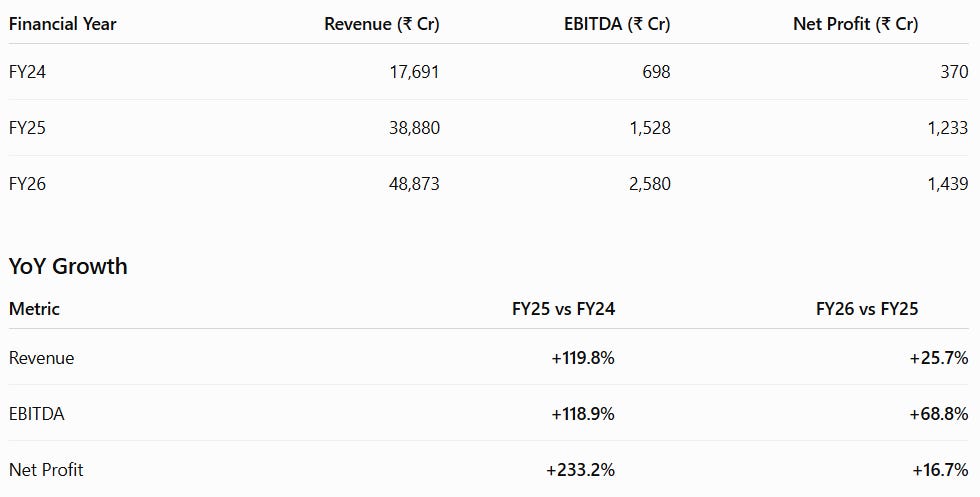
The numbers reveal the scale of Dixon’s transformation. In just two years, revenue nearly tripled from ₹17,691 crore to almost ₹49,000 crore, reflecting strong demand for electronics manufacturing, particularly in smartphones. Profit also increased substantially during the period, although the business continues to operate on relatively modest margins, a common characteristic of large-scale manufacturing businesses where raw materials and components account for a significant share of costs.
The key takeaway isn’t just that the company became larger, but that it successfully scaled its operations while expanding into newer product categories and strengthening relationships with leading global brands.
More Than Just a Manufacturing Company
What makes Dixon particularly interesting is that its growth mirrors India’s changing role in the global economy.
For years, India was primarily viewed as a massive consumer market where international brands sold products manufactured elsewhere. Today, that narrative is gradually changing. As companies diversify their supply chains and governments encourage local production, India is emerging as both a consumer and a manufacturing destination.
Dixon sits at the centre of this transition. Instead of building a global consumer brand, it has built manufacturing expertise that global brands increasingly rely upon. Every new factory, production line and customer relationship strengthens not only the company but also India’s broader manufacturing ecosystem.
Its journey also highlights an important shift in modern business. Increasingly, competitive advantage isn’t created by doing everything yourself—it’s created by becoming exceptionally good at one critical part of the value chain. Dixon chose manufacturing, invested patiently for decades and is now benefiting from structural changes taking place across the global electronics industry.
Lessons from Dixon’s Journey
Dixon Technologies offers several lessons that extend beyond finance and manufacturing.
The first is the importance of specialization. Rather than competing directly with global brands, the company focused on mastering manufacturing, allowing it to build deep expertise in an area many companies preferred to outsource.
The second lesson is adaptability. From colour televisions in the 1990s to smartphones, wearables and IT hardware today, Dixon has consistently evolved alongside changing consumer demand and technological progress.
Third, the company’s story highlights the value of patient execution. Its recent success wasn’t created by one government scheme or one large customer. It was built over three decades through continuous investment in factories, people and production capabilities.
Finally, Dixon reminds us that some of the world’s most influential businesses operate quietly behind the scenes. Consumers remember brands, but industries often remember the companies that make those brands possible.
Disclaimer: This article is for educational purposes only and should not be considered investment advice or a recommendation to buy or sell any security.Lingo of the Week
EMS (Electronics Manufacturing Services)
What it means: Electronics Manufacturing Services (EMS) refers to companies that design, manufacture, assemble, test, and sometimes repair electronic products for other brands.
Why it matters: Instead of selling products under their own name, EMS companies manufacture for global brands, allowing them to focus on design, marketing, and customer experience. Dixon Technologies is India’s largest listed EMS company.
Example: When you buy a smartphone or TV, the brand may sell it but an EMS company like Dixon could be the one that actually manufactured it.
Pocketful isn’t just another trading platform - we’re your partners on the journey to financial freedom.
Thank you for reading!
👀 Stay tuned. Stay diversified.
Until next time,
Team Pocketful.
Follow Us: Website
Download Our App: Available on Google Play & Apple App Store