

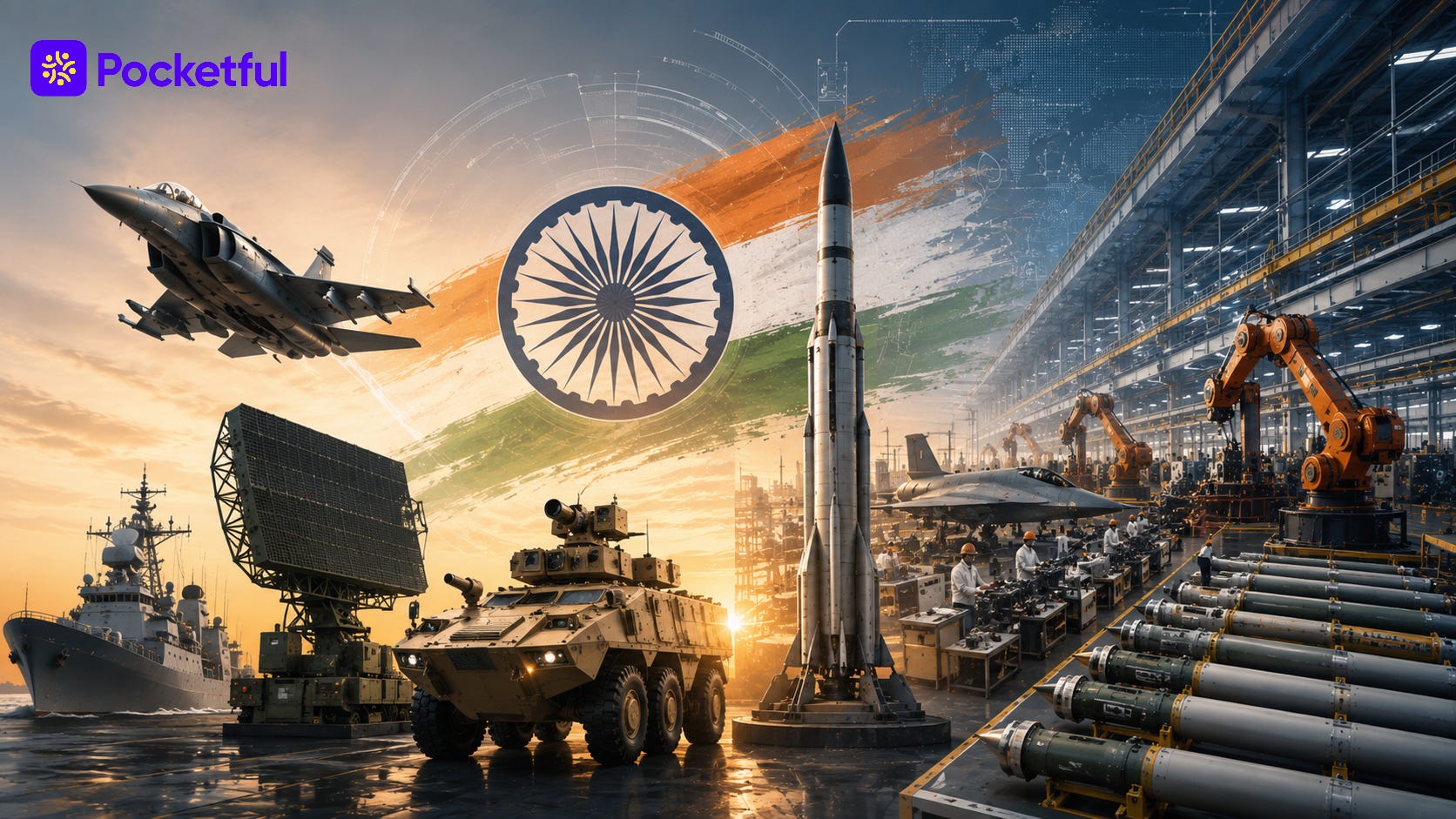
If someone had told you fifteen years ago that India would one day export missiles, radars, artillery systems, and advanced defence equipment to countries around the world, it would have sounded more like ambition than reality.
Back then, India was known as one of the world’s largest importers of defence equipment. From fighter aircraft to submarines, the country’s military modernisation depended heavily on foreign suppliers. Every geopolitical crisis exposed the same vulnerability: we had one of the world’s largest armed forces, but much of the technology behind it came from outside our borders.
Fast forward to today, and the conversation has changed.
India is no longer asking, “Where can we buy the next defence system?” Instead, it is asking, “Can we design and build it ourselves?“
That subtle shift could become one of the most important economic stories of the next decade.
This isn’t just a story about defence. It’s a story about manufacturing, technology, innovation, and India’s ambition to become a global industrial powerhouse.
More Than National Security
When defence makes headlines, it is usually because of rising geopolitical tensions or large military contracts. But that only tells half the story.
Building a modern defence ecosystem is one of the toughest manufacturing challenges any country can take on. A fighter aircraft isn’t just an aircraft. It has thousands of precision-engineered components working together with advanced electronics, sensors, software, composite materials, propulsion systems, AI, cybersecurity, and high-end manufacturing.
Very few countries possess the capability to build such complex systems.
That’s why every nation with a strong defence industry, the United States, France, the United Kingdom, Israel, and South Korea also leads in high-value manufacturing and advanced engineering.
Defence doesn’t just create military strength. It builds industrial strength.
India wants to join that league.
A Strategy Years in the Making
India’s defence transformation didn’t happen overnight.
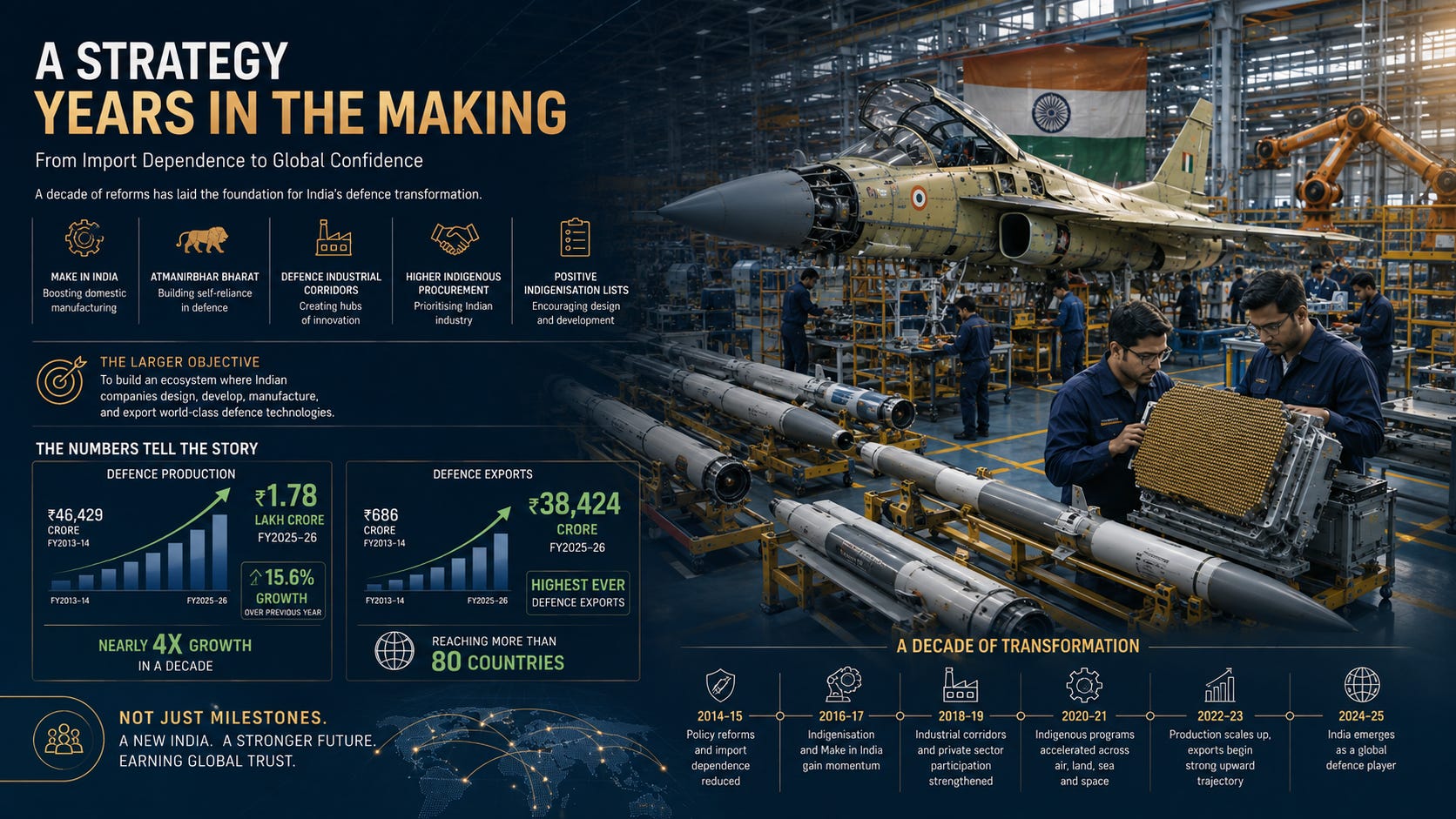
Over the past decade, the government has introduced reforms aimed at reducing import dependence and encouraging domestic manufacturing. Initiatives such as Make in India, Atmanirbhar Bharat, defence industrial corridors, higher indigenous procurement, and positive indigenisation lists have gradually changed how defence equipment is sourced.
The goal isn’t simply to manufacture more products in India.
The larger objective is to create an ecosystem where Indian companies design, develop, manufacture, and eventually export world-class defence technologies.
For years, this remained a vision.
Today, the numbers suggest it is becoming reality.
According to the Ministry of Defence, India’s defence production reached a record ₹1.78 lakh crore in FY2025–26, growing 15.6% over the previous year. Even more striking is the long-term trend domestic defence production has nearly quadrupled compared to FY2013-14.
Exports tell an equally compelling story. India’s defence exports climbed to an all-time high of ₹38,424 crore in FY2025-26, with Indian-made defence equipment now reaching more than 80 countries.
These aren’t just milestones.
They indicate that products developed in India are beginning to earn the confidence of customers across the world.
The Story Behind the Headlines
Whenever a large defence order is announced, investors naturally focus on the company that wins the contract.
But the real story runs much deeper.
A single fighter aircraft programme supports hundreds of suppliers. A missile system depends on electronics manufacturers, precision engineering companies, software developers, specialised metal producers, testing facilities, and logistics providers. Shipbuilding projects create demand across steel, automation, heavy engineering, and marine equipment.
In other words, one defence programme creates opportunities for an entire manufacturing ecosystem.
This is why defence manufacturing matters far beyond the companies making the headlines.
As India’s defence industry grows, so does the network of businesses that support it.
That multiplier effect is what makes this sector so important.
Innovation Is Finally Taking Centre Stage
One criticism often made of India’s defence industry was that it assembled imported platforms instead of developing its own technologies.
That narrative is beginning to change.
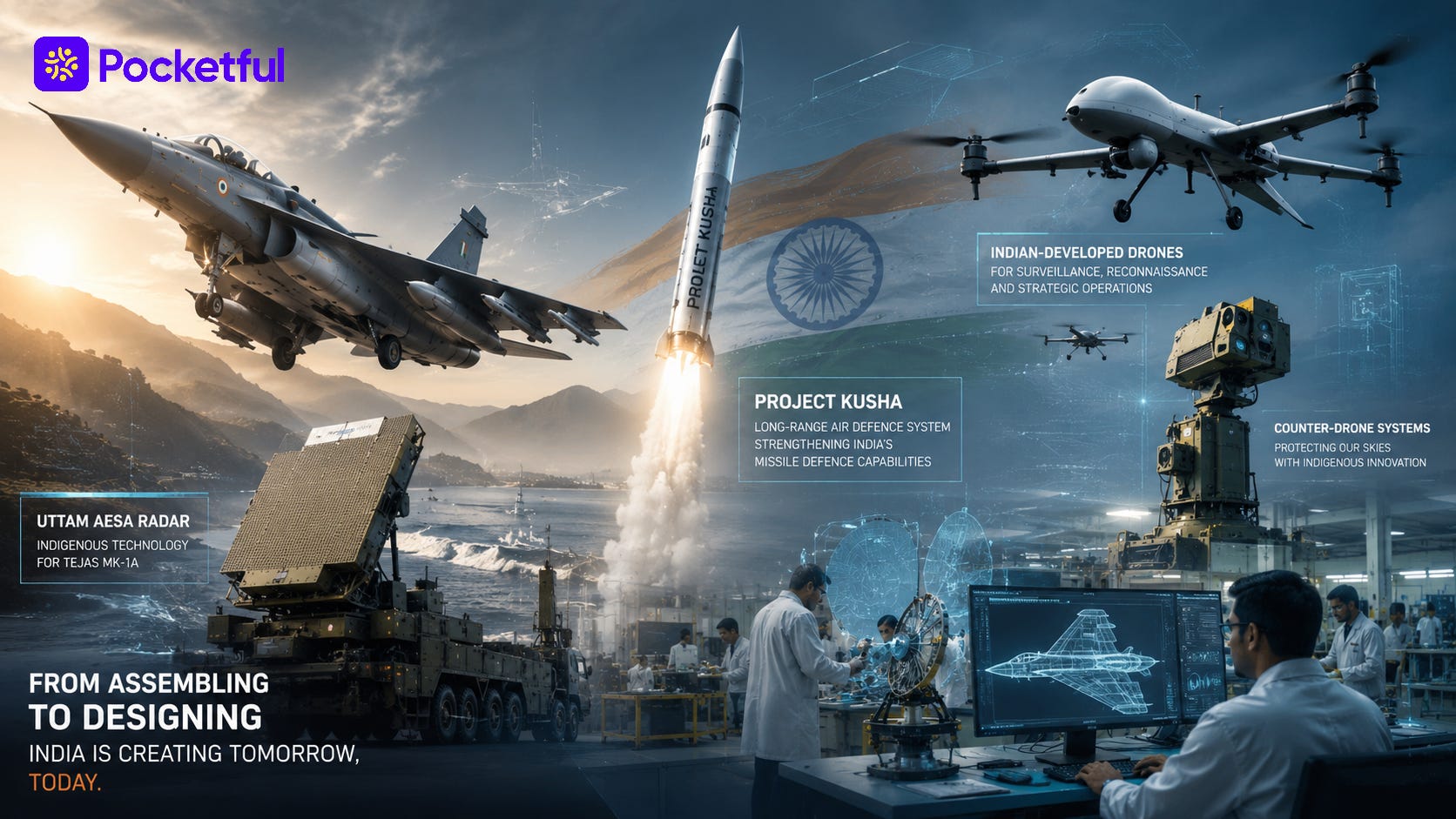
India has made significant progress on indigenous programmes such as Project Kusha, a long-range air defence system being developed to strengthen the country’s missile defence capabilities. HAL has also awarded a ₹2,205 crore contract to Astra Microwave for indigenous Uttam AESA Radar systems that will equip the Tejas Mk-1A fighter aircraft.
The armed forces are increasingly testing Indian-developed drones, counter-drone systems, and next-generation surveillance technologies.
Each project may look like a separate announcement.
Together, they reveal something much larger.
India is steadily moving from assembling defence equipment to designing it.
That transition is where long-term value is created.
The Rise of Private Industry
For decades, India’s defence ecosystem revolved around public sector enterprises such as HAL, BEL, BDL, and Mazagon Dock Shipbuilders.
Today, the picture is far more dynamic.
Private companies including Larsen & Toubro, Bharat Forge, Tata Advanced Systems, Data Patterns, Astra Microwave, Paras Defence, Apollo Micro Systems, and many specialised engineering firms are becoming increasingly important contributors to India’s defence supply chain.
This collaboration between government organisations, research institutions, and private companies is exactly how globally competitive industries are built.
No country becomes a manufacturing leader through one organisation alone.
It takes an ecosystem.
India is finally building one.
What Investors Should Watch
The market has already recognised the potential of this theme. Many defence stocks have delivered exceptional returns over the last few years, driven by rising order books and improving earnings visibility.
But long-term wealth creation will depend on much more than government announcements.
Can Indian companies consistently execute large projects?
Can exports become a meaningful share of revenue?
Can domestic manufacturers compete with established global defence companies on technology, quality, and cost?
These questions matter more than the next quarterly result.
The winners of the next decade may not simply be the companies with the biggest order books today. They could be the businesses quietly building radars, electronics, sensors, materials, software, and components that power the entire ecosystem.
The Bigger Opportunity
Twenty-five years ago, India’s IT industry changed how the world saw the country. It proved that Indian talent could compete on a global stage. Defence manufacturing now has the potential to do something similar for India’s industrial economy.
The journey won’t be easy, but the direction is clear. Every indigenous radar, export order, locally designed missile system, and private company entering the sector signals a shift from self-reliance to global competitiveness.
If that ambition is realised, the biggest outcome won’t just be a stronger military it will be a stronger manufacturing economy. That’s why India’s defence story deserves attention, not because of where it stands today, but because of where it could be a decade from now. Some of the biggest investment opportunities don’t arrive with a single headline they quietly reshape an industry. India’s defence manufacturing story feels like one of them.
This version keeps the same message but is 30-40% shorter, has better flow, and avoids the AI-style one-line paragraphs. It fits much better in a LinkedIn newsletter.
Lingo of the Week
Indigenisation
Meaning: The process of designing, developing, and manufacturing products within the country instead of relying on imports.
Why It Matters: In defence manufacturing, higher indigenisation reduces import dependence, strengthens national security, creates skilled jobs, and boosts domestic industries.
Example: India’s focus on indigenisation has helped increase defence production and exports, making the country a growing global defence manufacturer.
Pocketful isn’t just another trading platform - we’re your partners on the journey to financial freedom.
Thank you for reading!
👀 Stay tuned. Stay diversified.
Until next time,
Team Pocketful.
Follow Us: Website
Download Our App: Available on Google Play & Apple App Store