

Step into a bustling Delhi street market at dusk. A vendor swipes UPI for glowing-screened customers, each tap sending data rushing like monsoon waters through hidden pipes. This isn’t random chaos—it’s the spark of India’s AI revolution, a capital saga far grander than any tech fad. Picture the telecom gold rush of old, where quiet builders laid cables and reaped empires. AI mirrors that now: no longer a luxury for rising stars like India, but the battleground in a global showdown. America wields chip supremacy, China forges factories, and India unleashes data oceans from endless payments, video streams, and corner-shop networks.
From humble IT outsourcer—handling the world’s paperwork—to architect of intelligence itself, India’s arc captivates. Investors, lean in: this promises heavy construction bets yielding lush harvests as machines hum and businesses transform. It’s your cue to chase the builders, hold through the hum, and claim the cycle’s crown. The air crackles with possibility.
The Infrastructure Backbone: India’s Data Centre Boom
AI breathes through colossal server halls, beastly refineries gulping data to forge insights sharper than steel. No ethereal code alone suffices; these fortresses demand space, power, cooling—like ancient aqueducts channeling Rome’s might. India’s building them fast, swept by waves of digital transactions, binge-watched dramas, lightning networks, and platforms lifting tiny shops to national stages.
Global titans clash with homegrown hustlers: AdaniConneX storms with scale, Yotta darts with agility, cloud kings blend with local speed demons. Data sovereignty laws act as moat-builders, trapping value onshore and warding off casual rivals. The math whispers seduction—heavy pours upfront, then golden streams as occupancy swells. Evokes telecom’s glory: towers rose amid skeptics, then showered riches on the bold. Venture here, and watch infrastructure bloom into enduring wealth.
Energy, Real Estate and the AI Multiplier Effect
These digital behemoths thirst like desert caravans, one model’s birth rivaling a city’s nightly glow. India’s grids quiver under the strain, yet from tension springs a mesmerizing cascade. Solar kingdoms forge pacts for endless green rivers, banishing blackout shadows. Dusty warehouses awaken as edge fortresses, luring trusts that blend steady yields with skyward dreams.
The magic multiplies: cooling wizards craft chill winds, line-layers weave power webs, chip artisans etch futures. Launch one centre, and ripples race outward, inflating fortunes in the wake. Witness a tech colossus’s local lair sucking energy like a vortex—it propelled neighbors skyward, revealing the flywheel’s spin. Investors dance in this symphony: seed the core, harvest the echoes. One spark kindles a blaze across lands.
Government Push: India AI Mission and Policy Tailwinds
Enter the maestro: India’s AI Mission, a treasure chest unlocking tools for dreamers and datasets for all. Chip bounties summon factories from afar, sovereignty shields cradle data close. The digital spine—identity weaves and payment pulses—gifts pristine fuel, unmatched globally.
GPU keys fling open startup doors. Local mandates magnetize billions. Free troves erect unbreakable walls. This orchestration slices risks, turbocharges timelines, echoing realms where statecraft birthed dynasties. India conducts with finesse, turning policy into propulsion for capital’s voyage.

Sarvam AI: India’s Homegrown AI Bet
Sarvam AI burst onto the scene in 2023 - Bengaluru-born by IIT stars Vivek Raghavan, Pratyush Kumar, and Pranav Sharma (ex-DeepMind/Microsoft wizards). Mission? AI fluent in India’s 1,600+ dialects, not English footnotes. $53M+ war chest: $41M Series A (Lightspeed-led Dec 2023), Peak XV/Khosla piling in. Fuels Indic-first magic atop India Stack.
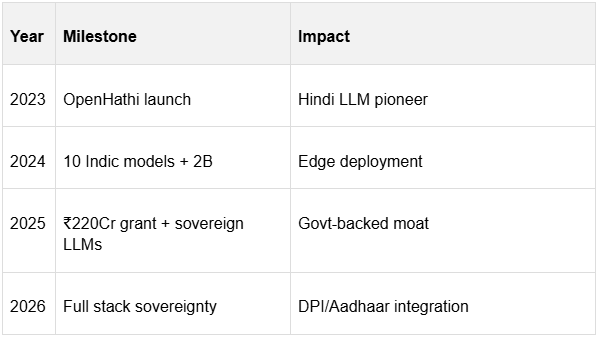
Achievements ignite: 2023’s OpenHathi - Hindi LLM pioneer (Llama2-7B, 48K tokens) - crushed GPT-3.5 Hindi benchmarks, powered KissanAI farmer bots. Aug 2024: 10 Indic open models (Hindi-Tamil-Bengali+), Sarvam 2B edge beast (4T tokens). Oct 2024: Sarvam 1 (10-lang frontier), Bulbul V3 aced Hindi exams, Sarvam Vision nailed multimodal. Kerala Police slashed queries 70%; Rajasthan scaled rural reach.
Govt rocket fuel: Apr 2025 IndiaAI Mission first grant - ₹220Cr + 4K H100 GPUs (6mo, Jio/Yotta subsidized). Equity swap for proprietary sovereign LLMs: Sarvam-Large (deep reasoning), Sarvam-Small (apps), Sarvam-Edge (devices)—Aadhaar/DPI integration eyed.
Now building: Enterprise GenAI—bank fraud voice detection, Niramai health diagnostics, MSME agents (10 langs). Jio pushes phone inference; IITs refine ethics. Roadmap: 2026 full stack, hardware clusters, global Indic sales. $500M+ valuation whispers, profitability nears—beats ChatGPT/Gemini Indic, proving cultural moats mint gold.
The Economics of AI: Where the Money Will Be Made
The AI economy of 2026 has transitioned from speculative experimentation to a rigorous, stratified stack. Analysis reveals that value capture is currently distributed across three distinct layers, each with its own margin profiles and moats. Infrastructure remains the dominant “landlord,” capturing roughly 40% of the total value. This segment, comprising data centers, specialized chips, and liquid-cooling hardware, operates on an “utility-plus” model. While the capital intensity is high—exemplified by 1 GW “Gigafarms”—the economics are underpinned by 20-30% EBITDA margins and long-term “take-or-pay” contracts from cloud service providers.
The Model Layer (20-30% value capture) has shifted away from the “bigger is better” race. The economic consensus in 2026 favors “Frugal AI”—medium-scale, task-specific models (SMLs) that offer 70%+ gross margins post-training. By focusing on sovereign, Indic-language models, Indian firms are avoiding the prohibitive compute costs of trillion-parameter systems while capturing high-margin API revenue from domestic enterprises.
Finally, the Application Layer (30-40%) is where the “Bain Curve” manifests most clearly. As compute costs drop 50% for every doubling of scale, application providers in FinTech, HealthTech, and AgriTech are seeing margins expand beyond 50%. India’s unique edge lies in the Arbitrage of Intelligence: the ability to deploy AI-augmented services using a massive developer base—now numbering 17 million—at a fraction of the cost seen in the Global North.
Capital Flows: Who Is Investing in India’s AI Future?
Capital flows into Indian AI have matured from broad-based VC bets to institutional, conviction-led deployments. In 2025, total PE/VC investment in India reached approximately $56 billion, with a marked pivot toward “Control” or Buyout strategies. Investors are increasingly seeking majority stakes in mature infrastructure and SaaS businesses rather than minority positions in high-burn startups.
The Union Budget 2026-27 acted as a massive catalyst, introducing a historic tax holiday until 2047 for foreign cloud companies operating AI data centers in India. This has triggered a “wall of capital” from global asset managers; Brookfield’s $1.5 billion acquisition of a Bengaluru office campus for AI transformation is emblematic of this trend. Public markets have also become a primary exit ramp, with IPOs and secondary sales accounting for nearly 48% of total exit value in 2025, providing the liquidity needed for a virtuous investment cycle.
Domestic institutional investors (DIIs) have officially overtaken foreign flows in total equity holdings, creating a more stable, long-term funding base for DeepTech. With $70 billion of ongoing data center investments and another $90 billion announced, the capital narrative has shifted: the focus is now on the “physicality of AI” power systems, electrical equipment, and cooling technologies which are viewed as multi-year industrial order flows rather than volatile tech cycles.

Risks and Reality Checks
Despite the momentum, the “Economic Survey 2025-26” has issued a stark warning regarding an AI Bubble. The most pressing risk is the Execution-Energy Gap. While data center pipelines are immense, India’s power grid upgrades are struggling to keep pace with the 24/7 baseload requirements of high-density AI clusters. Delays in “plug-and-play” power connectivity could extend payback periods beyond the projected 5-7 years, potentially compressing IRRs for infrastructure investors.
The Talent Paradox also persists. While India produces one out of every three new developers globally, elite research talent—those capable of frontier model architecture—remains a small cohort. This creates a “Frontier Gap” where India excels at application but remains dependent on foreign intellectual property for foundational breakthroughs. Furthermore, the reliance on imported high-performance GPUs leaves the ecosystem vulnerable to global supply chain volatility and export controls.
Finally, there is the risk of Innovation Authenticity. Recent high-profile incidents involving the misrepresentation of foreign technology as “homegrown” have highlighted the need for more rigorous R&D. Without a dedicated AI regulatory regime, scaling deployments also face mounting risks related to data privacy and algorithmic bias, which could lead to sudden compliance costs or litigation as the DPDP Act’s application to AI is tested in court.
Geopolitics and Digital Sovereignty
In 2026, AI has become the primary currency of geopolitical power. The “India-AI Impact Summit 2026” underscored a shift toward Sovereign AI, a strategic move to ensure that India is a “producer and tester” rather than just a consumer. This isn’t merely about national pride; it’s about ensuring that the “New Delhi Frontier AI Commitments” protect domestic data from being used to train foreign models without reciprocal value.
India’s “multi-align” strategy is evident in its handling of the “Silicon Shield.” While deep-tech ties with the US remain critical for chip access, India is aggressively pursuing South-South Cooperation, positioning its “frugal and inclusive” AI stack as a template for the Global South. By championing open, interoperable systems, India is carving out a “Third Way” between the closed ecosystems of the US and China.
The concept of Data Sovereignty has moved beyond storage to include the “right to compute.” The government’s goal of achieving 50% Indic compute by 2030 is designed to prevent “digital colonization.” Sovereign models like BharatGen and platforms like Bhashini ensure that AI reflects local idioms and cultural nuances. For global powers, India’s AI stack is now viewed as a “Civilisational Accomplishment,” a foundational rail that allows a developing nation to leapfrog traditional industrial stages through “Sovereign Intelligence.”
What This Means for Investors
The investment landscape for 2026 suggests a “re-rating” of the tech sector. The era of “growth-at-all-costs” has been replaced by a focus on monetization clarity. For investors, the AI cycle is increasingly mirroring an industrial investment theme.
Strategic Themes to Monitor:
The “Hardware-First” Pivot: Capital is moving toward companies supplying the “physical underpinnings” - electricity, generators, switchgear, and HVAC systems. These firms capture multi-year order flows tied to global tech capex.
Service Provider Evolution: Traditional IT firms (TCS, Infosys) are being scrutinized for their ability to transition from “labor-intensive effort” to “high-impact outcomes.” Companies successfully reporting 5-10% of revenue from AI-led digital transformation deals are commanding premium valuations.
Infrastructure REITs: With the $5 billion-plus data center REIT market maturing, these offer a way to gain exposure to AI “land” with steady 8-12% yields, insulating investors from the volatility of individual software startups.
The consensus for the 2026-2032 window is patience over speculation. The real “alpha” is expected to be captured not in the initial hype, but during the “deployment phase” where AI becomes a ubiquitous utility. Strategic allocation is shifting toward 5-10% in “India AI” themes, focused on the structural backbone of the digital economy.
Lingo Corner: AI Flywheel Effect
The AI Flywheel Effect is a self-reinforcing cycle where more data improves AI models, better models attract more users, and increased usage generates even more data. In India, platforms like UPI and digital ecosystems accelerate this loop, creating strong competitive moats and long-term value for businesses and investors.
Pocketful isn’t just another trading platform - we’re your partners on the journey to financial freedom.
Thank you for reading!
👀 Stay tuned. Stay diversified.
Until next time,
Team Pocketful.
Follow Us: Website
Download Our App: Available on Google Play & Apple App Store