


It’s that time of the quarter again. Revenue figures are being released, profits are under the scanner, and a single management comment can send a stock soaring or sinking.
The Q1 FY26-27 earnings season has begun, putting corporate performance back in the spotlight. But this time, the bigger question isn’t simply whether companies made more money. Investors want to know which sectors are gaining momentum, where growth is slowing, and whether corporate earnings can live up to market expectations.
From cautious global technology spending and changing banking sector trends to automobile demand and consumer spending, the June quarter results could reveal much more than just numbers.
The earnings season also arrives at an interesting time for the Indian stock market. Geopolitical uncertainty, volatile crude oil prices and changing global economic conditions have kept investors cautious.
So, which sectors could surprise investors this earnings season, and what should you really watch beyond headline profit figures?
What to Expect from Q1 FY26-27?
The June quarter earnings season could provide an early indication of how corporate India is performing in the new financial year.
According to market estimates, overall earnings growth during the quarter is expected to remain relatively moderate. However, the performance could vary significantly across sectors. Financial services and automobiles are expected to remain among the key areas of focus, while information technology companies could face challenges from cautious global technology spending. Consumer businesses will also be closely watched for signs of improvement in rural and urban demand.
At the same time, commodity-focused businesses may continue to face volatility due to fluctuations in global prices and geopolitical developments. This uneven performance makes sector-wise analysis particularly important during the current earnings season. Instead of looking at the overall profit growth of corporate India, investors may need to understand which industries are gaining momentum and which are struggling with slowing demand or rising costs.
Another important factor will be market expectations.
Indian stock markets have already witnessed significant movements across sectors in recent months. In some cases, stock valuations may already reflect expectations of strong earnings growth. This means even companies reporting healthy numbers could see negative stock price reactions if their performance falls short of what investors had expected.
Therefore, Q1 FY26-27 earnings season is not just about whether corporate profits are rising.
It is about whether companies can deliver the growth that markets have already priced in.
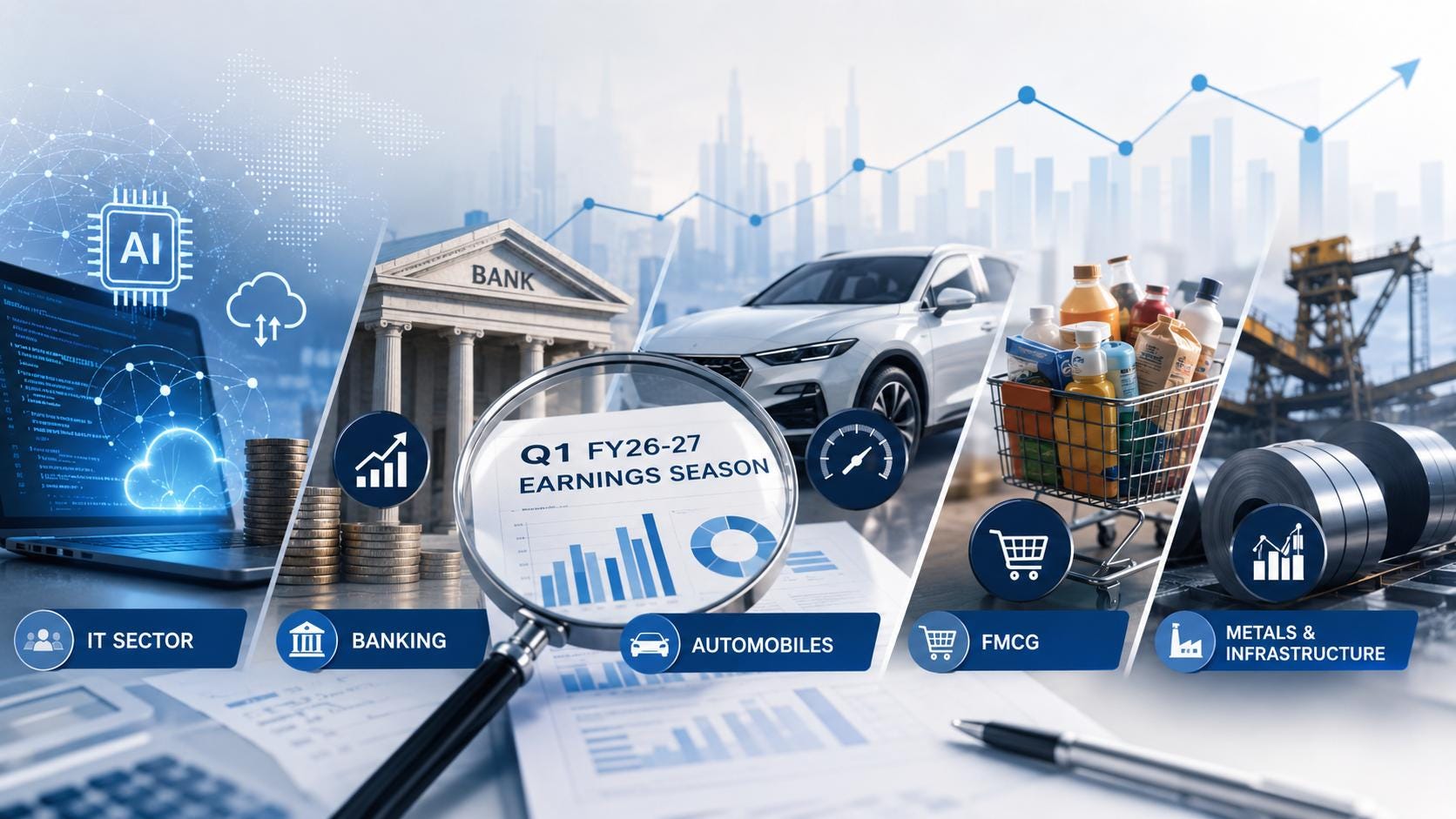
IT Sector: Can Growth Finally Make a Comeback?
The information technology sector is once again among the biggest areas of focus this earnings season. Indian IT companies generate a significant portion of their revenues from overseas markets, particularly the United States and Europe.
As a result, global technology spending, economic conditions and corporate budgets can directly influence their performance. In recent quarters, cautious discretionary spending by international clients has created challenges for the sector. Businesses have remained selective about large technology projects, while economic uncertainty has delayed decision-making in certain areas.
At the same time, artificial intelligence has emerged as one of the biggest opportunities and challenges for traditional IT companies. Businesses worldwide are increasing investments in AI, cloud computing and digital transformation.
For Indian IT companies, this could create new revenue opportunities.
However, investors are also questioning whether AI could disrupt traditional technology services and put pressure on existing business models.
During Q1 FY26-27, investors should closely track revenue growth, operating margins, large deal wins, employee hiring and management commentary. The performance of TCS, Infosys, HCLTech, Wipro and Tech Mahindra could provide important insights into the broader direction of technology spending.
Management guidance will be particularly important.
Investors will want to know whether clients are becoming more willing to spend on technology projects and whether demand conditions are improving. Deal wins will also remain an important indicator. Large contracts can provide future revenue visibility, but investors should also look at how quickly those deals are converted into actual revenue.
Margins will be another key factor.
Employee costs, wage increases and currency movements can influence profitability across the sector. Therefore, a company reporting revenue growth but weaker margins may still disappoint investors.
The key question for the IT sector is simple: Are we finally seeing a meaningful recovery in technology spending, or will cautious global demand continue to limit growth?
Banking & Automobiles: Can Domestic Demand Drive Growth?
While IT companies remain sensitive to global economic conditions, banking and automobile companies could provide important clues about the strength of India’s domestic economy.
Banks are among the most important businesses to watch during any earnings season. Their performance can indicate whether individuals and businesses are borrowing more, whether economic activity is improving and whether financial stress is increasing.
During Q1 FY26-27, investors should closely track loan growth, deposit growth, net interest margins, asset quality and credit costs.
Loan growth indicates whether demand for credit remains healthy. However, strong loan growth alone is not enough.
Banks also need sufficient deposit growth to support lending activity. The difference between the interest earned on loans and the interest paid on deposits also affects profitability. This makes net interest margin, or NIM, one of the most closely watched banking metrics.
Investors should also monitor non-performing assets and credit costs to understand whether borrowers are facing difficulties in repaying loans.
Alongside banks, automobile companies could remain another key area of focus.
The automobile sector can provide insights into consumer confidence, rural demand and broader economic activity. Investors should monitor sales volumes, operating margins, input costs and management commentary on future demand.
Rural demand could be particularly important for companies with significant exposure to two-wheelers and tractors.
Meanwhile, passenger vehicle companies will be watched for demand trends, inventory levels and changing consumer preferences.
The broader question is whether domestic consumption and credit demand can continue supporting growth when global economic uncertainty remains elevated.
From FMCG to Metals: Where Is the Pressure Building?
Beyond IT, banking and automobiles, several other sectors could provide important insights into India’s economic and business environment.
FMCG companies will remain closely watched for signs of improvement in consumer demand. For these companies, volume growth is often more important than revenue growth alone. A company may report higher revenues simply because product prices increased.
However, strong volume growth indicates that consumers are actually purchasing more products. Investors should therefore monitor rural demand, urban consumption, raw material costs and operating margins.
Companies such as Hindustan Unilever, ITC, Nestlé India, Britannia Industries and Dabur India could provide important insights into consumer spending trends.
Metals and commodity-focused businesses could face a different set of challenges. Their performance is often influenced by global commodity prices, demand from major economies and fluctuations in input costs. Investors should track sales volumes, realisations and operating margins when analysing metal companies.
Power, infrastructure and capital goods companies could also remain in focus.
India’s infrastructure development and capital expenditure cycle have been major investment themes in recent years. For these businesses, investors should monitor order inflows, order books and project execution.
A strong order book can provide future revenue visibility.
However, execution is equally important because companies need to convert orders into actual revenues and profits. Energy companies will also remain sensitive to crude oil prices and geopolitical developments. Sharp movements in global energy prices can affect refining margins, input costs and profitability differently across businesses.
Therefore, investors should avoid treating every company within the same sector equally.
Understanding individual business models remains particularly important during earnings season.

Good Results, Falling Stock: Why Does It Happen?
One of the most confusing parts of earnings season is watching a company report higher profits and then seeing its stock price fall.
The reason is simple.
Markets react to expectations, not just numbers. Suppose investors expect a company’s profit to grow by 20%, but it reports growth of 12%.
The company is still growing. However, the results may disappoint investors because actual performance was weaker than expected.
The opposite can also happen.
A company may report a decline in profits but still see its stock price rise if the numbers are better than what investors feared. This is why simply reading headlines such as “Profit Rises 25%” or “Revenue Reaches Record High” may not be enough to understand a stock’s reaction.
Investors should compare actual performance with market expectations and the company’s previous guidance.
Valuations also play an important role.
A stock trading at an expensive valuation may need to deliver exceptionally strong growth to justify its market price. Even a small earnings disappointment can lead to a sharp correction.
Meanwhile, companies trading at relatively lower expectations may see strong positive reactions to even moderate improvements in performance.
Management commentary can also significantly influence stock prices.
A company may report strong quarterly results but warn about weaker demand or rising costs in the coming quarters. In such cases, investors may focus more on future risks than past performance.
That is why one comparison matters more than almost anything else during earnings season:
Actual Performance vs Market Expectations.
Beyond Profit: What Should Investors Actually Track?
Revenue and net profit usually grab the headlines during earnings season.
But these numbers do not always reveal the complete picture of a company’s performance.
The first metric investors should track is revenue growth. It helps indicate whether the company’s core business is expanding.
Next comes operating margin. A company may report strong revenue growth, but if costs are increasing faster than sales, profitability could come under pressure.
Cash flow is another important metric. Profits reported on financial statements do not always translate into actual cash generation. Strong and consistent cash flows can indicate better financial health.
Debt levels should also be monitored, particularly for capital-intensive companies. High debt can become a concern when interest costs rise or business conditions weaken.
Investors should also track sector-specific metrics.
For banks, this includes net interest margins and asset quality.
For IT companies, deal wins and revenue guidance matter.
For automobile companies, sales volumes and margins are important.
For consumer businesses, volume growth can reveal demand trends.
Finally, management commentary and future guidance deserve close attention.
Corporate management teams often provide insights into demand, costs, expansion plans and future challenges during earnings calls.
Because stock markets are forward-looking, what a company expects to earn tomorrow can sometimes matter more than what it earned yesterday.
The Bottom Line
Q1 FY26-27 earnings season arrives at an important time for the Indian stock market.
Global uncertainty, volatile crude oil prices, changing technology trends and domestic consumption patterns have created different opportunities and challenges across sectors.
IT companies will be watched for signs of improvement in global technology spending.
Banks and automobile companies could provide insights into the strength of domestic demand.
Consumer businesses may reveal whether spending trends are improving, while infrastructure and capital goods companies could indicate whether India’s investment cycle remains strong.
But investors should remember one thing.
Earnings season is not just about finding companies with the highest profit growth. It is about understanding whether businesses are growing sustainably, maintaining profitability and meeting market expectations.
So, the next time a company announces its quarterly results, don’t stop at the headline profit number. Look at the revenue. Check the margins. Understand the business trends. Listen to management commentary. And most importantly, ask what the numbers could mean for the company’s future.
Because in the stock market, what a company earned this quarter matters but what it could earn next often matters even more.
Lingo of the Week
Market Expectations
Market expectations refer to what investors collectively anticipate a company will report or achieve before its earnings announcement. Stock prices often move based on whether actual results beat, meet, or miss these expectations not just on whether profits increased.
Example: A company reports a 15% profit growth, but the stock falls because investors were expecting 25% growth. The results missed market expectations.
Pocketful isn’t just another trading platform - we’re your partners on the journey to financial freedom.
Thank you for reading!
👀 Stay tuned. Stay diversified.
Until next time,
Team Pocketful.