


On November 20, 2025, a single remark from Bank of Japan board member Junko Koeda sent a tremor through global markets. Her call to “raise real interest rates to a state of equilibrium” landed at the very moment the yen was languishing at a 10-month low, its weakest point against both the dollar and the euro. Suddenly, whispers of a December rate hike turned into urgent speculation. Screens across trading floors flickered red. Even in the U.S., far from Tokyo’s policy chambers, the shock was immediate: the NASDAQ tumbled 2.38% as investors realized that Japan, the world’s quiet source of cheap money, might be preparing to shift its stance again.
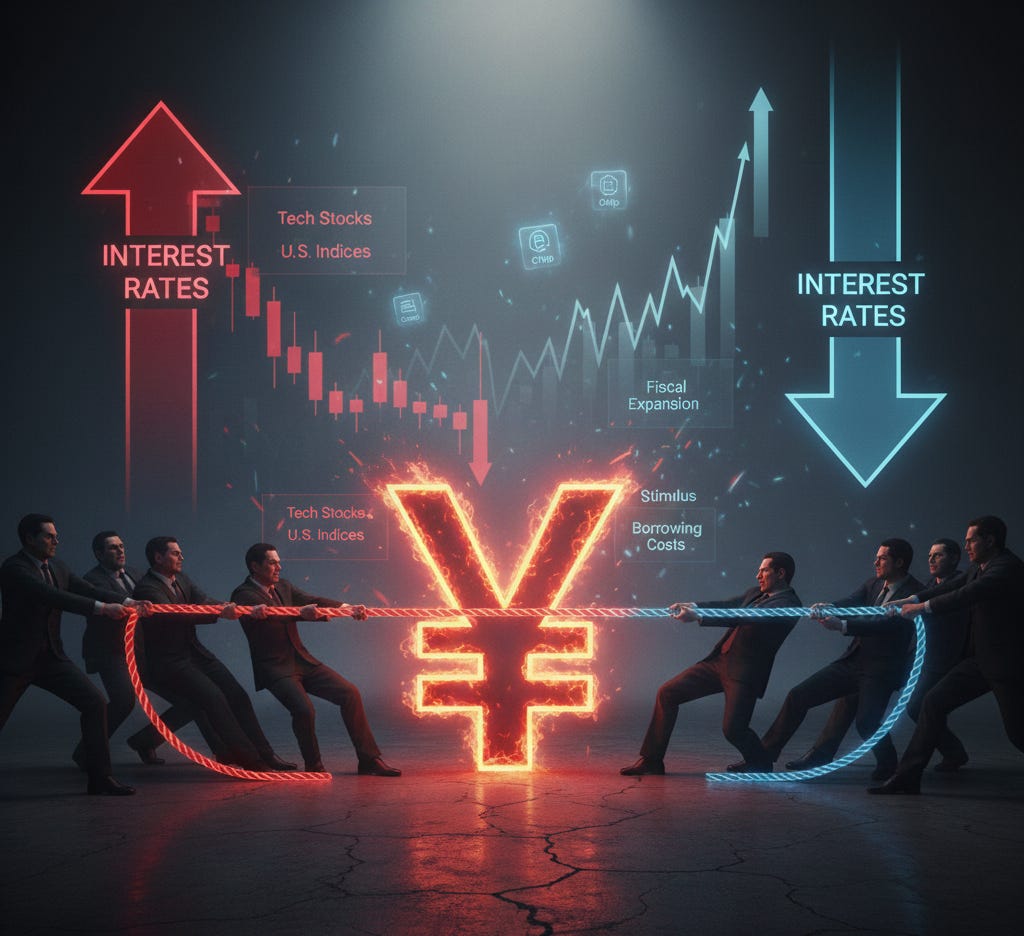
The reaction was so sharp because Japan’s slow climb out of its ultra-low-rate era has become one of the most consequential stories in global finance. Three rate hikes in less than two years have already unsettled traders, but the real drama lies in the divide within Tokyo itself. Hawks inside the BoJ warn of rising inflation, while Prime Minister Sanae Takaichi’s government pushes for looser fiscal conditions: two opposing forces pulling at the central bank’s next move. In this tug-of-war, even a hint of what comes next is enough to shake markets worldwide.
Japan’s shifting stance matters globally because its low interest rates have powered one of the most important engines of global capital flows: the yen carry trade. Investors have long borrowed yen at minimal cost and invested the funds in higher-yielding assets abroad. If that engine slows or reverses, the ripple effects can be felt worldwide. Before understanding the risks ahead, it is useful to see how the carry trade works.
The Mechanics of the Yen Carry Trade
At its core, the yen carry trade was simple. Investors borrowed money in yen at very low interest rates and invested that capital into markets offering higher returns. If the yen weakened while the investment was held, their profits grew even further when they converted back into yen to repay the loan.
Over the years, this strategy turned into a massive global force. Hedge funds, pension funds, insurers, and major institutions deployed billions into this trade, often with leverage. As long as the yen stayed weak and financial markets remained calm, the trade worked smoothly. But that stability created its own vulnerability. The more global markets leaned on Japan’s cheap liquidity, the more painful it would be if conditions suddenly shifted.
When volatility rises or the yen strengthens, the trade can unravel quickly. Borrowers are forced to buy yen to repay loans, pushing the currency up even faster. That is why the carry trade is often compared to a quiet fuse that can ignite suddenly.
August 2024: A Warning Shot
A preview of this risk came during the turmoil of August 2024. As the Bank of Japan lifted its policy rate to 0.25% and weak U.S. data hinted that the Federal Reserve might cut sooner than expected, the yen abruptly reversed course. The currency strengthened more than 12% in just three weeks, climbing from 161.99 per dollar on July 3 to 141.66 by August 5. The speed of the move caught markets off guard and left leveraged carry positions suddenly underwater.
As investors scrambled to repay yen loans, they were forced to buy yen at higher prices, accelerating the move. Many also had to sell the foreign assets they had invested in to raise cash, putting pressure on global markets. Japan’s Nikkei index suffered a historic double-digit drop in a single session, and U.S. markets fell sharply as well. Only a portion of carry trades were unwound by mid-August, but the message was clear: once the tide turns, the reversal can be violent.
Although the yen weakened later and calm returned, confidence in the trade’s stability had been shaken. Global investors were reminded that much of today’s asset pricing rests on the assumption that Japan will remain the world’s cheapest funding source. That assumption is now being tested again.
November 2025: A Gathering Storm
As 2025 nears its close, several forces are converging to raise the odds of another major shift. The yen has slipped back to weak levels, and Japanese officials appear increasingly uneasy. At the same time, Japanese government bond yields are rising. Prime Minister Takaichi’s large fiscal stimulus program has raised questions about long-term debt sustainability, prompting investors to demand higher returns on Japanese bonds. Higher domestic yields encourage Japanese institutions to pull money back home instead of investing abroad. That repatriation strengthens the yen and puts further pressure on carry trades.
Koeda’s speech added to this tension. She pointed to low real interest rates, tight labor markets, and an economy operating close to full capacity as reasons for further tightening. Many economists now expect a rate increase in December. Yet there remains resistance within the government, which is wary of higher borrowing costs. The central bank must now strike a delicate balance. Raise too quickly and risk sparking market volatility. Move too slowly and risk losing control of the currency.
This balancing act is made even harder by Japan’s enormous debt load and political pressure to support growth. Every decision carries consequences not just for Japan, but for markets worldwide.
If the Funding Engine Seizes
If the yen loses its status as the world’s cheapest source of capital, the first cracks will almost certainly appear in global equities. For years, the yen carry trade has quietly funneled money into U.S. technology giants, European blue chips, and emerging-market indices. When funding costs rise, these trades unwind and when they unwind, investors sell whatever is most liquid. That makes stocks the first casualty.
The turmoil of 2024 offered a clear preview of this risk. As the yen strengthened sharply, U.S. tech names fell hard even though they had no direct connection to Japanese policy. Another unexpected move from the Bank of Japan could easily send similar shockwaves across global stock markets and the impact could last far longer than the initial policy shift.
Adding to the fragility is the growing unease surrounding the AI boom. Peter Thiel has already exited his entire Nvidia stake of roughly 100 million dollars, warning that the enthusiasm looks overheated. Michael Burry has taken a different approach by building large put positions against Nvidia and Palantir and arguing that parts of the AI sector may be overstating profitability. Despite their different strategies, both investors are signaling fading confidence at the top of the market.
This creates a dangerous intersection. A yen driven tightening of global liquidity could fuel rising skepticism toward AI valuations. If Japan raises rates and the yen surges again, leveraged investors may be forced to unwind positions at the very moment sentiment toward market leading tech stocks is turning fragile. With both Thiel exiting and Burry betting against major AI names, a question is emerging: what if the AI boom is peaking just as Japan’s tightening cycle begins to reshape global liquidity?
The Road Ahead
The path forward depends largely on how Tokyo navigates its next moves. A gradual and clearly communicated approach to policy tightening could strengthen the yen in a controlled manner, allowing carry trades to unwind without triggering major disruptions.
A sharper or unexpected hike, however, could ignite rapid deleveraging. A sudden yen rally would force investors to unwind positions across asset classes, from stocks to commodities, potentially sparking another period of global turbulence.
There is also the scenario where the BoJ waits too long. Political pressure or weak growth could delay action, only for inflation or fiscal stress to force a more dramatic shift later. Such a delayed reaction could produce even larger market swings.
For now, the world is watching Japan more closely than at any point in recent years. Even the slightest move by Tokyo could send waves across global markets, challenging everything from currency flows to the soaring optimism behind the AI boom.
Lingo of the Week: Carry Trade
A carry trade involves borrowing in a low interest rate currency like the yen and investing in assets that offer higher returns elsewhere. Investors profit from the rate difference and, if the funding currency weakens, from currency gains as well. If the funding currency strengthens instead, the trade can reverse quickly and cause significant losses.
Pocketful isn’t just another trading platform - we’re your partners on the journey to financial freedom.
Thank you for reading!
👀 Stay tuned. Stay diversified.
Until next time,
Team Pocketful.
Follow Us: Website
Download Our App: Available on Google Play & Apple App Store
Fascinating. Your analysis of the carry trade's potential impact realy hits home. But do you think the BoJ will actualy have the political capital to push through a big shift, or will they keep kicking the can?