

In late 2024 and early 2025, Zepto was in serious trouble. Once known as India’s fastest quick-commerce startup, it was burning ₹250–300 crore every month. Its market share had fallen to around 23%. Customers complained about hidden charges and confusing app practices. Investors were losing confidence, and an IPO looked very far away. Many people believed Zepto might not survive if things continued this way.
By October 2025, the situation had changed sharply. Zepto raised $450 million at a $7 billion valuation, up from $5 billion earlier. CalPERS led the round, showing strong institutional trust. Monthly cash burn was cut to about ₹100 crore. Dark stores became profitable, and the company focused on discipline over reckless growth. Zepto’s comeback shows how founders can reset strategy, fix mistakes, and rebuild credibility when the market turns tough.
Weak Moat, Capital Disadvantage, and Market Share Pressure
By early 2025, Zepto was increasingly seen as a company burning cash at an unsustainable rate. Public remarks by Zomato CEO Deepinder Goyal suggested the quick-commerce industry was losing nearly ₹5,000 crore per quarter, with Zepto allegedly contributing a large share of that burn. Although Zepto co-founder Aadit Palicha strongly denied these figures, the episode revealed how deeply the perception of reckless spending had taken hold. In a market where funding had tightened, this perception alone began to erode investor confidence.
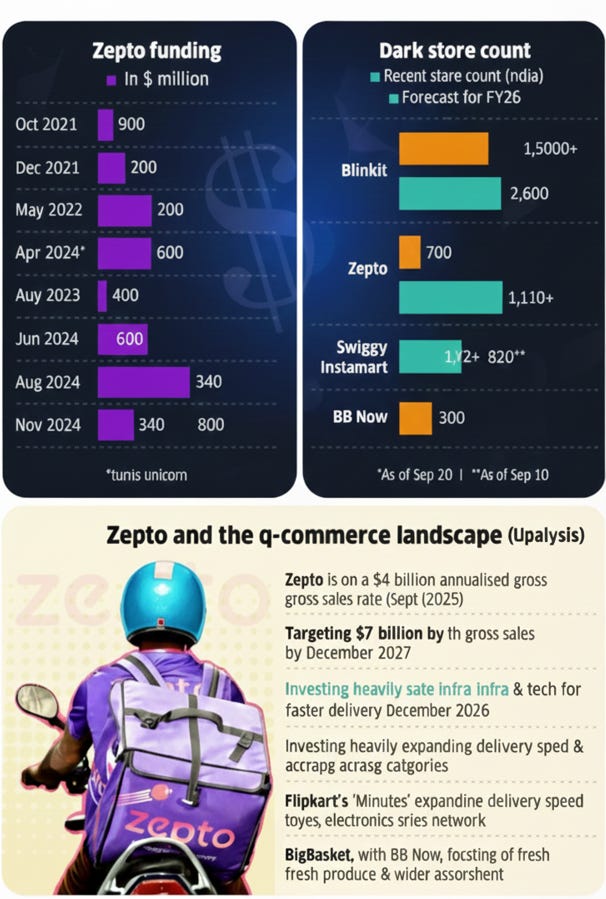
The core challenge was structural. Zepto’s model of dark stores and ultra-fast delivery had little defensibility once larger players entered the space. Swiggy and Zomato arrived with far stronger balance sheets, much higher valuations, and access to massive existing customer bases. While Zepto had been valued at around $225 million in 2021, its rivals were valued at $10–12 billion. This difference showed up in scale: by early 2024, Instamart operated about 705 dark stores and Blinkit roughly 526, compared to Zepto’s 350. Lower store density meant higher delivery costs and weaker unit economics.
Despite an early 10-minute delivery lead, Zepto struggled to hold ground. Swiggy and Zomato quickly converted their food-delivery users into quick-commerce customers. By end-2024, Blinkit led with about 40% market share, Instamart held 28%, and Zepto slipped to roughly 23%, pushing it into a weaker third position.
Dark Patterns, Trust Erosion, and Leadership Exits
As losses increased, Zepto attempted to recover margins by introducing extra fees and running aggressive pricing experiments. These moves quickly led to accusations of dark patterns. Customers reported cases where a product listed at ₹254 became ₹343 at checkout after multiple additions such as handling fees, processing charges, GST, delivery fees, and even cash-handling fees. In other instances, small orders were shown as offering huge “savings” based on inflated reference prices and waived, artificial charges. The final bill often felt confusing and misleading, damaging the perception of transparency.
Online backlash grew rapidly, and Zepto became the primary focus of criticism. A Reddit community of nearly 35,000 users formed to track and discuss alleged pricing tricks, amplifying negative sentiment. Over time, company leaders admitted that several of these experiments were poorly received and hurt customer trust. Efforts meant to plug short-term margin gaps instead reinforced the idea that Zepto was under financial stress.
At the same time, Zepto saw notable leadership churn. Senior exits included heads of strategy, IT, expansion, Zepto Café, and the meat business. When combined with high cash burn, market-share decline, and reputational damage, these departures intensified concerns about Zepto’s ability to raise capital. By early 2025, doubts about the company’s long-term survival had become difficult to ignore.
The Strategic Pivot: How Zepto Reset Its Business
By 2025, Zepto faced a difficult truth. Its rapid growth had come at a cost. Extra fees, fast expansion, and experiments outside its core business had weakened customer trust and increased losses. To survive and prepare for the future, the company had to change course. What followed was a major strategic reset focused on trust, cost control, and sharper execution.
Removing Fees to Win Back Customers
In early November 2025, Zepto made one of its most important decisions. The company removed all handling fees, surge charges, and convenience fees from its platform. This move clearly admitted that earlier pricing tactics had hurt customer trust.
CEO Aadit Palicha publicly stated that the fee removal was voluntary, not forced by regulators. His message was direct: the company had made a mistake and would not repeat it. This decision reduced short-term revenue, but it was necessary to repair the brand’s image at a time when competition was intense and customers were increasingly price-sensitive.
This change also brought Zepto closer to competitors like Blinkit, which had already moved to zero delivery fees above a minimum order value. However, removing fees created a new challenge. Without these extra charges, Zepto had to become far more careful with costs to protect margins.
Tightening Costs and Improving Efficiency
Cost discipline became the centre of Zepto’s turnaround plan. Management began closely reviewing every expense, with a clear goal of reducing burn without damaging core operations.
One major step was workforce restructuring. Instead of relying heavily on a large permanent workforce, Zepto shifted many roles to third-party service providers. In October 2025 alone, around 300 employees were moved to external vendors. When combined with earlier changes, nearly 1,000 roles were affected during 2025.
These changes covered customer support, operations, technology, finance, and category teams. Zepto positioned this not as sudden mass layoffs, but as a transition that allowed employees to continue working under third-party arrangements. For the company, this reduced fixed salary costs while keeping daily operations running smoothly.
At the same time, Zepto increased automation. The company built its own internal software to manage routine tasks such as invoice processing, store replenishment, and real estate management. Earlier, many of these functions were handled by external software tools or off-roll staff. Bringing them in-house reduced cloud and software expenses and gave Zepto better control over operations.
Making Dark Stores More Efficient
Zepto also focused on improving the efficiency of its dark-store network. Instead of expanding aggressively, the company optimized what it already had. Each dark store reduced its inventory to around 2,500–3,000 fast-moving products. This helped staff pick items faster, often in under 60 seconds, and improved order flow. The PPB model- picking, packing, and bagging remained central, but execution became tighter and more disciplined.
These combined efforts had a strong impact. By mid-2025, Zepto cut its monthly cash burn to around ₹100 crore. This was nearly a 75% reduction from earlier peaks. For investors, this was an important signal that the company could move toward profitability without shrinking its core business.
Stepping Back from Zepto Cafe
One of Zepto’s biggest mistakes in 2025 was Zepto Cafe. It was launched as a quick food delivery service and was expected to drive growth, but instead it caused heavy losses. By May 2025, Zepto started shutting Cafe outlets in North India due to supply problems and a shortage of trained kitchen staff. By July, nearly 200 Cafe locations across India were closed because demand was weak and costs were high. The Cafe failure highlighted a key lesson. Food service required skills, supplier relationships, and operational depth that Zepto did not fully have. Zepto’s early advantage disappeared quickly.
The struggles extended to Zepto’s private-label brand Relish. Poor customer feedback forced the company to bring back established brands like Licious to retain premium users. This reversal further showed the limits of over-expansion and eventually led to the exit of Relish’s leadership.
Finding Smarter Ways to Grow Revenue
After pulling back from Cafe, Zepto refocused on areas that matched its strengths. Instead of building complex new operations, the company chose categories that could use its existing logistics and customer base.
Zepto launched Super Mall and Zepto Pharmacy to expand beyond groceries. These verticals increased the total market opportunity while offering better margins. Categories such as electronics, beauty, and health products required less operational complexity than food services.
Most importantly, these businesses played to what Zepto already did well: fast delivery, efficient logistics, and strong customer reach. Rather than chasing every growth idea, the company began choosing its bets more carefully.
A Reset, Not an End
By late 2025, Zepto’s strategy looked very different from its earlier growth-at-all-costs approach. The company focused on trust, cost control, and disciplined expansion. While challenges remained, the reset showed that Zepto had learned from its mistakes and was building a more sustainable business model for the long run. The pivot did not guarantee success, but it gave Zepto a fighting chance to survive, stabilize, and grow smarter in a highly competitive market.
The Funding Round: A Reset Before the Next Climb
The October 2025 Round: $450 Million at $7 Billion
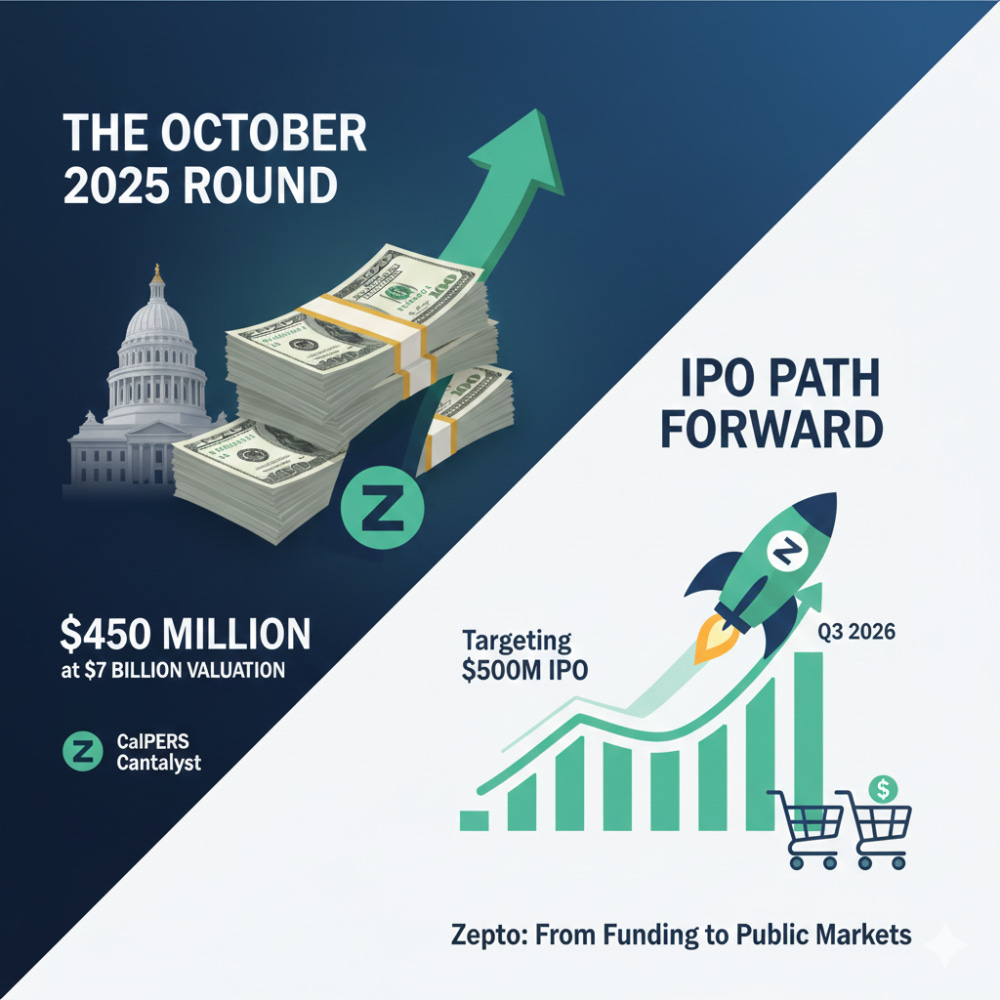
Zepto, the Indian quick-commerce startup, has raised $450 million in a new funding round led by the California Public Employees’ Retirement System (CalPERS), valuing the company at around $7 billion as it prepares for an IPO.
This round comes almost a year after its previous $350 million raise that valued the company at $5 billion. Zepto’s CEO Aadit Palicha said the funding is largely primary capital, meaning most of it will go into the company to strengthen its balance sheet, support moderate expansion, and help improve profitability as it heads toward a public listing. General Catalyst co-led the round, and existing investors such as Avenir, Glade Brook Capital, Lightspeed, and StepStone also participated. After the round, Zepto holds about $900 million in cash reserves and is considering filing draft IPO papers soon.
Zepto’s IPO Path Forward
Zepto’s path toward an IPO is emerging as a defining chapter in India’s quick-commerce story. After raising fresh capital in October 2025, the company accelerated preparations for a public listing. By December 2025, Zepto filed draft IPO papers through the confidential route, signalling serious intent to tap public markets by Q3 2026. The company is reportedly targeting an IPO size of around $500 million, building on its most recent funding round that valued Zepto at approximately $7 billion.
The confidential filing gives Zepto a crucial runway of two to three quarters to strengthen its fundamentals away from public glare. During this period, the focus is clear: improve unit economics, maintain tighter cost discipline, and prove that the removal of handling, surge, and convenience fees has helped rebuild customer trust without damaging margins. For public-market investors, profitability and predictability will matter far more than growth at any cost.
However, competition is intensifying. Swiggy’s ₹10,000 crore QIP has armed it with significant capital to expand its inventory-led quick-commerce model. With zero delivery fees and no extra charges above a ₹299 order value, Swiggy is now mirroring Zepto’s own strategy, increasing pressure on pricing and customer acquisition.
At a $7 billion valuation, Zepto’s IPO will be judged harshly. The coming months will decide whether it lists as a disciplined, credible business—or faces tough questions from the public markets.
Conclusion: Zepto’s Comeback
Zepto’s story over the last two years is less about speed and more about survival. In a sector where capital once masked inefficiencies, the funding winter of 2024–25 forced reality checks. Zepto entered that phase with high burn, falling market share, weak defensibility, and eroding customer trust. For a time, its future genuinely looked uncertain.
What changed was not the market, but Zepto’s mindset. The company accepted hard truths: growth without discipline was unsustainable, and trust once lost is expensive to regain. By cutting fees, tightening costs, shrinking burn by nearly 75%, and retreating from misaligned bets like Zepto Cafe, management showed a willingness to correct course rather than defend mistakes. Operational focus returned to dark stores, logistics efficiency, and categories that matched Zepto’s core strengths.
The $450 million raise at a $7 billion valuation was not just capital—it was a vote of confidence that the reset was real. Yet the road ahead remains narrow. Deep-pocketed rivals, pricing pressure, and public-market scrutiny will test every claim of discipline and profitability.
Zepto’s upcoming IPO is not a victory lap; it is an exam. The next few quarters will decide whether this turnaround becomes a durable business transformation—or just a temporary recovery before tougher questions arrive.
Lingo of the Week
Inventory-Led Model
An inventory-led model is where a company buys, stores, and manages its own products. This gives better control over pricing, delivery speed, and quality, but requires higher capital and operational efficiency.
Pocketful isn’t just another trading platform - we’re your partners on the journey to financial freedom.
Thank you for reading!
👀 Stay tuned. Stay diversified.
Until next time,
Team Pocketful.
Follow Us: Website
Download Our App: Available on Google Play & Apple App Store