


Every now and then, markets do something familiar – like watching the same movie play out again. A sharp rally happening right now looks exactly like a sharp rally from last year. A sudden market crash today feels like a smaller version of the Covid crash you remember. The same breakout pattern you noticed on one stock suddenly appears on another stock too. This is not magic. This is the effect of market cycles and time cycles – patterns that repeat because people and the economy behave in repeating ways. In this week’s letter, let’s break this down in simple language.
The Rhythm Behind Market Moves
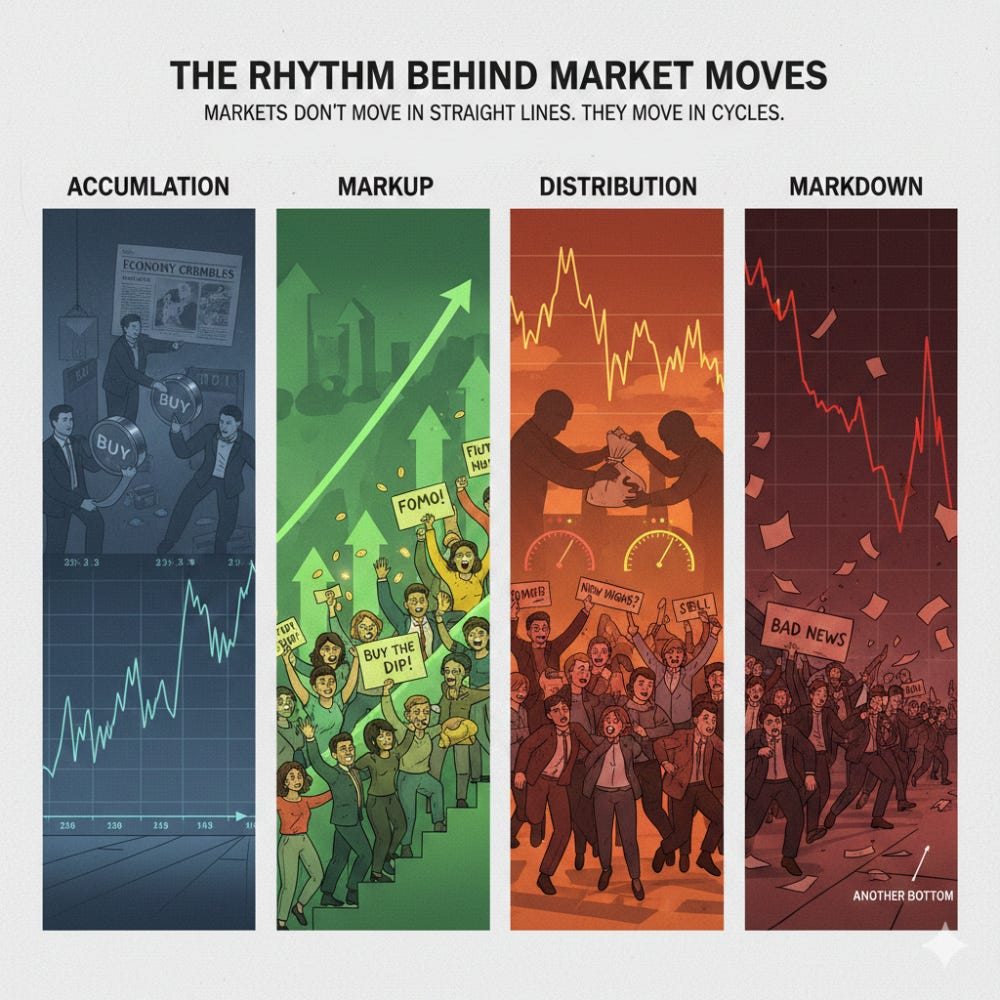
In the big picture, markets don’t move in straight lines. They move in cycles. There are four broad phases that repeat again and again:
Accumulation: After a fall, prices stop crashing and move sideways. News is still negative, but smart money slowly starts buying. This happens quietly, almost invisibly. While headlines remain grim and most investors are terrified, experienced players recognize value. They accumulate positions at bargain prices, knowing that sentiment extremes often mark turning points. This phase can last weeks or months, feeling like nothing is happening. But beneath the surface, the foundation for the next move is being built.
Markup: Confidence comes back. Prices trend up strongly, dips are bought, and more people feel they are “missing out”. The uptrend becomes undeniable. Each pullback is bought eagerly. Volume increases. More retail investors notice and want to participate. This is where most of the easy money is made – where wealth creation happens fastest. The trend is your friend, and staying with it during markup is where consistent profits accumulate.
Distribution: Prices stop making strong new highs. Big players quietly start selling to late entrants, and volatility rises. The rhythm changes. Prices chop sideways instead of trending higher. This is the deceptive phase – it doesn’t feel like a top because the news might still be good and prices might still be near highs. But smart money is exiting while public money is still enthusiastically buying. Most traders miss this turning point because they’re caught in the excitement.
Markdown: The trend breaks. Bad news hits, prices fall, and many investors exit in fear, bringing us back toward another bottom. The same psychology that drove prices higher – greed and confidence – now reverses into fear and panic. Stop-losses trigger. Volume spikes on down days. The cycle returns to its starting point, ready to begin again.
What Are Time Cycles?
Most people only look at the price: “Nifty is at this level.” Time cycles ask a different question: “How often do important turns happen?” Traders look at past major lows (or highs) on a chart and measure how many days, weeks, or months were between them. If they notice that, for example, a stock often forms a swing low every 40–50 trading days, they start watching more carefully whenever that time window comes again.
Think of it like a bus that is “usually” every 10 minutes – it may not arrive exactly on time, but you know roughly when to be alert. Time cycles don’t tell you the exact date of a turn; they just tell you: “This period has a higher chance of something important happening.” That is why smart traders always combine time cycles with price action and indicators instead of blindly trusting dates.
The beauty of time cycles is that they transform you from a reactive trader to a proactive one. Most traders react to news headlines – “Oh, earnings disappointed! Sell!” or “Great earnings! Buy!” But traders who understand time cycles are prepared ahead of time. They know a major turning point window is likely approaching based on past patterns. They’re watching. They’re ready. When price action and indicators confirm during that window, they have real conviction.
Why the Same Setups Keep Coming Back
If the drivers repeat, the chart patterns repeat. Economies go through recurring phases of expansion, slowing, and recovery, which affects company earnings and valuations in a fairly rhythmic way over years. On the behaviour side, at early bottoms most people are scared and don’t trust any bounce, in the middle of a bull run investors start averaging up because “it always goes higher”, near tops risk-taking goes crazy, and in sell-offs many stop-losses trigger together and people capitulate.
Because of this, certain setups appear at similar points in every cycle. Near the end of a rally, you often see overextended charts, sharp last spikes, and failed breakouts – a sign that smart money is exiting while public money is entering. Near the end of a fall, you often see heavy volume, panic candles, and then a slow, quiet base where selling pressure reduces, which becomes the next accumulation zone.
This repeating nature isn’t coincidence – it’s human nature. Fear feels the same whether it’s 2008 or 2025. Greed feels the same whether it’s a tech bubble or real estate mania. The underlying psychology repeats, so the patterns repeat. Once you see this, you stop being surprised by market moves. Instead, you expect them. You prepare for them. You profit from them.
Different Kinds of Time Cycles You’ll Hear About
Time cycles are not one single tool. Classical time cycles measure the gap between past swing lows or highs and project similar gaps forward to mark “watch zones” on the calendar. If a stock tends to low roughly every 40 days, you mark future dates accordingly and watch those periods more closely.
Gann-style cycles use fixed counts (like 30, 45, 60, 90 days or 1 year) based on the idea that markets often react around certain time numbers or anniversaries. While this approach is more mystical than scientifically proven, many traders have found it remarkably effective. The logic is that if many traders are watching the same time counts, their collective action creates real turning points – a self-fulfilling prophecy of sorts.
Then there is seasonality – a calendar-based cycle where historical data shows that some months and seasons tend to be stronger or weaker for markets and for specific sectors. For example, certain indices or sectors might show better average returns in particular quarters, while others underperform in specific months. Traders check this as a background filter but still wait for price confirmation before acting.
How Traders Actually Use Time Cycles To Take Better Trades
Good traders use time cycles to prepare, not to act blindly. They first mark likely “time windows” for a potential top or bottom based on past cycle lengths, and as that window comes closer, they watch price action more closely instead of being casual.
Step 1: Mark your time windows. Based on historical analysis, identify the typical cycle length for the security you’re trading. If it’s a 40-50 day cycle, mark those dates on your calendar – but with flexibility, knowing it could be ±5 days.
Step 2: Prepare, don’t commit. As your time window approaches, shift into a higher state of alertness. Watch price action more carefully. Track volume more closely. Monitor indicators more intently. You’re preparing. You’re ready. But you’re not committed yet.
Step 3: Wait for confirmation. If, during that window, price hits a key support or resistance, indicators confirm, and volume behaviour matches, then take the trade with higher confidence. This is when time cycles combine with price action and indicators to create high-probability setups.
This shifts you from random trading to planned trading. When you respect time cycles, you avoid chasing every intraday move and focus on repeated, high‑probability setups that tend to appear around similar points in the cycle. Over time, this is exactly how many professionals turn “market rhythm” into a practical edge for entries and exits.

The Real Power: Rhythm Over Randomness
Markets look random day to day, but over time, they reveal a rhythm. Once you understand this rhythm, everything changes. You stop fighting the market. You stop trying to predict what “should” happen and instead observe what is actually happening. You recognize that certain patterns do repeat, and when they do, you’re ready.
Real traders understand that money is made during specific phases of the cycle. Fortunes are not made equally during all four phases. Accumulation is quiet – not much money flows. Markup is where gains come easily – this is the wealth-creation phase. Distribution is where smart money exits quietly while late money is still entering – this is where most traders get trapped. Markdown is where losses happen fastest – but it’s also where smart accumulation begins.
By knowing where you are in the cycle and using time cycles to anticipate turning points, you can position yourself ahead of the crowd. You can start accumulating before others even notice prices are stabilizing. You can build up and exit before the distribution phase traps latecomers. You can avoid the panic selling that happens during markdown phases.
The professionals who’ve made fortunes – whether it’s George Soros, Warren Buffett, or Michael Burry – all understood cycles. They didn’t get rich by being right about every single move. They got rich by understanding cycles, respecting them, and positioning ahead of the crowd.
Lingo of the Week: Time Cycle
A time cycle is a repeating time gap between important highs or lows in the market (for example, every few weeks or months) that traders use as a guide to watch for the next possible turning point, instead of trading blindly on news. It’s the market’s internal rhythm – and learning to feel that pulse is what separates consistent traders from those who struggle.
Pocketful isn’t just another trading platform - we’re your partners on the journey to financial freedom.
Thank you for reading!
👀 Stay tuned. Stay diversified.
Until next time,
Team Pocketful.
Follow Us: Website
Download Our App: Available on Google Play & Apple App Store