


The AI trade was supposed to be unstoppable. But this week, Wall Street reminded investors that even the strongest market narratives can come undone when expectations become too expensive.
The US stock market suffered a brutal sell-off on November 20, with technology and AI stocks leading the decline. The Nasdaq Composite plunged 5.3% in a single session and lost nearly 10% during the week, marking one of its worst weekly declines since 2020. The S&P 500 fell 3.7%, entering correction territory more than 10% below its recent record high while the Dow Jones declined 1.9%.
The selling was not driven by a single disappointing earnings report. Instead, investors are beginning to question the economics of the AI boom itself. Companies are spending billions on data centres, chips, computing capacity and AI infrastructure, but the market is increasingly demanding answers about how quickly these investments will translate into sustainable profits.
For months, investors rewarded companies simply for having exposure to artificial intelligence. Now, the conversation is changing. How much capital will AI require? Who will ultimately pay for it? And will the returns justify the enormous investments being made today?
The AI revolution may still be in its early stages, but Wall Street appears to be entering a new phase one where excitement is giving way to scrutiny, and growth expectations are being tested against financial reality.
And the companies at the heart of this revolution are now feeling the pressure.
NVIDIA, AMD & the Chip Giants: When AI Leaders Become the Sell-Off
The biggest casualties of the week’s market turmoil were the semiconductor companies that had become the backbone of the AI rally.

NVIDIA, the company that became synonymous with the AI boom, suffered one of its sharpest declines. The sell-off came despite strong earnings and demand for its AI chips, highlighting the growing disconnect between business performance and investor expectations. Concerns surrounding AI spending sustainability, valuations and uncertainty added to the pressure.
AMD was caught in the same wave. Investors have increasingly viewed the company as a major challenger in the AI accelerator market, but when sentiment turns against the semiconductor industry, even companies benefiting from AI demand can face aggressive selling.
Broadcom and Micron also suffered sharp declines, showing that the selling was not limited to GPU manufacturers. The correction spread across AI infrastructure, networking and memory areas that had benefited from expectations of rising data-centre investment.
The weakness also extended to companies across the semiconductor supply chain, from chip designers and manufacturers to equipment providers. This suggests investors are reassessing the entire AI ecosystem rather than simply booking profits in a handful of stocks.
The long-term AI opportunity remains intact. But in the short term, investors appear to be moving away from buying the AI story indiscriminately. The next phase may reward companies that can demonstrate sustainable revenue, margins and cash flows rather than simply promise exposure to the technology.
For NVIDIA, AMD and the broader semiconductor industry, the AI opportunity has not disappeared. But the market’s tolerance for expensive expectations may have.
Anthropic’s IPO Couldn’t Save the AI Trade
If there was one event investors expected to reignite excitement around artificial intelligence, it was Anthropic’s blockbuster IPO. Instead, its market debut became another reminder that investor enthusiasm for AI is no longer enough to keep stocks rising.
Anthropic, the company behind Claude, attracted enormous attention with its public listing. Its shares initially surged after listing, but the excitement quickly faded. The stock subsequently came under pressure as the wider technology sell-off intensified.
The timing could hardly have been more challenging. Anthropic entered the public markets when investors were already questioning whether AI companies were spending too aggressively, whether valuations had become stretched, and whether future revenue would justify the enormous infrastructure investments taking place across the industry.
The IPO was a landmark for the AI industry, but its subsequent share-price weakness showed that a successful listing does not automatically translate into a sustained rally. Investors are becoming increasingly selective, and even a high-profile AI company is not immune to broader market sentiment.
The irony is difficult to ignore. An IPO that was expected to demonstrate the strength of the AI investment cycle ended up trading amid fears that the cycle may have become overheated.
This does not necessarily mean the AI boom is over. It may instead signal that the market is separating AI businesses with credible monetisation opportunities from companies whose valuations depend heavily on future expectations.
The industry may continue growing. But the stock market is beginning to ask a more uncomfortable question: How much of the AI future is already priced into today’s valuations?
India Stands Tall: Is Global Capital Looking for a New Home?
While Wall Street struggles with the AI trade, Indian equities are telling a different story.
The global sell-off has raised questions about whether investors will begin reducing exposure to expensive technology-heavy markets and diversify into economies with broader growth drivers. India, with its consumption story, infrastructure spending, manufacturing ambitions, financial sector growth and expanding domestic investment base, could attract attention during this shift.
Indian markets have shown relative resilience compared with the recent weakness across global technology-heavy indices. The difference is not that India is disconnected from the global economy it is not. A sustained global sell-off can still affect Indian equities through foreign flows, currency movements, crude oil, interest rates and overall risk appetite.
However, India’s investment narrative is more diversified than the AI-driven concentration seen in some overseas markets. Banking, capital goods, consumption, infrastructure, healthcare and manufacturing provide investors with multiple avenues to participate in economic growth.
That diversification may become increasingly relevant if global investors start reassessing portfolios that have become heavily concentrated in AI and semiconductor stocks.
The opportunity for India is clear: if global investors begin seeking diversification beyond crowded AI trades, Indian equities could emerge as one of the destinations for that capital.
But the opportunity comes with a caveat. Foreign money does not move into India simply because another market is falling. Investors still evaluate earnings growth, valuations, inflation, currency stability and the relative attractiveness of Indian assets.
India may be standing tall at the moment, but sustaining that position will require fundamentals to do the heavy lifting.
The FII Comeback: Foreign Money Is Flowing Back Into India
One of the biggest changes in the Indian market narrative is the return of foreign institutional buying.
After months of selling pressure that weighed on sentiment, FIIs have returned with significant buying activity. The shift is particularly interesting because it comes at a time when global investors are reassessing exposure to expensive AI stocks and technology-heavy markets.
The flow data indicates that foreign investors have bought heavily across Indian equities, debt and derivatives during recent periods.
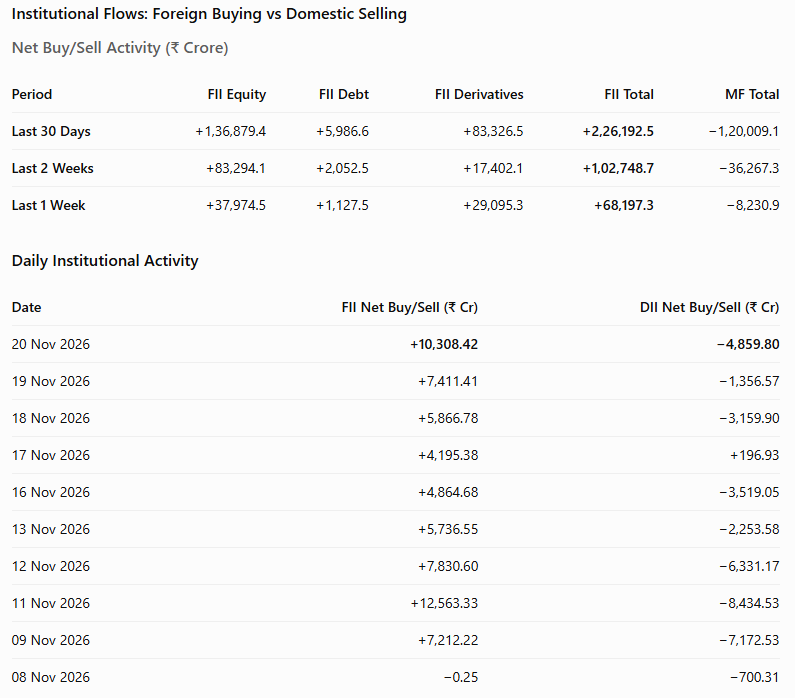
Foreign investors recorded net buying of ₹10,308.42 crore on November 20, while domestic institutional investors sold ₹4,859.80 crore in the cash segment.
The divergence is noteworthy. Foreign investors appear to be increasing their exposure to Indian equities, while domestic institutions have been booking profits in recent sessions. This does not necessarily indicate a complete shift in market positioning, but it highlights how institutional participants can have very different views at the same time.
FII flows can become an important support for large-cap stocks and market sentiment, particularly when global investors are searching for diversification. However, foreign flows are also sensitive to US bond yields, dollar strength and global risk appetite.
The recent comeback is encouraging for Indian markets. But the sustainability of these inflows not just the headline numbers will determine whether foreign buying becomes a lasting market catalyst.
Gold Is Falling Too: What Comes Next for Investors?
If the stock market is falling because investors are becoming nervous, why are gold and silver falling too?
That is one of the more confusing developments of the current market correction. Precious metals are traditionally viewed as defensive assets, yet they have also witnessed sharp declines alongside equities. The reason is that markets do not always behave according to textbook expectations during periods of rapid repositioning.
Gold can come under pressure when interest-rate expectations rise, the dollar strengthens, or investors book profits after a significant rally. During periods of liquidity stress, investors may also sell assets they otherwise consider safe to raise cash or reduce overall exposure.
Silver faces an additional challenge because of its industrial use. Its demand is linked not only to investment sentiment but also to manufacturing, electronics, solar energy and broader economic activity. Concerns about slowing growth can therefore weigh on silver more heavily than on gold.
Copper, meanwhile, remains an important indicator of global economic expectations. Its price movements can offer clues about the outlook for industrial activity, manufacturing and infrastructure demand.
The simultaneous weakness across equities, gold, silver and copper suggests that investors are reassessing risk, growth expectations and liquidity across markets rather than simply rotating from stocks into safe havens.
For investors, this creates a difficult environment. Falling prices across asset classes can offer opportunities, but volatility also makes it harder to distinguish temporary corrections from deeper changes in fundamentals.
The coming week will therefore be important for understanding whether markets are simply unwinding crowded positions or preparing for a more prolonged period of uncertainty.
What Investors Should Watch Next Week
AI stocks: Can NVIDIA, AMD and other semiconductor stocks stabilise after the sharp correction?
Anthropic: Will its post-IPO volatility settle, or will it continue influencing sentiment around AI valuations?
Foreign flows: Can FIIs sustain their buying momentum in Indian equities?
Inflation: Will rising price pressures complicate the outlook for interest rates?
Currency: Can the rupee remain stable amid global uncertainty?
Commodities: Will gold, silver and copper find support after the recent decline?
Indian markets: Can the Nifty maintain its relative strength if global selling continues?
The Bottom Line
The AI story is not over. But the market’s relationship with it is changing.
NVIDIA, AMD, Broadcom, Micron and other AI-linked companies have become symbols of a trade that once seemed unstoppable. Their recent declines suggest investors are no longer willing to overlook valuations, capital expenditure and the uncertainty surrounding future returns. Anthropic’s IPO, despite being a landmark event, could not reverse the broader sell-off.
At the same time, India is entering this global correction with a different narrative. Foreign investors are returning, domestic economic drivers remain important, and Indian equities are showing relative resilience.
But resilience is not immunity. Inflation, currency movements, global interest rates and corporate earnings will determine whether India can continue attracting capital while the rest of the world reassesses its investment priorities.
The coming phase of the market may not reward those chasing the loudest story. It may reward investors who look beyond momentum, understand valuations and identify businesses capable of delivering sustainable growth.
AI may still define the next decade. But this week’s sell-off is a reminder that even the biggest investment story in the world cannot escape the market’s oldest rule: expectations eventually have to meet reality.
Disclaimer: This newsletter is for informational and educational purposes only and should not be considered investment advice. Investments in securities markets are subject to market risks. Please conduct your own research or consult a registered financial advisor before making investment decisions.Lingo of the Week: Capital Rotation
Capital rotation refers to investors shifting money from one asset, sector, market or investment theme to another based on changing expectations, valuations, risks and potential returns.
For example, if investors reduce exposure to expensive technology stocks and move funds towards emerging markets, financials, commodities or other sectors, it may indicate capital rotation. However, a decline in one market and a rise in another do not automatically confirm rotation actual fund-flow data is needed to establish where capital is moving.
In the current environment, the possibility of global capital moving away from crowded AI trades and towards markets offering diversification is one of the trends investors are watching. India could benefit from such a shift, but sustained inflows will depend on its growth outlook, valuations, earnings and macroeconomic stability.
Pocketful isn’t just another trading platform - we’re your partners on the journey to financial freedom.
Thank you for reading!
👀 Stay tuned. Stay diversified.
Until next time,
Team Pocketful.
Follow Us: Website
Download Our App: Available on Google Play & Apple App Store