


Imagine waking up to see petrol prices gradually easing, inflation cooling, and companies quietly reporting better profits not because they sold more products, but because one global commodity became cheaper.
That commodity is crude oil.
Unlike oil-producing nations, India imports nearly 85% of its crude oil requirements, making oil one of the country’s biggest expenses. Every movement in global crude prices eventually finds its way into transportation costs, manufacturing, corporate earnings, inflation, government finances, and even the stock market.
Recently, crude oil prices have softened, giving investors another important macroeconomic trend to watch. While the headlines simply say “oil prices fall,” experienced investors know the story is much bigger.
Lower crude doesn’t just mean cheaper fuel. It can improve corporate margins, ease inflation, strengthen the rupee, reduce India’s import bill, and create a supportive environment for equities.
But there is another side to the story.
Sometimes oil falls because supply improves. Other times it falls because the global economy is slowing. One is bullish, while the other deserves caution.
So, how should investors interpret the recent decline in crude prices?
Let’s break it down.
Why Crude Oil Matters More Than Most Investors Think
Crude oil is often called the lifeblood of the global economy and for India, that couldn’t be more accurate.
Every day, millions of barrels of crude are imported to keep factories running, trucks moving, flights operating, and households functioning. Since India depends heavily on imported oil, changes in global prices directly influence the country’s economy.
When crude becomes expensive, India’s import bill rises sharply. That increases pressure on the current account deficit, weakens the rupee, and raises costs across industries.
When crude becomes cheaper, the opposite happens.
Businesses spend less on fuel, logistics, and production. Import costs decline. Inflationary pressure eases. The economy gets some breathing room.
For investors, crude acts like a macroeconomic thermometer.
If oil prices remain stable or move lower for healthy reasons, they often signal a more supportive backdrop for Indian equities.
That’s why professional investors monitor Brent crude just as closely as inflation data, interest rates, and GDP growth.
How Lower Crude Improves Corporate Earnings
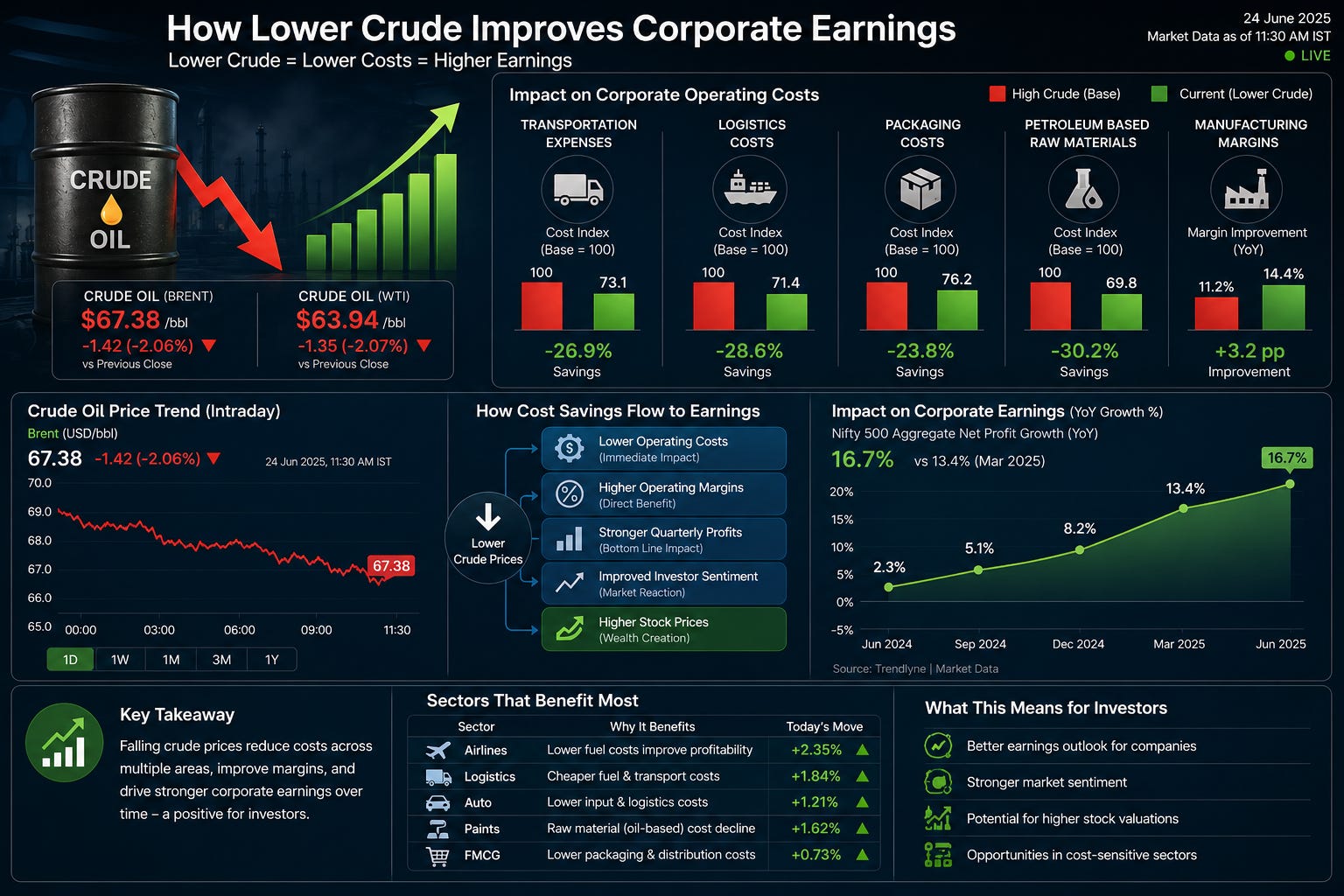
One of the biggest advantages of falling crude prices is lower operating costs for businesses.
Fuel is an unavoidable expense for almost every company. Whether products travel by road, rail, ship, or air, transportation costs eventually affect profitability.
Manufacturers also rely on energy throughout the production process.
When oil prices decline, companies begin saving money across several areas:
Transportation expenses reduce.
Logistics become cheaper.
Packaging costs decline.
Petroleum-based raw materials become more affordable.
Manufacturing margins improve.
These savings may appear small individually, but together they can significantly improve operating margins over several quarters.
Companies can either retain these savings as higher profits or pass some of the benefits to customers through lower prices, supporting demand.
For investors, this matters because earnings ultimately drive stock prices.
If lower input costs lead to stronger quarterly profits, market sentiment often improves as investors begin pricing in healthier earnings growth.
Which Sectors Stand to Benefit the Most?
Not every sector reacts the same way to crude prices.
Some industries benefit immediately, while others experience gradual improvements over time.
Consumer Goods
FMCG companies spend heavily on transportation, packaging, and distribution. Lower crude helps reduce these costs while supporting consumer purchasing power.
Automobiles
Cheaper fuel often improves consumer sentiment and lowers logistics expenses for manufacturers, creating a positive environment for the sector.
Paint Companies
Paint manufacturers use crude-based chemicals as important raw materials. Softer oil prices generally improve profit margins.
Airlines
Aviation turbine fuel remains one of the largest operating expenses for airlines. Falling crude directly reduces fuel costs and improves profitability.
Chemicals & Manufacturing
Several industrial chemicals originate from petroleum products. Lower crude helps manufacturers control production costs.
Logistics
Freight and transportation companies benefit from lower fuel expenses, improving operational efficiency.
However, not every company gains.
Upstream oil exploration and production companies often face pressure because lower crude reduces the prices they receive for their output.
This is why investors should avoid assuming that “lower oil benefits every stock.”
The impact depends on each company’s business model.
The Inflation Story Every Investor Should Understand
Perhaps the biggest reason markets celebrate lower crude prices is inflation.
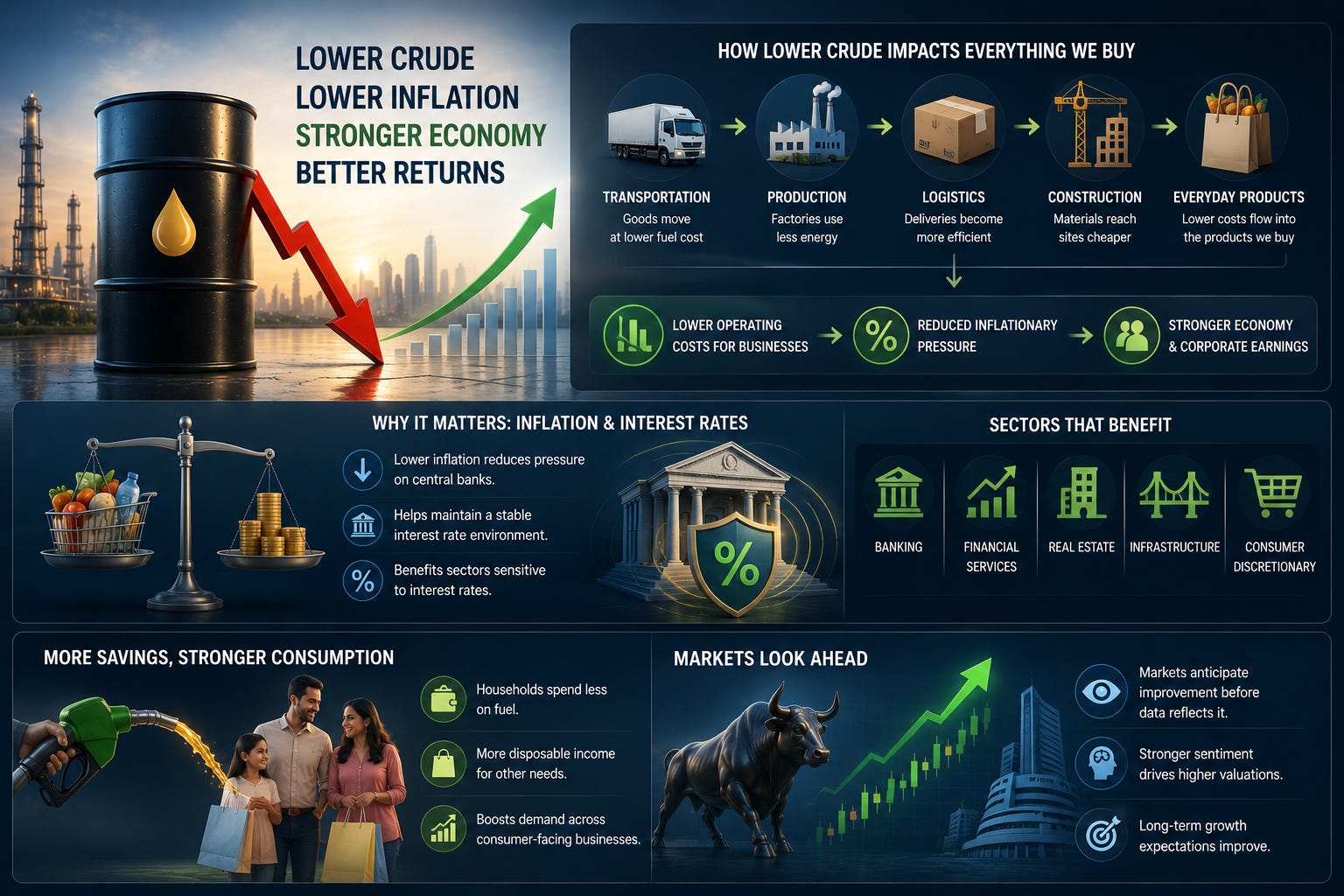
Fuel is connected to almost everything we buy.
Food reaches supermarkets through trucks.
Factories use energy during production.
Online orders depend on logistics networks.
Construction materials require transportation.
When fuel costs decline, businesses gradually experience lower operating expenses.
These savings don’t appear overnight, but over time they help reduce inflationary pressure across the economy.
Why does this matter?
Because inflation heavily influences interest rates.
If inflation remains under control, central banks usually face less pressure to tighten monetary policy aggressively.
A relatively stable interest-rate environment benefits several sectors, including:
Banking
Financial Services
Real Estate
Infrastructure
Consumer Discretionary
Lower inflation also improves household disposable income.
When consumers spend less on fuel, they often have more money available for shopping, travel, entertainment, automobiles, and housing.
That creates another positive cycle for businesses focused on domestic consumption.
Markets typically react to these expectations well before official inflation numbers begin reflecting the improvement.
What Investors Should Watch Before Getting Too Bullish
Although falling crude is generally positive for India, investors should ask one important question:
Why is oil falling?
There are two very different scenarios.
Scenario One: Supply Improves
Oil prices may decline because:
Global production increases.
Geopolitical tensions ease.
Supply disruptions disappear.
Producers increase output.
This is generally positive for India because cheaper imports improve macroeconomic stability without hurting domestic demand.
Scenario Two: Global Demand Weakens
Sometimes oil falls because businesses and consumers worldwide are buying less energy.
This may happen when:
Manufacturing slows.
Global trade weakens.
Major economies enter recession.
Consumer demand declines.
In this situation, lower crude becomes a symptom of weaker economic activity rather than stronger fundamentals.
India still benefits from cheaper imports, but export-oriented businesses and cyclical sectors could face slower growth.
Investors should also monitor:
Inflation trends
Rupee movement
Corporate earnings
RBI policy outlook
Global economic growth
These indicators help determine whether lower crude is creating a genuinely supportive environment or simply reflecting global weakness.
The Bottom Line
Lower crude prices are generally a constructive signal for Indian investors.
Cheaper oil reduces import costs, eases inflationary pressure, supports corporate margins, and improves the overall macroeconomic backdrop. It can create opportunities across sectors such as consumer goods, automobiles, airlines, paints, chemicals, logistics, and financials while strengthening confidence in domestic consumption themes.
However, crude should never be viewed in isolation.
The reason behind the fall matters just as much as the fall itself. If oil prices decline because supply improves or geopolitical risks ease, Indian markets often benefit. But if crude weakens because the global economy is slowing sharply, investors should remain selective.
For long-term investors, the best approach is to focus on fundamentally strong businesses that can consistently benefit from lower input costs while maintaining healthy earnings growth.
After all, successful investing isn’t about reacting to one commodity price, it’s about understanding how macro trends translate into corporate earnings and long-term wealth creation.
Lower crude may not guarantee a market rally, but when combined with stable inflation, resilient earnings, and healthy domestic demand, it can become one of the strongest tailwinds for Indian equities.
Lingo of the Week
Current Account Deficit (CAD)
The Current Account Deficit (CAD) occurs when a country imports more goods, services, and capital than it exports. Since India imports a large amount of crude oil, higher oil prices usually widen the CAD by increasing the import bill. Conversely, lower crude prices help reduce the deficit, strengthen the rupee, and improve overall economic stability—making CAD an important indicator that investors closely monitor.
Pocketful isn’t just another trading platform - we’re your partners on the journey to financial freedom.
Thank you for reading!
👀 Stay tuned. Stay diversified.
Until next time,
Team Pocketful.
Follow Us: Website
Download Our App: Available on Google Play & Apple App Store