


The Indian stock market is ending September with investors asking a simple question: why are stocks falling despite the economy still showing resilience?
The answer is not one single trigger. Expensive crude oil, elevated US bond yields, foreign investor selling, a weaker rupee and geopolitical uncertainty have arrived at the same time. The result has been a broad-based risk-off move, pushing the Nifty 50 and Sensex lower and making September one of the toughest months for Indian equities in recent years.
Rising Crude Oil Prices Are Putting Pressure on India
The biggest immediate concern for Indian equities is crude oil.
India imports nearly 90% of its crude oil requirements, which makes the country particularly sensitive to sharp movements in global oil prices. When crude becomes expensive, India’s import bill rises, putting pressure on the rupee and potentially worsening inflation and the current account balance.
In late September, Brent crude moved above $105 per barrel and briefly approached $108, as uncertainty surrounding the Middle East and US-Iran conflict raised concerns about supply disruptions.
This matters for the stock market because higher oil prices can affect companies in several ways:
Airlines: Higher aviation fuel costs can hurt margins.
Paint companies: Crude-linked raw materials become more expensive.
Chemicals: Input costs can rise.
Logistics: Fuel costs increase.
Consumer companies: Higher household expenses can affect discretionary spending.
Oil-importing businesses: Working-capital and cost pressures can increase.
The problem is also inflationary. If crude remains elevated for an extended period, it can make it harder for policymakers to support growth through easier monetary conditions.
Business Standard reported that the combination of Brent above $106, elevated US yields and a weaker rupee was keeping the macro environment unfavourable for Indian equities.
In simple terms: expensive oil is not just an energy problem it can become an earnings, inflation, currency and valuation problem.
US Bond Yields Above 5% Are Changing the Investment Equation
The second major pressure point is the US bond market.
The US 10-year Treasury yield climbed above 5.2% in late September, reaching levels not seen in many years. On September 29, Business Standard reported the 10-year yield around 5.25%, while Reuters reported it at approximately 5.246%.
Why does an American bond yield matter to an Indian stock investor?
Because US Treasuries are considered among the world’s key low-risk assets. When their yields rise significantly, global investors can demand a higher return before putting money into riskier emerging-market equities.
That creates pressure on markets such as India.
Business Standard noted that the spread between the Sensex’s earnings yield and the US 10-year Treasury yield had turned negative, making Indian equities relatively less attractive to foreign investors.
Higher US yields can also strengthen the dollar. A stronger dollar can put pressure on the Indian rupee, which creates another challenge for an economy heavily dependent on imported crude.
So, there is a chain reaction:
Higher US yields → stronger dollar → weaker rupee → higher import costs → inflation concerns → pressure on Indian equities.
This is why investors are watching the US bond market almost as closely as the Nifty itself.
FII Selling Is Adding Fuel to the Decline
Foreign Institutional Investors, or FIIs/FPIs, have been another major source of pressure.
According to Reuters, foreign investors sold approximately $2.7 billion of Indian equities in September, taking their total equity outflows for 2026 to around $26.8 billion.
Business Standard separately reported that global funds had sold around $2.1 billion of Indian equities during September at the time of its September 30 report. The difference reflects timing and data cut-offs.
Why are foreign investors selling?
There are several possible factors:
Higher US interest rates.
Attractive dollar-denominated fixed-income returns.
Elevated crude prices.
Geopolitical uncertainty.
Currency weakness.
Relative valuation opportunities in other markets.
This selling can create a feedback loop.
FII selling → market weakness → weaker sentiment → additional selling → pressure on the rupee and broader indices.
However, there is an important counterbalance: domestic investors have continued to provide liquidity.
This is one reason the market decline has not translated into an uncontrolled collapse. Domestic institutional flows and retail participation have helped absorb some foreign selling pressure. Business Standard reported that domestic inflows helped support small-cap stocks during the first half of FY27 despite the September sell-off.

Geopolitical Tensions Are Keeping Investors Nervous
The fourth factor is the uncertainty surrounding the Middle East and US-Iran conflict.
Markets generally dislike uncertainty, particularly when geopolitical developments can directly affect energy supplies.
The recent oil spike shows exactly how quickly geopolitical developments can move financial markets. Even when there are signs of potentially improving oil supplies, uncertainty over the duration and outcome of the conflict can keep a risk premium embedded in crude prices.
Reuters reported that rising oil prices, Middle East tensions and higher global interest rates were among the key factors behind September’s decline in Indian equities.
The effect goes beyond oil.
Geopolitical uncertainty can influence:
Crude oil
Gold
The US dollar
Bond yields
Shipping costs
Inflation expectations
Foreign capital flows
Corporate earnings expectations
For India, the oil channel is particularly important.
Reuters reported that the rupee touched a two-month low of ₹96.1475 per dollar on September 29 before recovering to around ₹95.98, with crude oil movements remaining a key influence.
Until investors have greater clarity around the geopolitical situation, markets may continue reacting sharply to every major headline.
September’s Sell-Off Became Broad-Based
This isn’t simply a story about the Nifty 50 falling.
The weakness spread across multiple segments of the market.
According to Reuters, the Nifty 50 declined 6.1% in September to 22,620.45, while the Sensex fell 5.8% to 72,480.29. Both benchmarks recorded their second consecutive monthly decline.
The broader market also struggled:
Nifty MidCap: down 7.6% in September
Nifty SmallCap: down 3.4%
Nifty IT: down 11.2%
Nifty Financial Services: down 6.3%
Nifty Auto: down 8.8%
Reuters also noted that all 16 major sectors declined during September.
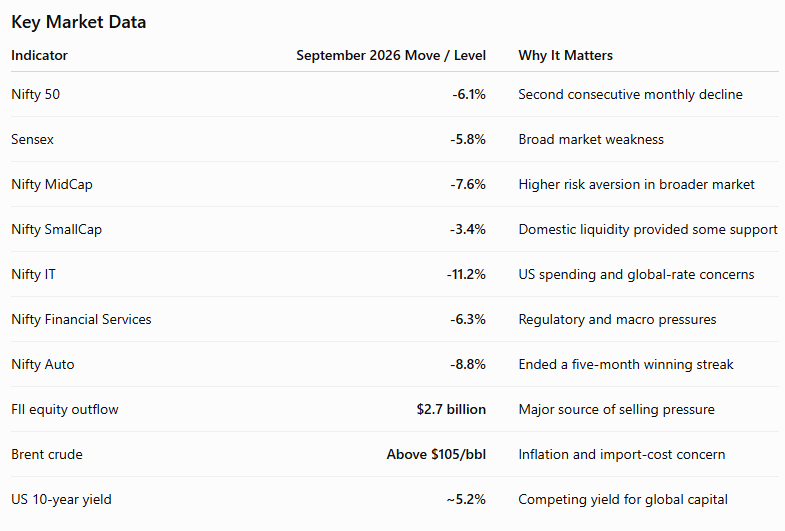
Source: Reuters, NSE and Business Standard.
Interestingly, not every stock fell.
Coal India gained 5.8% during September, while Adani Ports, Dr Reddy’s Laboratories and ITC were among stocks that ended the month higher. This shows that investors were not abandoning every part of the market; they were becoming more selective.
So, Is This a Buying Opportunity or a Falling Knife?
This is where investors need to separate market correction from market timing.
The decline has already made valuations more comfortable in some segments. Business Standard reported that the Nifty had undergone a substantial correction, while analysts continued to highlight earnings, crude prices, US yields, FPI flows and the rupee as key variables for the next phase.
But a lower price alone does not automatically mean a stock or index has reached its bottom.
The important question for October is whether the major pressure points start improving:
Does Brent move lower? Do US Treasury yields stabilise? Does FII selling slow? Does the rupee stabilise? Do corporate earnings estimates hold up?
If these indicators improve together, market sentiment could change. If they remain under pressure, volatility may continue.
For investors, therefore, the focus should shift from simply asking “Why is the market falling?” to “Which factors can reverse the selling?”
Reuters also reported that analysts see recovery depending heavily on earnings and developments around geopolitical risks.
The Bottom Line
The Indian stock market’s September decline is the result of multiple pressures arriving simultaneously, rather than one isolated event. Expensive crude is raising inflation concerns, US yields are making global capital more selective, FII selling is weighing on sentiment, geopolitical uncertainty is keeping investors cautious, and the weakness has spread across sectors.
The next phase of the market will depend heavily on whether these macro pressures begin to ease. For October, investors will be watching Brent crude, US 10-year yields, FII flows, the rupee and corporate earnings closely.
Lingo of the Week: Risk-Off
Risk-Off describes a market environment where investors become more cautious and move away from riskier assets such as equities toward relatively safer assets such as government bonds, cash or the US dollar.
In the current market, rising crude prices, geopolitical uncertainty, high US Treasury yields and FII selling are all contributing to a risk-off environment.
The opposite is Risk-On, when investors become more comfortable taking risk and tend to increase exposure to equities and other risk assets.
In one line: Risk-Off = Investors prioritise safety over aggressive returns.
Pocketful isn’t just another trading platform - we’re your partners on the journey to financial freedom.
Thank you for reading!
👀 Stay tuned. Stay diversified.
Until next time,
Team Pocketful.
Follow Us: Website
Download Our App: Available on Google Play & Apple App Store