

Recently, PM Narendra Modi made an unusual appeal. He urged Indians to reduce unnecessary imports, avoid excessive foreign spending, use public transport more often, and most importantly, stop buying gold for a year as part of a broader “Nation First” economic message.
At first, many people viewed it as symbolic patriotism. But just days later, the government sharply raised gold import duty from 6% to 15%. That is when markets started paying attention. Jewellery stocks witnessed pressure, analysts started discussing India’s forex reserves, and investors began connecting the dots between rising crude oil prices, a weakening rupee, and the country’s growing import bill.
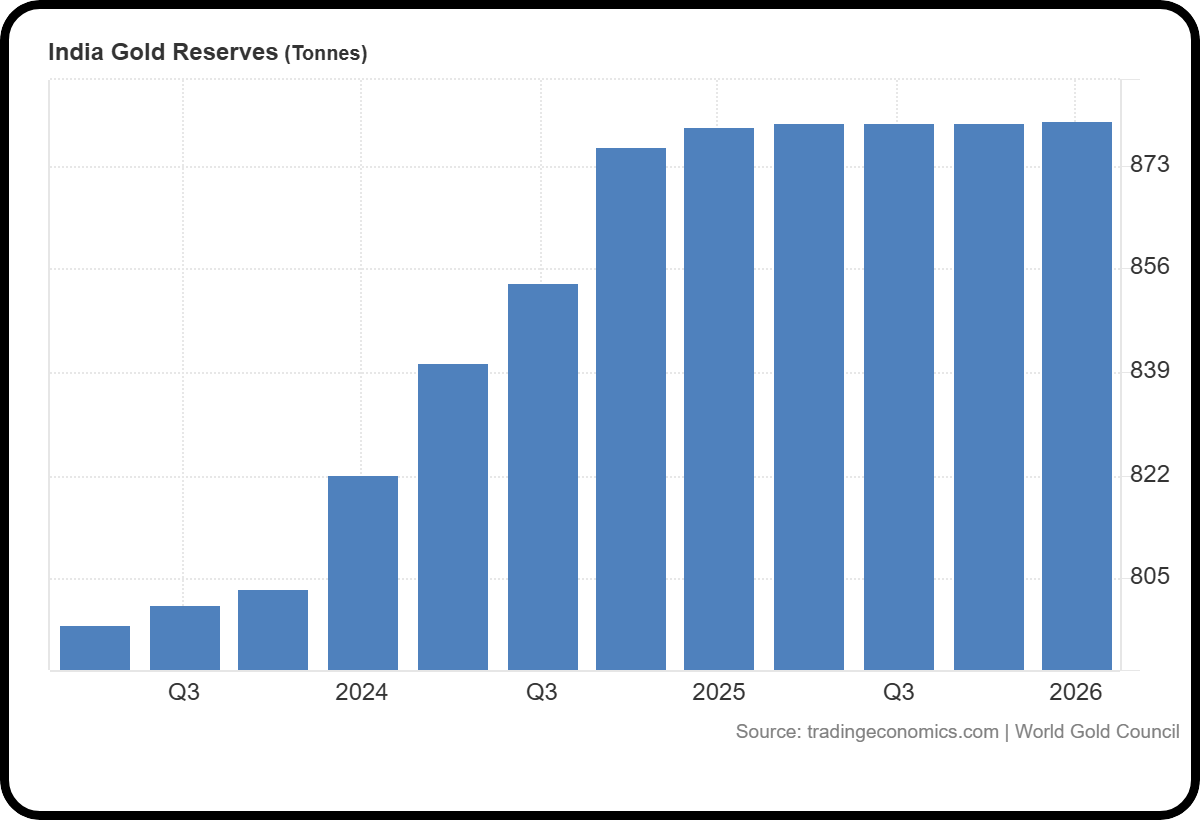
But hidden inside RBI data was an even more fascinating detail. While citizens were being asked to stop buying gold, India itself had quietly increased its gold reserves from nearly 794 tonnes to around 880 tonnes over the last two years.
That raises a powerful question. Why is gold considered risky when citizens buy it, but strategic when the country buys it?
To understand this contradiction, we need to look beyond jewellery demand and into the deeper pressures building inside India’s economy.
Why India Needed To Act, And Fast
The crisis did not start with gold. It started with oil.
India imports nearly 85% of its crude oil requirements, and oil is globally priced in US dollars. That means whenever crude prices rise, more dollars leave India to pay for imports. And due to geopolitical tensions and the ongoing West Asia crisis, crude prices surged sharply from around $70 to even $120 per barrel during periods of volatility.
That became a serious problem for India because dollars are not just another foreign currency for the country. They are how India pays for crude oil, technology, electronics, machinery, fertilizers, and gold imports.
When dollars leave the economy faster than they enter, pressure starts building on the rupee. And once the rupee weakens, the impact spreads everywhere. Imported goods become more expensive, fuel prices rise, transportation costs increase, inflation accelerates, and corporate margins come under pressure.
The numbers already showed signs of stress. India’s forex reserves reportedly fell from nearly $728 billion to around $690 billion within just a few weeks. At the same time, the rupee weakened sharply and reportedly touched record low levels against the US dollar.
With crude oil being non-negotiable, policymakers started searching for other major dollar drains they could reduce quickly. And gold became the next obvious target.
India spent nearly $72 billion on gold imports in FY26, making it the country’s second-largest import category after crude oil. Unlike oil, gold is not considered economically essential. So from a policymaker’s perspective, reducing gold imports became one of the fastest ways to slow dollar outflows and protect forex reserves.
This explains why PM Modi first urged citizens to avoid buying gold for a year. And shortly afterward, the government sharply increased gold import duty from 6% to 15%.
But this is where the story becomes far more interesting.
Because while the government was raising barriers to discourage citizens from buying gold, the RBI had spent the previous two years doing exactly that.

The Global Event That Changed Everything
To understand why central banks suddenly became obsessed with gold, we need to go back to 2022.
When Russia invaded Ukraine, the United States and European nations froze nearly $300 billion worth of Russian foreign exchange reserves held abroad. That decision shocked central banks around the world because for decades, countries believed reserves held in US dollar assets and Western financial institutions were completely safe.
But the Russia sanctions changed that perception overnight.
The message became clear: foreign reserves held in another country’s financial system can become inaccessible during geopolitical conflicts.
Gold works differently. Physical gold stored within your own country cannot be frozen or controlled externally. And after this realization, central banks across the world accelerated gold purchases aggressively, including India.
The RBI significantly increased its gold reserves over the next two years, becoming one of the world’s largest central bank gold buyers during this period. By 2025, India’s gold reserves had climbed to nearly 880 tonnes.
At the same time, rising gold prices increased the value of India’s holdings sharply, pushing gold’s share within forex reserves much higher. This was not about jewellery demand. It was about financial protection.
Gold had become a strategic reserve asset in a world where trust in the global financial system was slowly weakening.
Why RBI Buying Gold Is Different From Citizens Buying Gold
At first glance, the situation appears contradictory. Why would the same government discourage gold purchases while the RBI buys more gold?
The answer lies in how money moves through the economy.
When Indian households buy imported gold, more dollars leave India, import bills increase, pressure on forex reserves rises, and the rupee weakens further. This creates stress on the broader economy.
But when the RBI buys gold, the process is completely different.
The central bank is not increasing household consumption. Instead, it is reallocating reserve assets.
Think of it like a mutual fund manager reshuffling a portfolio. A fund manager may reduce exposure to one asset and increase exposure to another for diversification and safety. Similarly, the RBI shifts part of its reserve holdings from US Treasury bonds, dollar deposits, and foreign reserve assets into gold.
This is reserve diversification, not consumption.
The economic impact is fundamentally different. One increases dollar outflow. The other changes where national wealth is stored.
And in today’s uncertain geopolitical environment, many central banks increasingly see gold as one of the safest reserve assets available.
The Weak Rupee Created Winners And Losers
As the rupee weakened, markets quickly started adjusting.
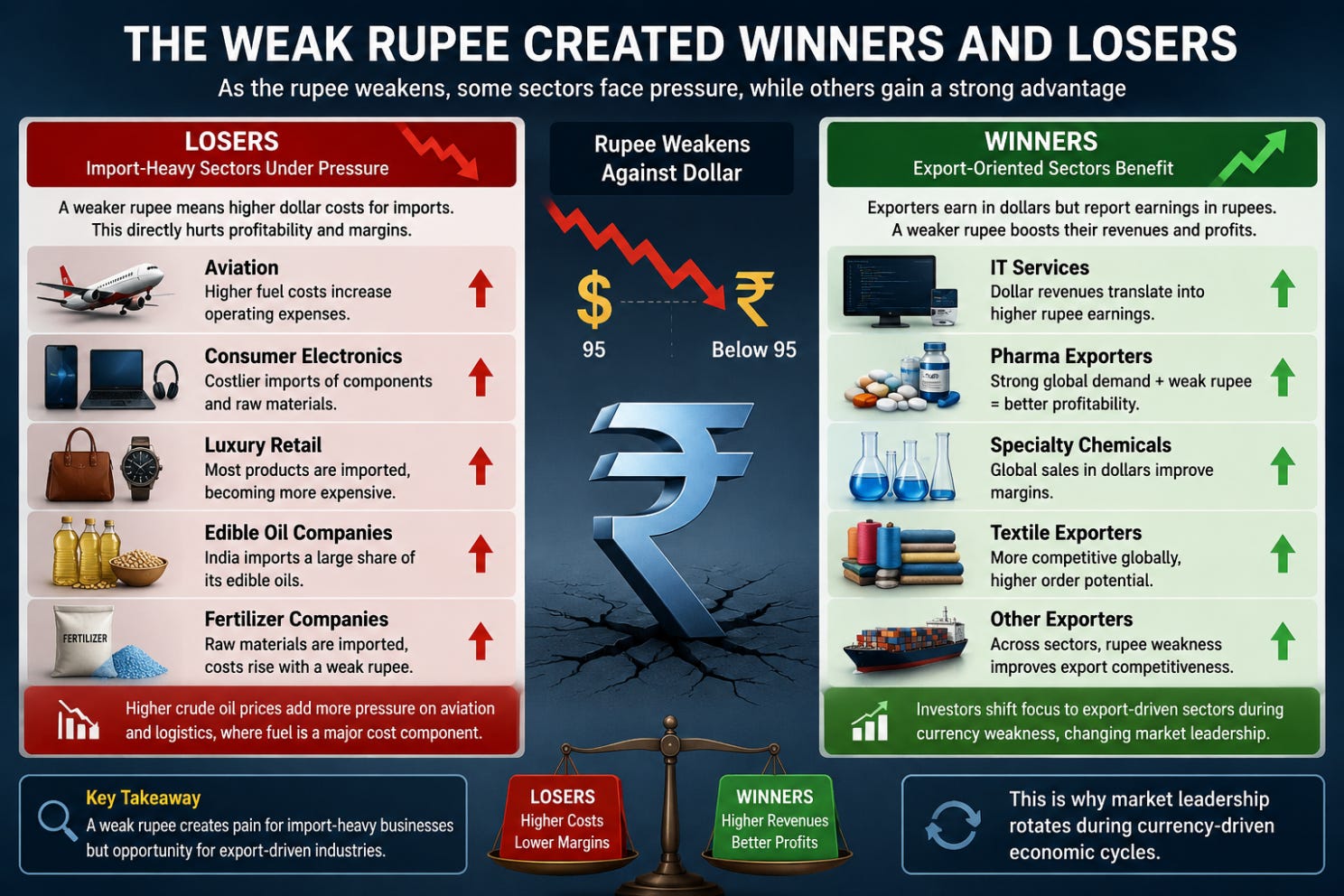
Import-heavy industries faced pressure because rising dollar costs directly hurt profitability. These sectors include aviation, consumer electronics, luxury retail, edible oil companies, and fertilizer businesses.
Higher crude oil prices worsened the situation further for aviation and logistics companies, where fuel costs form a major part of operating expenses.
But not every sector suffered.
Export-oriented industries actually benefited from rupee weakness because exporters earn revenues in dollars while reporting profits in rupees. As the rupee falls, their dollar earnings translate into stronger rupee revenues.
This is why investors shifted attention toward IT services companies, pharma exporters, specialty chemical firms, and textile exporters. Many of these sectors witnessed renewed investor interest after PM Modi’s economic appeal because markets believed rupee weakness could continue supporting export earnings.
This also explains why market leadership often changes during currency-driven economic cycles.
The Smuggling Risk Returns
While increasing import duty helps reduce official imports, it also creates another major problem: smuggling.
At a 15% import duty, the tax difference on large gold imports becomes massive, creating strong incentives for illegal trade networks.
And India has experienced this before.
The last time import duties were sharply increased, gold smuggling activity reportedly surged significantly. According to industry estimates and reports from previous years, nearly 15–17% of India’s gold demand shifted toward unofficial channels when import duties became too high.
This creates a difficult balancing act for policymakers.
Higher duties reduce official imports, protect forex reserves, and slow dollar outflows. But they also encourage black market activity, increase smuggling incentives, and reduce transparency.
One reason import duties were earlier reduced was to discourage illegal trade activity. Now with duties back at elevated levels, investors and policymakers are closely watching whether history repeats itself.
The Bigger Shift Nobody Is Talking About
This entire situation reveals something much larger than gold demand or jewellery consumption.
It reflects how countries are slowly changing the way they think about economic security.
For decades, US dollar reserves were considered the safest financial asset in the world. But after sanctions, reserve freezes, geopolitical tensions, trade conflicts, and rising global fragmentation, many countries are reconsidering how they store national wealth.
Gold is no longer just a commodity.
It has become a hedge against currency weakness, protection against geopolitical uncertainty, a reserve diversification tool, and a symbol of financial sovereignty.
India’s recent actions suggest the country is adapting to this changing global reality.
On one side, the government wants to reduce unnecessary gold imports to protect the rupee and forex reserves. On the other side, the RBI wants larger strategic gold reserves to strengthen long-term financial security.
Both actions may appear contradictory on the surface. But economically, they are solving two very different problems.
Conclusion
India’s recent gold policy is about far more than jewellery demand.
It reflects deeper concerns around rising crude oil prices, weakening rupee, growing import bills, forex reserve protection, and an increasingly uncertain global financial system.
For households, excessive gold imports increase pressure on India’s economy by accelerating dollar outflows.
For the RBI, gold has become a strategic reserve asset capable of protecting national financial stability in a world where geopolitical risks are rising rapidly.
And that is the contradiction at the heart of India’s gold strategy today.
Gold is no longer just a store of wealth in India. It has become part of a much larger battle involving currency stability, economic security, and the future of global finance.
Lingo of the Week: Reserve Diversification
When a central bank spreads its foreign reserves across different assets like US dollars, gold, euros, and bonds to reduce risk and improve financial stability.
In simple terms: “Don’t keep all national wealth in one basket.”
Example: After global sanctions on Russia, many countries including India increased gold reserves instead of relying only on US dollar assets.
Pocketful isn’t just another trading platform - we’re your partners on the journey to financial freedom.
Thank you for reading!
👀 Stay tuned. Stay diversified.
Until next time,
Team Pocketful.
Follow Us: Website
Download Our App: Available on Google Play & Apple App Store